Places to Go: Elgin Cathedral and Spynie Palace, Moray
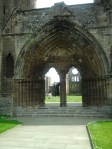
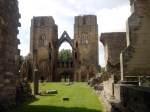
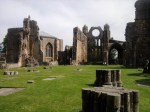
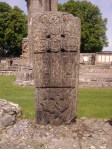
Though, as evidenced by the beautiful ninth century Pictish cross above, Elgin was an early centre of Christianity in Scotland, perhaps its most famous religious object is its cathedral. The cathedral, once the seat of the bishops of Moray, is a singularly stunning ruin, and was even grander in its heyday as a religious centre. In the words of one of its bishops, Alexander Bur, this great edifice was:
“the ornament of the realm, the glory of the kingdom, the delight of foreigners and stranger guests: an object of praise in foreign lands.”
However, for all its famed beauty, Elgin was not the first centre of the diocese. This distinction was claimed by three separate sites in the Laich of Moray- Birnie, Kineddar, and Spynie (where the bishop’s palace was later built- we’ll come back to this in a minute) and, as they were fairly close together, it was not too difficult for the bishops to travel from one to the other. This was in the twelfth century, but by the early thirteenth century, the building of a small cathedral was underway at Spynie, ostensibly because the previous cathedral, wherever this was, was in an inconvenient location. Spynie, however, was also unsuitable, it seems, for in 1224 the cathedral was moved to its present spot at the edge of Elgin. This move may also have been partly motivated by a wish for greater protection for the bishops and their cathedral through the close proximity of the royal burgh which had been founded in the twelfth century by David I, in order to reinforce royal control over the troublesome Moravians.
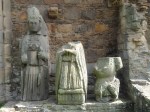
Whatever the reason, the new cathedral soon outstripped its less grandiose predecessors in size and in magnificence. By the mid-thirteenth century it housed 25 canons and 17 substitute clergy. The cathedral would not have been the only religious building in the chanonry, but was surrounded by manses (of which the precentor’s still stands, known erroneously as the Bishop’s House) and other church buildings, almost making the chanonry a separate settlement from the adjacent burgh. The cathedral itself grew quickly, and a large amount of rebuilding may have taken place after a fire in 1270. By the fifteenth century, one of the most impressive sections was possibly the huge central tower which rose above the crossing. Unfortunately this no longer stands, having collapsed at Easter in 1711, but it is known to have included at least three statues in niches at each corner (see the picture above) which were carved in the likeness of a bishop, a knight, and what is thought to be a burgess, representing the Three Estates. It has been surmised that there may have been a fourth, representing the king. Even without the central tower, the high towers of the nave and the splendid windows of the choir give some hint as to the glory Bishop Bur mentioned.
But, even if it contained a thriving royal burgh at Elgin, and a beautiful cathedral, mediaeval Moray was by no means a peaceful place. Though it is perhaps hard to see it in the low flatlands of the Laich, much of Moray’s terrain is hilly and, while it would have been inhospitable to many in the Middle Ages, remained a haven for caterans and brigands. Though it luckily escaped destruction during the Wars of Independence, Elgin was not safe, and by the late fourteenth century, Alexander Stewart, the Wolf of Badenoch, held sway in the area. His practice of extracting various payments from the local magnates and their tenants did not endear him to many of the other powers in the region, least of all the Bishops of Aberdeen and Moray, the former of whom is supposed to have had his property stolen and his peasants butchered. The latter meanwhile (the aforementioned Bishop Bur) having probably paid protection money to the Wolf in the 1380s, and made several property and land grants in his favour, eventually grew sick of being bullied by Stewart and switched his allegiance to Thomas Dunbar, the son of the Earl of Moray. This was unfortunate, as later political developments in Scotland as a whole led to a greater falling out between the Wolf and the Earls of Moray and, while Moray was in England attending a tournament held by Richard II, Badenoch seized the opportunity to launch a vicious attack on Elgin at the head of his cateran forces. Eighteen of the manses were burnt, as well as the greater part of the burgh and the cathedral itself. Though Bur wrote to Badenoch’s brother Robert III seeking compensation, and the cathedral was clearly rebuilt to a high standard (with Badenoch excommunicated for his crime), another assault in 1402, by Alexander of the Isles, served to reinforce the dangerous position of the cathedral and its priests.
Nevertheless, the cathedral continued to be regarded as a jewel in Moray’s crown right down to the sixteenth century. But, as with many of Scotland’s greatest religious foundations, the Reformation killed off worship there, and its bishops moved to the nearby parish church of St Giles. Though it was informally used for worship well into the 1600s, and the Earl of Huntly held a catholic mass there in 1594, the building gradually fell into decay. Luckily, it is now in the care of the nation, but it’s glory days are long since behind it. Even so, when standing in the beautiful shell of its former greatness, it takes little imagination to think of what must have been.
Spynie palace, meanwhile, is another example of the majestic surroundings that the Bishops of Moray so enjoyed. Though there was probably a residence next to the church in the thirteenth century, the earliest surviving masonry dates from the 1300s. When Lothian was struck by the plague in 1362, David II and his court were housed in Spynie by Bishop John, and several of the Stewart monarchs followed in his footsteps through visits to Spynie in the fifteenth century. James IV visited several times in the course of his annual visits to the shrine of St Duthac at Tain, and is known to have spent some time at the palace engaging in the rather less wholesome pursuit of cards, having always been a heavy gambler.
However, the most famous visitor to Spynie was, as in so many places, Queen Mary, who stayed there for two days in September of 1562. She was accompanied by a large armed force intended to bring the Gordon Earl of Huntly to heel, and after staying at Spynie, she departed for the Aberdeenshire, where her army defeated the Gordon forces at the Battle of Corrichie. At the time of her visit, the Bishop of Moray was Patrick Hepburn, the uncle of her future husband, the Earl of Bothwell and, after his defeat at Carberry Hill in 1567, Bothwell fled north to his uncle’s home at Spynie. Even there he was not safe, however, as according to an English spy held prisoner there, there were plots against his life. In turn, Bothwell killed a son of the bishop, before having his men take over the palace. Soon after, he had fled to Orkney.
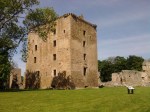
The great fifteenth century David’s Tower, which may be seen in the foreground of the picture above, dominates the palace, and bears the royal coat of arms, as well as the personal arms of three bishops- David Stewart, William Tulloch, and Patrick Hepburn. But this grand tower house was not the only feature of the complex- the Bishops lived in great style, surrounded by a great hall, a chapel, and at least three other towers. Though bishops continued to reside in the palace in the seventeenth century, the abolition of the rank of bishop in 1689 saw Spynie’s abandonment and ruin. But, like the cathedral, it’s magnificence is still present in some form, and the beauty of its position can’t be denied.

 Rush's tumblr archive