Ooooooookay this is a Big Ask and honestly I’m kind of overwhelmed with Life right now so Disclaimer: This is almost all from memory with only minimal referencing during its composition. I apologize for mistakes present. It’s an oversimplified answer.
First of all, Judaism has denominations, cultures and movements. Denominations are the big, major divides of a religion; like how Islam has Sunni and Shia, and Xtianity has Orthodox vs Catholic (and all the subcategories that descended from each, xtianity is kind of bonkers when it comes to religious disunity…). Cultures are how the different customs and “flavors”, if you will, of a religion differ from place to place (like how Irish Catholicism just feels different from Italian Catholicism which feels different from Latine Catholicism). Movements are sub-categories within a denomination that have the big questions in common, but differ on the details (such as the varieties of Protestantism).
So, in Judaism, there are three major denominations: Rabbinic Judaism, Karaite Judaism, and Ethiopian Judaism. You might also argue that Samaritanism counts as a branch of Judaism, so I’ll touch on it, but note that it is controversial – it’s kind of a lumper/splitter issue. In categorizing life a lot of the distinctions between genera and species break down with fossil organisms so scientists are constantly arguing over whether or not a group of related animals are all different genera or different species within the same genus – it’s like that. If Samaratanism isn’t Judaism, then it’s like, one of its closest relatives on the religious evolutionary tree. Etc.
What is Judaism? Judaism is an ethnoreligious tradition and cultural system which is united by the idea of treating the Torah, a group of five books called Genesis (Bereshit), Exodus (Shemot), Leviticus (Vayikra), Number (Bamidbar), and Deuteronomy (Devarim), as a sacred text and guide for life. Judaism holds that if there is a deity, there is a single Deity, indivisible and absolute. Judaism holds that the Jewish people, defined by a common ancestry (from a semi-mythical figure Yaakov ben Isaac v’Rivka), were the only group of people to accept the Torah and to, thus, live the way to be closest to HaShem. Since around two thousand years ago, Jews have also been defined by their rejection of Jesus as the Moshiach, the moshiach being a concept of a figure who would come in after the world was perfected (or if the world just went completely caput) to usher in an age of peace and joy. Jewish people consist of those who treat the Torah as an important text and who reject Jesus as the Moshiach, and were either born into a Jewish family or converted into the Jewsih people. The things that make different Jewish groups different are entirely based upon how they interact with the Torah and what they believe the origin of the Torah to be, as well as the specific place of the Jewish people as the ones who accepted the Torah.
So, big divisions. Samaritanism is a denomination of Judaism or an Abrahamic religion very close to Judaism who do hold a version of the Torah sacred and continue to carry out many of the rules of the Torah more closely than even rabbinical Jews do today (more on what that term means in a bit). However, they hold that the holy site of the Jewish people is not the city Jerusalem, but rather Mount Gerizim. They consider themselves to be the descendants of the Northern Kingdom of Israel, rather than the Southern Kingdom of Judah, from Biblical times (long story, basically the twelve tribes of Israel, so people who considered themselves descendants of Yaakov, split up, you know, family disputes, and all that). As such, they aren’t Jewish in the sense that they aren’t from Judah, but they do a lot of the same things that Jewish people did and study a very similar text to Jewish people, and fulfill a lot of the qualities of Judaism (ie, they don’t think Jesus is the Moshiach, they have the one Deity, they treat the Torah as sacred, etc.) So, are they Jews? Definitionally no. But also kind of yes. There are very few of them, less than one thousand, all found in modern Israel/Palestine.
Ethiopian Judaism (Haymanot) is a very unique denomination of Judaism based on a group of Jews who migrated to Ethiopia and settled there, creating the Beta Israel community. They hold the Torah sacred and follow its laws, believe in one deity, and reject Jesus as the Moshiach. However, because their traditions and laws diverged before the onset of rabbinic tradition (again, more on that later, it’s the biggest group so I have to save it for last), they do act very differently from most other Jewish groups and thus constitute a denomination rather than movement. They celebrate Jewish holidays a little differently, sometimes even at different times, and have their own holidays in addition. They also have important texts that are not found in any other branch of Judaism. There are 135,000 Ethiopian Jews around today, with 130k of those found in Israel, 4k in Ethiopia, and 1k in the United States. Unlike Samaritanism, you can convert to Ethiopian Judaism, and currently there are a lot of Ethiopian Jewish customs slowly working their way in to more mainstream Judaism as Ethiopian Jews integrate more in Israel.
Karaite Judaism is a form of Judaism descended from a somewhat reactionary movement from a little more than a thousand years ago. Rejecting rabbinic writings (again, just, wait), they declared that only the Tanakh (”Old Testament,” basically the Torah + Prophetic Writings + Other Spiritual Writings) was sacred and everything else should be held in equal esteem, but not sacred – so they rejected things like the Talmud and rabbinic commentary. They lived mainly in Egypt and the middle east and did spread to Eastern Europe. Today, most Karaite Jews live in Israel – there are about 50,000 of them total and 40,000 are found in Israel. The Ukraine and United States each have about 1,000 Karaite Jews. Though they don’t usually take converts, they do interact with Rabbinic Jews to varying degrees (my Rabbi once officiated a wedding between a reform Jew and a Karaite Jew). Unlike traditional Rabbinic Jewish practice (see below), Karaite Jews define Jewishness based on if the individual has a Jewish father – if they do, they’re Jewish.
Rabbinic Judaism is the most common form of Judaism, with millions of followers around the world with a variety of cultures and customs. Rabbinic Jews hold that in addition to the written Torah, the five books of Moses listed above, G-d gave the Jews the oral Torah, the laws and statutes and explanation of the Torah as discussed by Jews, at Sinai – meaning it was just as sacred. This meant that the Talmud and other writings by these scholars of Torah – known as rabbis – was as sacred as the original Torah. The Talmud and other writings such as commentaries and midrash thus became foundational for rabbinic Jewish practice, elaborating on the laws and customs set in the Torah and expanding on them. Traditionally, Rabbinic Jews define Jewishness based on the mother – if your mother is Jewish, so are you.
Rabbinic Judaism, being the most populous denomination, varies extensively in ways that aren’t as fundamentally different as whether or not you accept the Talmud or the varying different writings of the Ethiopian Jews as sacred. Unlike Xtianity, however, where the movements are the second deepest division level and culture is the most minor differences; in Judaism movements are actually third tier. The second tier is culture.
There are a lot of different cultures of Rabbinic Judaism based on location of origin. How they are divided is under some debate – there are either two, three, or many different groups. Though all these groups accept the Talmud, the further commentaries made by rabbis after the era of the Talmud differs (so, a little more than a thousand years ago on) and their history differs due to that different location of origin.
Sephardic Jews are one of the two biggest divisions of Judaism. Sephardim are either 1) Just Jews who originally come from the Iberian Peninsula, 2) Jews who come from the general region around the Iberian Peninsula including Morroco, 3) Jews from former Islamically-controlled regions such as the Iberian Peninsula and West Asia/Middle East, 4) All Jews who aren’t Ashkenazim. The confusion comes from the fact that the specific interpretations of Jewish law unique to the Sephardim of the Iberian Peninsula also apply to every other Jewish culture other than the Ashkenazim – so while there are different Ashkenazic and Sephardic versions of prayers, there aren’t differences in prayer in Mizrahim (see in a second) and Sephardim, for example. Sephardic Jews have their customs and interpretations heavily influenced by the cultures of the Mediterranean region – which influences music, prayer structure, relationships around gender and marriage and sex, and food (especially food). There are about 2.2 million Sephardim alive today, most residing in Israel, with notable populations present in France and the United States.
Mizrahim are those Jews who come from MENA regions – Middle East and North Africa. So, oftentimes they’re lumped in with Sephardim, but while they share similar theological and philosophical customs, they often have very unique cultural characteristics in terms of food, marriage rituals, etc. Though Mizrahi Jews have a lot of things in common, they also have specifics from community to community based on country of origin. They do, however, follow many of the same specifics of religion as the Sephardim sensu stricto. There are about 3.5 million Mizrahim alive today, who are almost entirely all in Israel due to the expulsion of Jewish populations from most MENA countries in the second half of the 20th century, with notable populations occurring in the United States and Russia, two other locations of migration.
There are a lot of other groups of Jews that don’t fall into the Mizrahim, Sephardim (sensu stricto), or Ashkenazim (give me a second) that I really do not have the spoons to go into specifically but will touch on: there are the Bene Israel from India who now mainly live in Israel; the Cochin Jews, another Indian Jewish group, mostly residing in Israel today as well (both of these groups, though deriving from other Jews very very early on, do follow the Talmud to some degree); the specific Italian Jews who differ from other European Jewish cultures and lived in Italy since Roman times; the Romaniotes who are native to locations such as Greece and Turkey and most of whom were killed during the Holocaust which is a huge freaking bummer; various groups of Chinese Jews such as the Kaifeng Jews who unfortunately were oppressed into dropping their Judaism but are now reclaiming it; the Bene Ephraim, yet another Indian Jewish group who are kind of controversial but they are currently practicing “modern” Judaism; the Abayudaya Jews of Uganda; and so many more I’m just going to give up now
FINALLY. Ashkenazim are the largest group of Jews, with up to 11.2 million people of Ashkenazic descent, mostly found in the United States (up to 6 million Jews live in the USA), with nearly 3 million in Israel, and many found throughout the world. This group of Jews is where we find the Jewish movements, which is why we did this in this order. Reform, Renewal, Conservative, etc. are all Ashkenazic movements of Judaism. Ashkenazic Jews are those Jews who stemp from populations in central and Eastern Europe such as Germany and Russia. Ashkenazic Jews have a lot of differences in custom and culture and liturgy compared to Sephardic Jews (sensu lato) due to their location of origin and the cultures they formed themselves in. Given that this is the largest group of Jews, especially in the United States, most Jewish culture you picture is probably Ashkenazic in origin.
When emancipation happened – ie, Jews were allowed citizenship in their various counties of dwelling, most notably those in Europe – there was a lot of division over how much Jews should integrate with the surrounding society. This lead to the formation of different movements within Ashkenazic Judaism. While many Jews who aren’t Ashkenazic now follow the philosophy of these movements, they are fundamentally Ashkenazic in origin. This is due to, primarily, many of these other cultures not being as isolated from the surrounding gentile culture as the Ashkenazim were – Ashkenazic Jews were extremely isolated whereas Sephardic Jews oftentimes developed their culture and practice already integrated into the surrounding society, and though that changed later on (most notably after the Spanish Inquisition) the original culture and the attitudes towards Jewish law were developed within that integrated society. So, Ashkenazic Jews were faced with the problem of: what the heck do we do now that we can interact with people normally. Though these are the origins of the movements, the way these movements define themselves today is actually a bit different, so I will be focusing on the modern interpretations.
Reform Judaism was the first of these movements to arise, mainly as a response to the need for a Jewish practice that allowed acting like the gentile citizenry. As such, it started out being very gentile-esque in practice, beginning in the 19th Century of Germany; molding the way prayers were said after Xtian protestant service, focusing on appearing like gentiles (for example, no longer wearing kippot in service), etc. [Note: this did not make them Xtian. They did not believe that Jesus was the Moshiach and they still had the basic characteristics of Jews – Torah and Monotheism, and were decidedly rabbinic Jews, holding the Talmud as a major portion of their Jewish practice]. However, this did take the reform movement extremely far away from Jewish culture and identity. As such, during the 20th Century it began to return more uniquely Jewish practices to the religion, as well as to the service of prayer. Today, Reform/Liberal/Progressive Judaism defines itself how it views the Torah and what that means for what commandments/laws they observe and how – though the Torah is sacred, Reform Jews believe that the Torah was authored by divinely inspired human beings who were limited by their understandings of culture and society at the time, and as such, over time Jews have modified and adapted this instruction over time as culture has evolved. This is in fact clearly seen in the writings of the Prophets, the Rabbinic Writings, Talmud, and commentaries. As such, Reform Jews believe that Judaism is an evolving tradition, and that it is up to Jews to continue to add to our understanding of revelation and what it means to be Jewish over time, in addition to opening up Judaism to be a more inclusive tradition. For most Reform Jews, this means that commandments/law/mitzvot are a matter of choice. You choose to adopt the mitzvot based on how you feel they would help you to lead a Jewish life. This movement especially focuses on tikkun olam, the Jewish notion of social justice. Reform Jews also see Jewish-ness as being both a factor of ancestry and of upbringing – so, reform Jews consider anyone to be born Jewish who has at least one Jewish parent, and was raised exclusively within Judaism with no other religions.
Orthodox Judaism was the second of these movements to arise, as a direct response to reform Judaism. Also known as traditionalist Judaism, they teach that the Torah, as we have today, was written directly by God. As such, it is not open to interpretation at the fundamental level, and all its laws have to be followed exactly, both from the Torah and the rabbinic writings, in order to live a Jewish life. Though Orthodox Jews often consider themselves the “original” Jews, and ascribe their movement to all Jews prior to the emancipation origin of Jewish movements, it is actually a lot more nuanced than this, with the ideology and methods of thinking about the law evolving in direct response to modernity. Orthodox Jews follow the mitzvot to the letter, with the differences amongst various groups arising due to cultural differences from community to community, rather than differences in how they view mitzvot/the law. There are a variety of Orthodox Jewish communities today. Modern Orthodox Jews are those who still view the Torah as divinely written and the mitzvot as binding, but try to integrate themselves with gentile society to the degree allowed within that system. They think that interacting with the outside world will enrich their Judaism, and that they are able to evolve with society without abandoning Jewish law (most progressive forms of Orthodox Judaism are Modern Orthodox). Haredi Judaism, in contrast, are those Orthodox Jews who utterly reject modern life and remain as isolated as possible from the outside world. Most Haredi Jews live in Israel. Hasidic Judaism is a spiritual Orthodox Jewish movement that arose in the Ukraine and is notable for focusing more on the spiritual and emotional aspects of Judaism than the scholarly ones (as opposed to Haredi Jews). Hasidic Jews often isolate themselves a lot like Haredi Jews, but usually not to as much of an extent; and sometimes they integrate in modern society much like Modern Orthodox Jews. One subsection of Hasidic Judaism, Chabad, focus extensively on outreach to non-Orthodox Jews to attempt to have them return to Orthodoxy (kiruv), and are definitely one of the least isolationist Orthodox Groups. Focusing on proper practice of the mitzvot is the focus of Orthodox Judaism. Jewishness in Orthodoxy is defined by maternal descent – if your mother is Jewish, regardless of your upbringing, so are you; but if your father isn’t, you aren’t either. Given their emphasis on strict adherence to Jewish law, many Orthodox Jewish groups do not accept conversions by any other movement as valid – it depends based on conversion to conversion and community to community, but it is a major source of controversy between Orthodox Jews and all other Jewish movements.
Conservative/Masorti/Traditional Egalitarian Judaism is the third movement to have arose as a reaction to both Orthodoxy and Reform Judaism. Recognizing that pure adherence to the law was not entirely possible in the modern era, but considering reform judaism (at the time) to have gone too far, a middle road was attempted by this group (note: their name “conservative” has nothing to do with political stature, and most jews in this group fall left of center politically speaking. most Jews fall left of center politically speaking, but that’s not what we’re talking about today…) Conservative Judaism focuses on preserving tradition and Jewish law while allowing for changes to occur due to need or an evolving understanding of social justice – many hallmarks of conservative Judaism include requiring women to conduct the same mitzvot as men, etc. A movement extremely focused on scholarship, there is a constant debate between members on a variety of deep theological questions, with members both believing the Torah was written by Gd and that it was written by Divinely Inspired humans, that it is influenced by culture, that we are contributing to it today, et cetera; but the mitzvot remain important if not outright binding. In addition, it was very dedicated to maintaining Jewish practice as Jewish, and did not go through an unfortunate gentile-if-ication of service as reform did (though, with reform as the movement it is today, conservative and reform judaism are oftentimes indistinguishable from one another in practice, if not in philosophy). Jewish Law and history and texts are subject to criticism and scientific scholarship, while still being adhered to as closely as possible. Conservative Jews, therefore, see Jewishness as being defined the same way the Orthodox Jews define it – by maternal ancestry – however, they’ll often allow patrilineally descended Jews a more easy conversion process (oftentimes calling it reaffirmation instead), especially if they were raised Jewishly.
Reconstructionist Judaism is the fourth movement to evolve, which views Judaism primarily as a civilization rather than a religion, and thus tackles questions of Jewish practice from that lense. Evolving from conservative Judaism, it often has been at the forefront of major developments in Jewish Egalitarianism, ordaining the first woman rabbi. Reconstructionist Judaism was founded on the knowledge that evolving understandings of science and history would prevent traditional theological claims to remain amongst Jews. As such, Reconstructionist Judaism seeks to remold Jewish claims – rejecting Anthropomorphic depictions of Gd, rejecting the idea of Jews as the chosen people; etc, and instead focuses on Judaism as the culture and traditions of the Jewish people, and thus playing a fundamental part in the survival of Jews as a civilization. Reconstructionist Judaism maintains that Jews have to define their civilization in each generation, and that their purpose is to help repair the world around them. Reconstructionist Jews believe that contemporary morality does have precedence over Jewish law, but Jewish law is still important, if considered mainly tradition and cultural practice rather than law in the strict sense. Reconstructionist Jews thus follow a similar choice model as reform jews, though coming from a slightly different point of view; oftentimes, they are more traditional in liturgy and practice of mitzvot, since they descended from conservative Judaism. Reconstructionist view of Jewish ancestry can vary extensively, with some congregations accepting patrilineal descent, and others not.
Humanistic Judaism is the fifth movement, and probably one of the most dramatic changes in Judaism seen amongst all the movements. Humanistic Judaism takes the culture-society focus of reconstructionist Judaism and rejects all supernatural aspects of Judaism, instead focusing on Jewish cultural and peoplehood identity. Most humanistic Jews do not believe in Gd, but rather focus on Jewish history as their part of the human story, and in upholding traditions and Jewish custom independently of a deity. Ethics had to be maintained in order to serve human needs, and Jewish freedom had to coexist with freedom for all human beings. Jewishness is, thus, defined extensively by peoplehood and self-identification, and humanistic jews do take converts. Given their lack of belief in a deity, however, very very few other Jewish groups accept Humanistic conversions.
Renewal Judaism is the sixth and final “movement”, though it fancies itself as not so much a movement as a trans-movement endeavor/attitude change to invigorate all Jewish traditions with more spirituality, excitement, and joy. Taking many of these principles from Hasidic Judaism, this movement applies these joyful and spiritual aspects to all philosophies on mitzvot and the origin of Torah. Seeking to unite Jews based on their similarities rather than their differences, there is an extensive amount of focus on Jewish mysticism, music, and evolving social justice including gender equality in the mitzvot. Rather than considering meditation and mysticism to be “new”, renewal heavily emphasizes that these aspects of Judaism have always been there, and that the movement is actually attempting to bring back these aspects of Judaism that had received less focus over time. Many of these changes begun by renewal Judaism have been adopted by the other movements, influencing many changes in practice from community to community.
So, if I were to sum this all up – you’d go to reform jews for your social justice, to orthodox jews for your mitzvot, to conservative jews for your torah scholarship, to reconstructionist jews for your jewish history, to humanistic jews for a non-theological perspective, and to renewal jews for your davening/prayer. That’s a gross oversimplification but it’s also fun, in a way.
Of course, keep in mind that all these movements are more institutions than they are people. Most Jews actually don’t identify strictly with one movement or another – instead, they go to shuls they like the feel of, but oftentimes have philosophies that line up with other movements that aren’t the movement of their shul. I’d consider myself, for example, to be most closely alined with renewal Judaism, but I go to a reform temple because I love the community there; and I do feel a call to try out conservative Judaism. Also keep in mind that many Jews are just secular – they don’t practice any form of Judaism at all, but because Jewishness is defined by peoplehood as well as religious practice, they are also Jewish.
I… hope… this… answered… your… question…
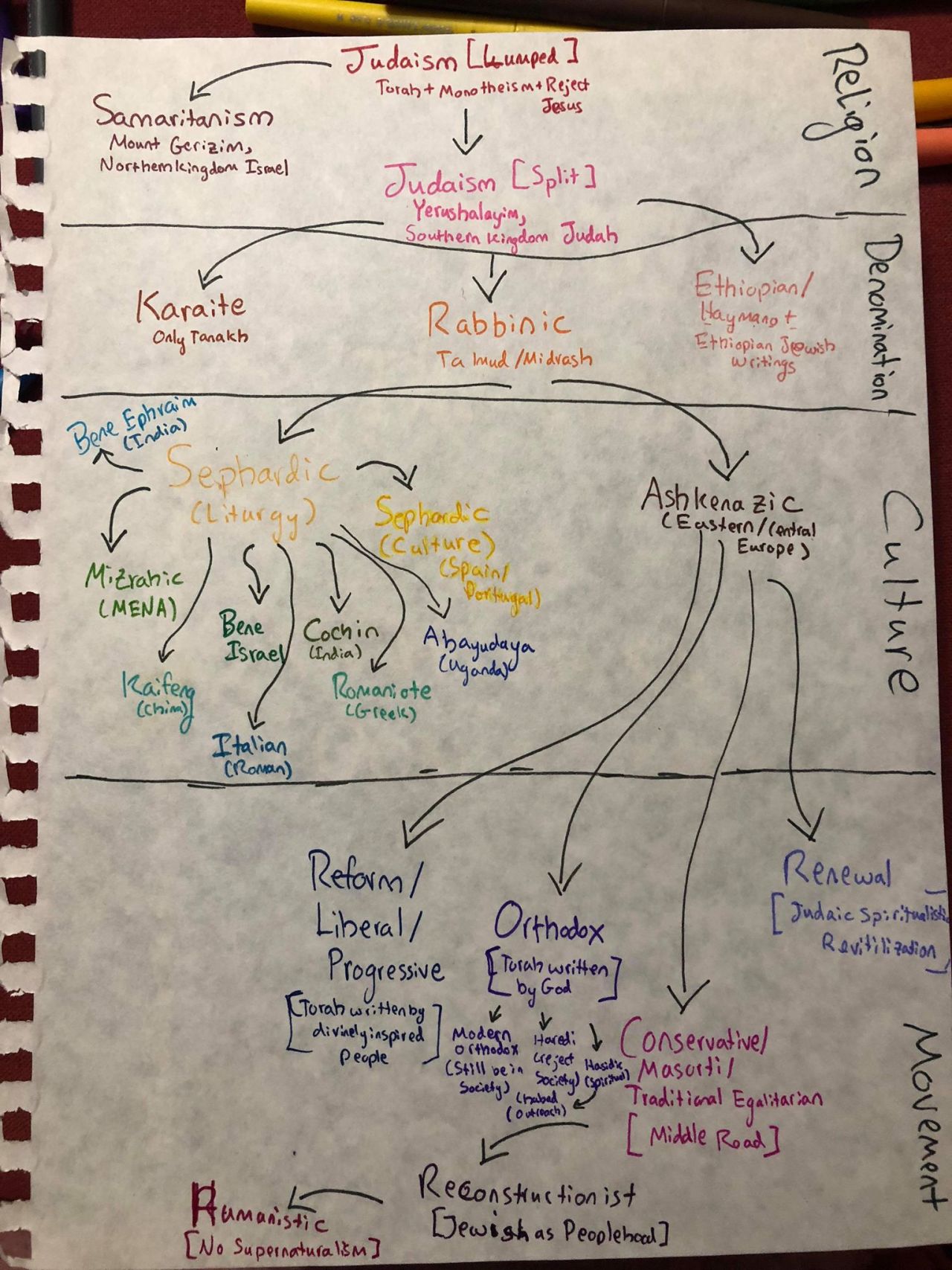
So if I were to sum it up into a diagram:
… okay I already noticed a mistake so long story but the Abayudaya actually follow Ashkenazic liturgy bc a lot of them got converted by the Masorti movement but let’s just leave it at this for now
Have fun?! Wooo Judaism
I’m laughing because the op was like hey what’s up and you were like IN THIS ESSAY I WILL and to sum it up that’s Judaism yolo

 Rush's tumblr archive