every single goddamn site now has a little pop-up whining about my ad blocker, but not a single one promises me an actual human being has vetted their ads to make sure they’re not malware, wildly inappropriate, or migraine fuel.
gosh, it’s a big ol’ mystery why i still have the blocker on.
I have Privacy Badger. It isnt an adblocker but it blocks trackers. I still get those posts because websites whose ads are designed to track you all over the internet get caught in its filter.
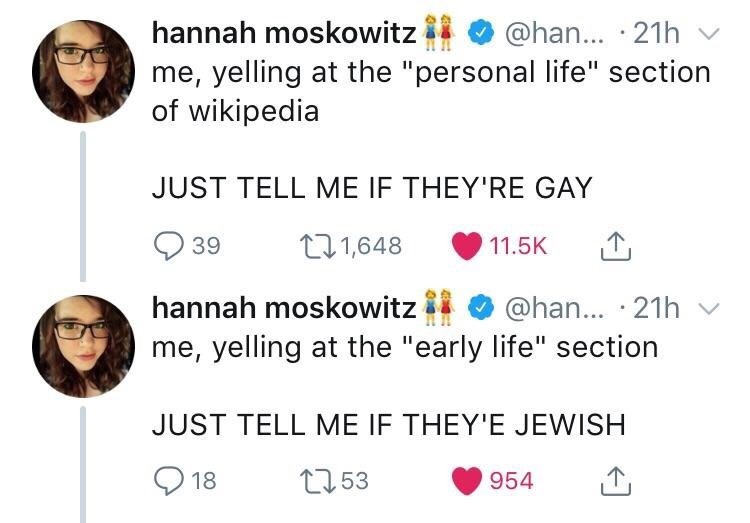
This weekend I was schmoozing at an event when some guy asked me what kind of history I study. I said “I’m currently researching the role of gender in Jewish emigration out of the Third Reich,” and he replied “oh you just threw gender in there for fun, huh?” and shot me what he clearly thought to be a charming smile.
The reality is that most of our understandings of history revolve around what men were doing. But by paying attention to the other half of humanity our understanding of history can be radically altered.
For example, with Jewish emigration out of the Third Reich it is just kind of assumed that it was a decision made by a man, and the rest of his family just followed him out of danger. But that is completely inaccurate. Women, constrained to the private social sphere to varying extents, were the first to notice the rise in social anti-Semitism in the beginning of Hitler’s rule. They were the ones to notice their friends pulling away and their social networks coming apart. They were the first to sense the danger.
German Jewish men tended to work in industries which were historically heavily Jewish, thus keeping them from directly experiencing this “social death.” These women would warn their husbands and urge them to begin the emigration process, and often their husbands would overlook or undervalue their concerns (“you’re just being hysterical” etc). After the Nuremberg Laws were passed, and after even more so after Kristallnacht, it fell to women to free their husbands from concentration camps, to run businesses, and to wade through the emigration process.
The fact that the Nazis initially focused their efforts on Jewish men meant that it fell to Jewish women to take charge of the family and plan their escape. In one case, a woman had her husband freed from a camp (to do so, she had to present emigration papers which were not easy to procure), and casually informed him that she had arranged their transport to Shanghai. Her husband—so traumatized from the camp—made no argument. Just by looking at what women were doing, our understanding of this era of Jewish history is changed.
I have read an article arguing that the Renaissance only existed for men, and that women did not undergo this cultural change. The writings of female loyalists in the American Revolutionary period add much needed nuance to our understanding of this period. The character of Jewish liberalism in the first half of the twentieth century is a direct result of the education and socialization of Jewish women. I can give you more examples, but I think you get the point.
So, you wanna understand history? Then you gotta remember the ladies (and not just the privileged ones).
Holy fuck. I was raised Jewish— with female Rabbis, even!— and I did not hear about any of this. Gender studies are important.
“so you just threw gender in there for fun” ffs i hope you poured his drink down his pants
I actually studied this in one of my classes last semester. It was beyond fascinating.
There was one woman who begged her husband for months to leave Germany. When he refused to listen to her, she refused to get into bed with him at night, instead kneeling down in front of him and begging him to listen to her, or if he wouldn’t listen to her, to at least tell her who he would listen to. He gave her the name of a close, trusted male friend. She went and found that friend, convinced him of the need to get the hell out of Europe, and then brought him home. Thankfully, her husband finally saw sense and moved their family to Palestine.
Another woman had a bit more control over her own situation (she was a lawyer). She had read Mein Kampf when it was first published and saw the writing on the wall. She asked her husband to leave Europe, but he didn’t want to leave his (very good) job and told her that he had faith in his countrymen not to allow an evil man to have his way. She sent their children to a boarding school in England, but stayed in Germany by her husband’s side. Once it was clear that if they stayed in Germany they were going to die, he fled to France but was quickly captured and killed. His wife, however, joined the French Resistance and was active for over a year before being captured and sent to Auschwitz.
(This is probably my favorite of these stories) The third story is about a young woman who saved her fiance and his father after Kristallnacht. She was at home when the soldiers came, but her fiance was working late in his shop. Worried for him, she snuck out (in the middle of all the chaos) to make sure he was alright. She found him cowering (quite understandably) in the back of his shop and then dragged him out, hoping to escape the violence. Unfortunately, they were stopped and he, along with hundreds of other men, was taken to a concentration camp. She was eventually told that she would have to go to the camp in person to free him, and so she did. Unfortunately, the only way she could get there was on a bus that was filled with SS men; she spent the entire trip smiling and flirting with them so that they would never suspect that she wasn’t supposed to be there. When she got to the camp, she convinced whoever was in charge to release her fiance. She then took him to another camp and managed to get her father-in-law to be released. Her father-in-law was a rabbi, so she grabbed a couple or witnesses and made him perform their marriage ceremony right then and there so that it would be easier for her to get her now-husband out of the country, which she did withing a few months. This woman was so bad ass that not only was her story passed around resistance circles, even the SS men told it to each other and honoured her courage.
The moral of these stories is that men tend to trust their governments to take care of them because they always have; women know that our governments will screw us over because they always have.
Another interesting tidbit is that there is sufficient evidence to suggest that Kristallnacht is a term that historians came up with after the fact, and was not what the event was actually called at the time. It’s likely that the event was actually called was (I’m sorry that I can’t remember the German word for it but it translates to) night of the feathers, because that, instead of broken glass, is the image that stuck in people’s minds because the soldiers also went into people’s homes and destroyed their bedding, throwing the feathers from pillows and blankets into the air. What does it say that in our history we have taken away the focus of the event from the more domestic, traditionally feminine, realms, and placed it in the business, traditionally masculine, realms?
Badass women and interesting commentary. Though I would argue that “Night of Broken Glass" includes both the personal and the private spheres. It was called Kristallnacht by the Nazis, which led to Jewish survivors referring to it as the November Pogrom until the term “Kristallnacht" was reclaimed, as such.
None of this runs directly counter to your fascinating commentary, though.
When a poor man asks you for aid, do not use his faults as an excuse for not helping him. For then God will look for your offenses, and He is sure to find many.
RENO MY RENO! Canadians fix people’s home improvement mistakes and are super nice about it but FIRM with man who don’t finish projects!
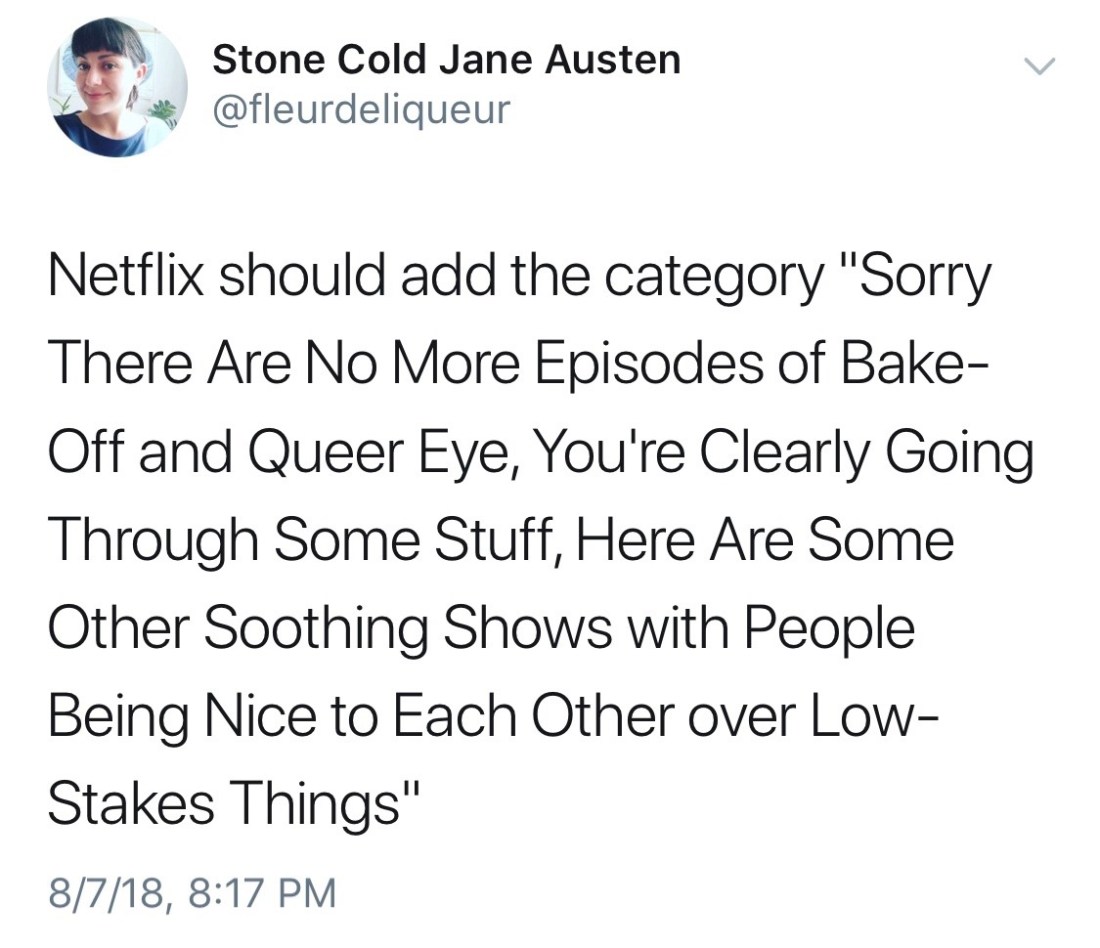
so far some shows that have worked for me:
Lord & Ladles – scottish chefs cook historical feasts in historical mansions! you meet wacky old money people and learn about strange things their ancestors got up to! you get to watch as world-renowned chefs fail at catching a fish! someone makes a hedgehog out of marzipan! people in the olden times ate some crazy shit! every episode ends with the chefs cheersing each other while lying on vintage furniture!
Big Dreams, Small Spaces – cute british people have cute yards that cute gardening man helps to make into much cuter yards. one lady wants to grow vegetables to share with her neighborhood. one lady wants to sculpt a huge mud head covered in moss coming out of the ground. one dad wants a garden for his down’s syndrome kid so he makes a sensory garden with a thousand different smells and textures. one couple wants to grow flowers for their wedding. it’s all wonderful.
Nailed It! – a bunch of people probably got high and decided to throw money at this show idea. everybody tries their best and everybody comes away either having learned something helpful, having had a rollicking good time, or having won a bunch of money. all the judges are good sports and nobody is made to feel bad for doing bad. also there’s some fucking crazy shit they get up to with modeling chocolate i tell you what.
Skin Wars – actually a lot about artists and their craft??? not really at all about sexy ladies being naked??? very cool stuff done by people with atrocious fashion sense and a complete willingness to buy into the moment. a few bad apples but mostly the reality-show-ness is pretty toned down and people are there to make cool art.
A Cook Abroad – chefs go to different parts of the world and learn about food there. A dumb white guy makes bread with adorable egyptian ladies! A british man gets exhausted by the length of roads in argentina and is only recharged by steak! An awesome woman makes cheese in france!
Love Your Garden – british man does garden makeovers for wholesome deserving families with special needs. Maybe a little bit on the weepy side of things but his assistants are all great and have fantastic hairstyles and people in wheelchairs deserve flowers!
Puffin Rock – this show is supposedly for babies but it is SO PRETTY and SO CHARMING and it’s about animals and nature and stuff and doesn’t really completely shy away from that?? like, one of the characters is a little rodent and the seagulls are the bad guys and he’s actually afraid of getting eaten?? anyway baby birds sing songs with baby bunnies and play splishsplash with baby seals and snuggle with baby animals of all sorts in a beautiful hand painted island.
Animal Airport – hey did you know some crazy shit goes down in Heathrow?? Did you know that there isn’t rabies in the UK? Everyone’s doggies and kitties have a long trip but they all get home in the end and also there are turtles and cheetahs and bugs and fish and everything!!!
this list is so relevant to my interests it hurts.
i’d also suggest the bbc historical farms series–it’s not on netflix, but it *is* mostly on youtube. the metafilter guide that originally introduced me to it is here. there are a bunch of different series of it, now, and each one is a group of archaeologists and historians living on a period location–victorian farm, they live in a farmhouse from the era, and they farm and raise animals and etc wearing period clothing, using period tools and sources as guides. and it sounds like it could be cringey, but they’re all experts in their fields and actually really invested in trying to do things well, so instead it’s a bunch of shows about teamwork and being friends (most of the core team stays the same) and learning things, and it’s delightful.
similarly, the sweet makers and victorian bakers have modern confectioners and bakers recreating period foods wearing appropriate clothing and using cookbooks from the era to guide them. (warning that one of the sweet makers episodes deals heavily with the history of sugar, and the slavery and horrific abuses associated with the same.)
If you want something positive, somewhat peaceful, and food craft related to watch on YouTube, look up loftypursuits (they make candy if you’re unfamiliar) and manaboutcakes (I might have a bit of a crush on the host)
I need my Netflix to have this category.
While I’m at it, I need Netflix to have the ability to make, curate and share playlists. Why isn’t that a thing?
Escape to the Country – British people looking for pretty houses in the country.




 Rush's tumblr archive