Moon- Are you currently reading any books? If so, what book(s)?
Planets- If you could go anywhere, where would you go?
Mercury- Describe your aesthetic.
Venus- What’s your favorite tv show?
Earth- If you could be anyone else for a day, who would you want to be?
Mars- If you could change one thing about yourself, what would you change?
Jupiter- If you had to pick one color to use for an entire week, what color would you choose?
Saturn- How far would you go for those you care about?
Uranus- What would you say is your greatest achievement?
Neptune- Describe yourself in one sentence.
Pluto- If you could meet anyone, alive or dead, who would you meet?
Constellations- If you could have one talent, what would you want it to be? (can be magical or not)
Asteroid- When you die, what do you want to be done with your body?
Aquarius- What’s a topic you enjoy learning about?
Aquila- Do you prefer to read books or watch movies?
Aries- What is something you enjoy doing?
Auriga- If you had to pick one villain from any media, who would you rather have to face and why?
Bootes- If you could have any animal, wild or not, fake or not, which would you want?
Cancer- How do you want to be remembered?
Canis Major- How many friends do you have?
Capricornus- What’s a song lyric that you relate to?
Cassiopeia- What’s your favorite quote?
Cygnus- If you could go back to any time period for a couple days, when/where would you want to go?
Gemini- Do you have any siblings? How many?
Leo- If you could change the way any movie was made, which movie would you change?
Libra- If you could talk to your past self, what would you tell yourself?
Lyra- Would you rather be feared or loved?
Orion- What’s your favorite type of weather?
Pegasus- What’s your favorite music genre?
Perseus- What’s your favorite movie genre?
Pisces- Describe someone you love without saying their name.
Sagittarius- What do you do when you don’t feel well? What do you eat/drink?
Scorpius- If you had to pick someone to betray you, who would you pick?
Taurus- What makes you feel comfortable?
Ursa Major- If you had to pick any job to have, what job would you want?
Virgo- What do you value the most- artistic ability/creativity, musical ability, athletic ability, intellect, or work ethic?
Neutron- Are you more of a leader or a follower?
Supernova- How do you feel about yourself?
Supergiant- What’s something you like about yourself?
Red Giant- Would you get into a debate/argument with someone if you heard them saying something you disagree with or know to be wrong, or would you stay silent?
Red Dwarf- What’s your favorite smell? What smell makes you feel most comfortable?
harry could be anglicised form of hari, which is another name for the indian god vishnu who reincarnates on earth to restore justice
potter could be anglicised potdar or potluri
the night he died, james was making pretty-colored lights for harry 31 october 1981 was deepavali, the indian festival of lights
fleamont potter making money through potions after coming from india as a first gen. immigrant
fleamont potter made hair potions which was really just charmed coconut oil
people would notice harry’s green eyes all the time if he was half desi
when harry has visions through voldemorts eyes that he always distances himself using voldemort’s whiteness or how pale the hand was or something to that effect
unlikely couple james and lily potter prophesied to have a world-saving baby is literally the motif of the indian epic kumarasambhava
harry flying on buckbeak is god vishnu on garuda iconography
ive said it once and ill say it again but if you live in like . california or another state where lgbt shit is decently accepted please be mindful of the fact that others have it worse than you. Indiana very recently tried to pass laws that allow for same sex couples to be banned from restaurants, in lots of states conversion therapy is still legal, and gay people are still beat for simply existing. think about that please
not to mention in lots of countries its still very much illegal and people are killed for being lgbt
yes this is fine to rb. if u live in a privileged place id appreciate it.
It was kind of a dick move to create animals that require air, then confine them to the freaking ocean
If you are talking about dolphins they used to be wolf like creatures that due to scarcity of food they had to hunt in water so they slowly evolved into water mammals, dolphins still have claw bones but they are unnecessary and dolphins will get rid of them with time and will develop abilities to breath under water
Thank you so much!!!! Ancestral creatures are Gorgeous, Valid, Perfectly Reasonable things with legs.
In regards to the first comment, most things in the ocean perform gas exchange anyway so it isn’t that bold of a move – in some respects it’s kind of a fool’s move of terrestrial animals to leave the saline bath that life started off in, since we now have to lug our dumb bodies around, full of carefully balanced metaphorical-saltwater, because our cells are just Like That
regarding the second comment on this thread, dolphins are probably fine mostly as they are, and I would not expect them to “lose” attributes to demonstrate their “evolving/progressing away from their origins.“ People think that evolution is like an unstoppable escalator that either kills you or forcibly moves you from primitive things to sophisticated things, but it isn’t. Things don’t become More Thingish with Time, that’s not how evolution works.
There is no particular evolutionary pressure on dolphins to lose traits that suit their lifestyles perfectly well. Most of the high-pressure challenges that wild dolphins face today – fishing activities, pollution, habitat destruction, food network disruption and climate change – are not going to exert evolutionary pressure on remnant bones; and the act of breathing appears to be as natural to dolphins as, well, breathing.
For example, being able to breathe surface air means that dolphins and whales can move through water that has very low quantities of oxygen (such as highly polluted water) where fish cannot survive, because there is not enough oxygen diffused in the water to maintain a constant supply for fish; whales and dolphins can simply surface to take a gulp of air.
With enormous lungs that are adapted to holding breath for incredibly long periods of time, whales and dolphins can essentially scuba-dive to areas of the ocean that other animals cannot access, as well as eying up things above the surface of the water. In a rapidly changing environment, with food/climate/water all doing things they’ve NEVER done before, this offbeat mammalian funkiness may even be the key towards sticking around and surviving a weird period of history.
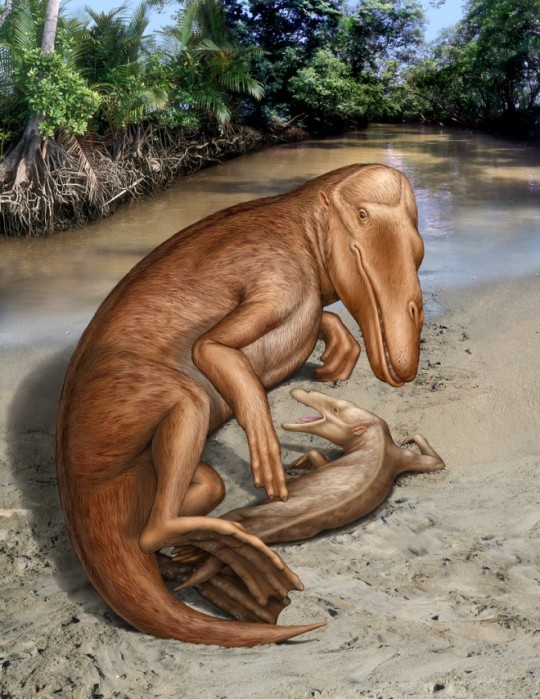
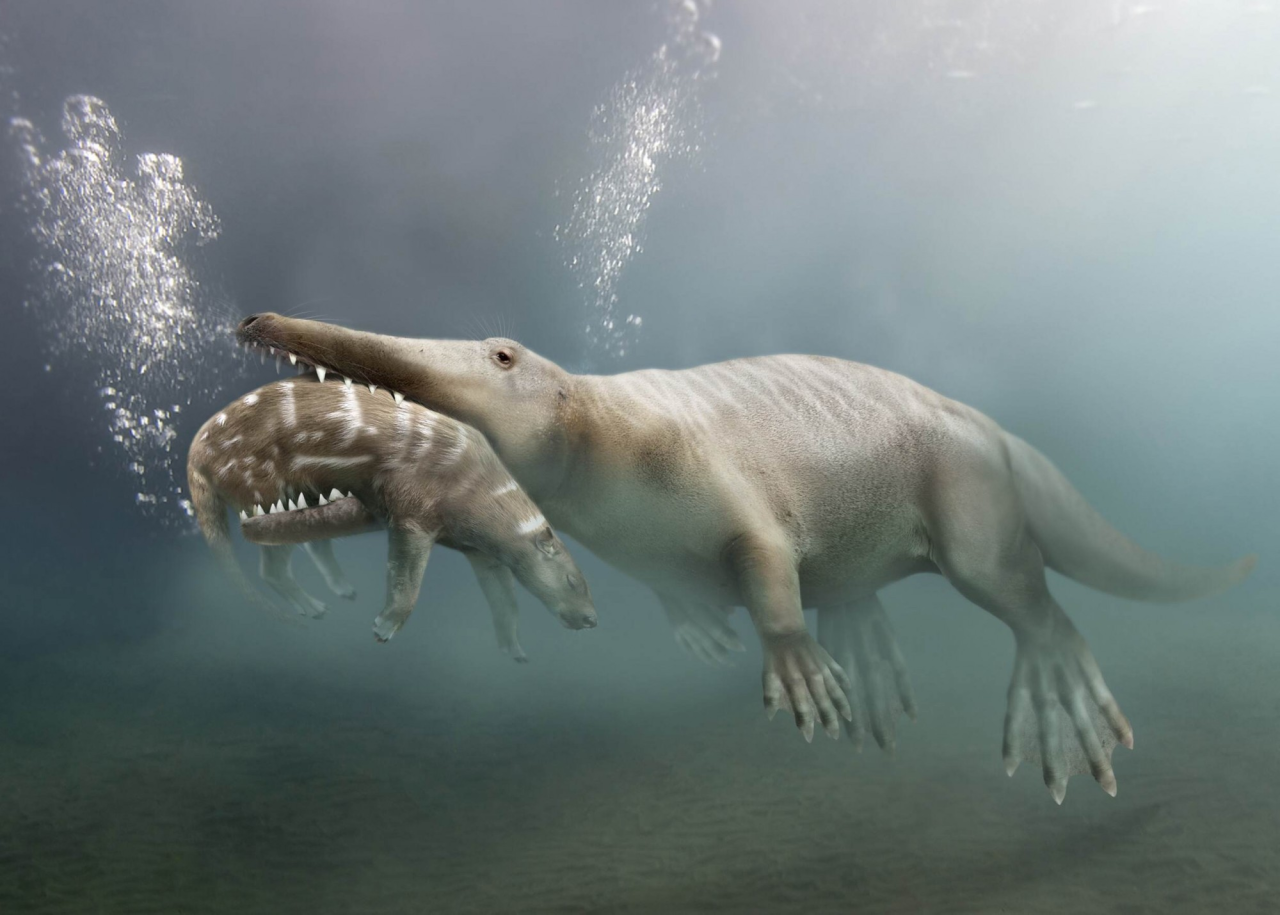
Anyway, these are Valid Historical Legges, and evolution is not a straight line from Bad Animals to Good Progressive Animals. As evidenced by how excellent and powerful these ancestral beasties are. They may be ancestral but they are MAGNIFICENT
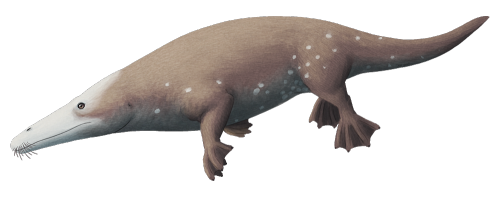
pictured: a good girl, valid and perfect in herself, a stage of someone else’s evolution but also perfectly complete in herself, somebody’s daughter and somebody’s ancestor but also just somebody in her own right, perhaps not as good at swimming as the cetaceans of the future, but perfectly acceptable in her moment of history, and in all other moments
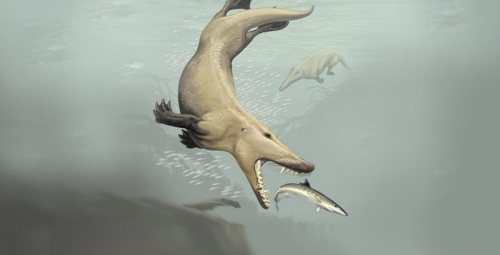
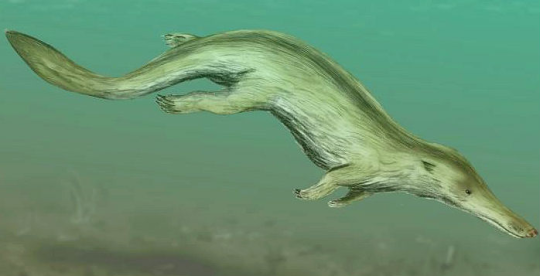
I have reblogged this once before, but I’m going to do it again, to show some better reconstruction images:
Miacetus (same species as the Shrinkwrapped Monstrosity of the first picture)
Ambulocetus
Kutchicetus
Don’t let horrible palaeoart mislead you about the weird, wonderful and beautiful creatures of the past! They were animals, adapted to a niche, slowly evolving in ways that made them better and better at living the way they were living.
HOLY SH*T. THEY FOUND NITROGEN-FIXING CORN BRED BY INDIGENOUS PEOPLE IN MEXICO. @botanyshitposts
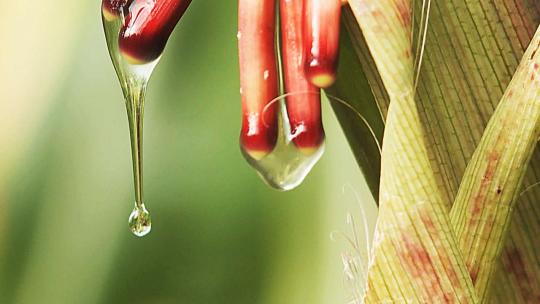
“The study found the Sierra Mixe corn obtains 28 to 82 percent of its nitrogen from the atmosphere. To do this, the corn grows a series of aerial roots. Unlike conventional corn, which has one or two groups of aerial roots near its base, the nitrogen-fixing corn develops eight to ten thick aerial roots that never touch the ground.
During certain times of the year, these roots secrete a gel-like substance, or mucilage. The mucilage provides the low-oxygen and sugar-rich environment required to attract bacteria that can transform nitrogen from the air into a form the corn can use.
“Our research has demonstrated that the mucilage found in this Sierra Mixe corn forms a key component of its nitrogen fixation,“ said co-author Jean-Michel Ané, professor of agronomy and bacteriology in the College of Agricultural and Life Sciences at UW–Madison. “We have shown this through growth of the plant both in Mexico and Wisconsin.”
…
“
Researchers are a long way from developing a similar nitrogen-fixing trait for commercial corn, but this is a first step to guide further research on that application. The discovery could lead to a reduction of fertilizer use for corn, one of the world’s major cereal crops. It takes 1 to 2 percent of the total global energy supply to produce fertilizer. The energy-intensive process is also responsible for 1 to 2 percent of global greenhouse gas emissions.
“
I’ve written about this before, this is one of those ‘saving the planet’ levels of discovery. No joke.
if you’ve been here any length of time you will recall that I’m usually the killjoy over here going “there are no silver bullets.” And this has a long way to go before it’s actually of use to farmers, but IF that happens (and that’s still a BIG IF) this would be a legit Big Fucking Deal.
Two things make me hopeful that this will not just disappear into corporate-owned varieties: one, this research was largely done through two land grant universities. Over decades. This is what land grant universities are FOR: their stated purpose is to do useful shit that’s too unprofitable for corporate R&D to care about. They are exactly the people you want developing awesome new ag tech. Mars, Inc. is involved with this too, and I trust them…not at all, but they’re not Monsanto, so it could be worse.
The other thing is this, from the linked article:
The municipal authority and community in the isolated village in the
Sierra Mixe region were an integral part of this research project.
Biological materials were accessed and utilized under an Access and
Benefit Sharing (ABS) Agreement with the community and with permission
from the Mexican government. An internationally recognized certificate
of compliance under the Nagoya Protocol has been issued for such
activities.
The ABS Agreement was structured under the terms of the Nagoya
Protocol on Access and Benefit Sharing, which is designed to ensure the
equitable sharing of benefits arising out of the utilization of genetic
resources and contributing to the conservation and sustainable use of
biodiversity.
I don’t know the details of the Nagoya Protocol. But at the very least, this isn’t outright theft of indigenous technology for corporate profit. Someone has at least thought through an equitable way for the community that developed this trait over centuries of growing maize to benefit from its use.
Finally: this is (one reason) why it’s important to preserve local crop varieties (also called landraces). Most industrialized agriculture is incredibly homogeneous genetically. It’s from the landraces that people developed slowly for specific conditions that we can find new traits–this is an extreme example, but it’s common to find landraces that are resistant to certain pests and diseases.
Oh and one more thing: Zea mays aka maize aka corn aka “indigenous Mesoamericans were better crop breeders than anyone alive today, apparently” is the WEIRDEST FUCKING PLANT, WHAT THE FUCK.
Okay so now that I’ve actually poked around the literature a bit, more thoughts:
My
standards for “poor soil” are skewed by working in Africa, so what
these folks call “poor” seems pretty okay to me, but STILL, they’re
reporting 2000 kg/ha maize grain yield with no fertilizer inputs, from a
tall, slow-growing local variety. That is pretty good, in the context of
low-input agricultural systems on not-so-great soil. Which is a good sign that it’s possible to get decent yields even while the plant is spending extra energy on getting nitrogen.
This is actually not an obvious thing. Nitrogen
fixation is a collaborative effort between a plant and some clever
bacteria. The plant feeds the bacteria carbohydrates, the bacteria turns
N2 from the air into ammonia, which the plant can use to make proteins
(plants can’t use N2 directly because it’s too hard to break apart.
N-fixing bacteria have special skills). This is pretty cool, but it does
have a cost to the plant: carbohydrates that go toward feeding bacteria
can’t be put into grain or leaves. So if you can get nitrates and ammonia and whatnot directly from the soil, it’s not worth the extra effort to
feed all these hungry bacteria. That’s probably why this trait was bred out of most maize varieties around today, and why it’s unlikely that N2-fixing corn will
become widespread in, say, the US corn belt. As long as
fertilizer is cheap, it’ll be more profitable to let the plant focus on making grain and get the nitrogen elsewhere.
Nitrogen fixation is much more useful in places where fertilizer is
NOT cheap or easily accessible (like, say, most of Africa). But there’ll have to be a lot of breeding work done before
we can get varieties with the “makes goop for bacteria” genes but not the “grows
16 feet (5m) tall and that’s a waste of energy” genes and the “takes
8-9 months to reach maturity and that’s too long if it only rains for 4
months out of the year” genes.
That breeding work needs to be done by public organizations–universities,
national agricultural research services, the CGIAR–or else the profits will go to whatever corporation does it
first. Or, more likely, since poor farmers aren’t considered a
profitable target market, there won’t be nitrogen-fixing
varieties that are appropriate to the wide range of smallholder growing
conditions. In the US, this means the USDA and USAID and NSF funding. Long-term funding, because crop breeding is slow (yes, even with genetic engineering).
Finally, some information about where and who this variety comes from: the Sierra Mixe region of Oaxaca is named for
the Mixe people who live there (who call themselves Ayuukjä’äy). The
Mixe/Ayuukjä’äy were never conquered. Not by the Zapotecs, not by the
Aztecs, not by the Spanish. When peoples are conquered, culture is often
destroyed (not “lost”–deliberately destroyed). Agriculture is part of
culture. Conquest and colonization have costs we don’t even know how to
count.














 Rush's tumblr archive