Yep! I have a huge box fan in my window. at night, it cools my room down pretty well, but until 9 PM (on good days), it stays about 85-100 degrees F in my room, and it’s also incredibly humid. The rest of my house isn’t air conditioned either. I have terrible heat-tolerance, but I’d trungle on through if it weren’t for my asthma and my cat’s asthma. She’s staying with my mom until I can get an AC unit, but I myself have been spending every day in the library after work until it’s cool enough to go home and to bed. And on hotter more humid nights, the fan does nothing. It’s miserable el oh el !!!
This isn’t a permanent solution, but just for now, I’ve found it can help to hang a wet cloth in front of the fan so it cools down the air! Also, keeping a small spray bottle near me and spritzing myself when I get hot and then regularly refilling it with cold faucet water is good!
One thing I do on warm nights is I take a cold shower immediately before bed and I don’t dry my hair. I’ve found that cools me off quite a bit. If you’re fine with wet hair I’d recommend that.
This by no means a comprehensive list, it is simply a reference point, not a diagnostic tool. If you identify with a majority of this list and wish to receive a diagnosis, consult a medical professional, preferably a specialist in autism spectrum disorders who has had experience diagnosing women.
Tends to analyze everything constantly
Often straightforward and practical in nature.
Often gets lost in own thoughts and zones out (may display a blank stare)
May appear naive or innocent (despite not being so)
Prone to honesty, has difficulty lying
May struggle to understand manipulation, disloyalty, vindictive behavior and retaliation.
May be gullible and easily taken advantage of, misled, or conned.
May have feelings of confusion and isolation in relation to others
Escapism frequently used to relax or avoid overwhelming situations.
Often holds fixations, obsessions, and extreme interest in specific topics.
Finds comfort in escaping through imagination, fantasy, and daydreaming.
Often has slower reaction times due to need for mental processing.
May have had imaginary friends as a child.
Frequently imitates (takes social cues from) people on television or in movies.
May obsessively collect, organize, count, categorize, or rearrange objects.
Often highly adapted to social imitation.
May find math and numbers easier to deal with due to logic and lack of objective answers.
May struggle to relax or rest due to many racing thoughts.
Often has comorbid conditions, such as OCD, anxiety, ADD or ADHD, depression, bipolar disorder, etc.
Often has sensory processing disorder (sight, sound, texture, smells, taste)
May have dyspraxia (Poor muscle tone, lack of coordination and depth perception)
May have dyslexia
May have an eating disorder or food obsessions
May have been misdiagnosed or diagnosed with other mental illness or possibly labeled a hypochondriac.
Tends to drop small objects
May frequently engage in “stimming” (self-stimulation) i.e., flicks fingernails, flaps hands, drums fingers, rubs hands/fingers, tucks hands under or between legs, clenches fists, twirls hair, taps foot/shakes leg, sways side to side, spins in circles, bouncing up and down, rocking, etc.
May use various noises to express herself rather than using words.
May have a tendency to over-share with friends and sometimes strangers
May have little impulse control when speaking
May accidently dominate conversation at times.
Often relates discussion back to self (sharing as a means of reaching out)
May be incorrectly seen as narcissistic
Often sounds eager or over-zealous at times.
May feels as if she is attempting to communicate “correctly.”
Often struggles with and is confused by the unwritten social rules of accurate eye contact, tone of voice, proximity of body, stance, and posture in conversation.
Eye contact often takes extreme focus, which may lead an individual’s eye contact to be darting and insufficient, or over-the-top staring/glaring.
May have difficulty regulating voice volume to different situations. Is frequently observed as being either too loud or too quiet.
Conversation, specifically small talk, can be exhausting.
May have trouble focusing on/engaging in conversation that is not centered on one’s primary interests.
May observe and question the actions and behaviors of self and others continually.
May have difficulty with back-and-forth conversation
Trained self in social interactions through readings and studying of other people.
Visualizes and practices how she will act around others and before entering various social situations.
Difficulty filtering out background noise when talking to others.
Has a continuous dialogue in mind that tells her what to say and how to act when in a social situations.
Sense of humor sometimes seems quirky, odd, or different from others.
As a child, it may have been hard to know when it was her turn to talk, may still be true as an adult.
Often finds the norms of conversation confusing.
Tend to say what they mean. Are often brutally honest, coming off as rude when they do not mean to be.
May feel misunderstood and tend to over-explain/ramble in an attempt to compensate for possible miscommunication.
Feels extreme relief when she doesn’t have to go anywhere, talk to anyone, answer calls, or leave the house.
Feelings of dread about upcoming events and appointments on the calendar.
Knowing she has to leave the house causes anxiety from the moment she wakes up.
The steps involved in leaving the house are overwhelming and exhausting to think about.
Must prepare herself mentally for outings, excursions, meetings, and appointments.
Question next steps and movements continually.
Often needs a large amount of down time or alone time.
May feel extremely self-conscious and uncomfortable in public locker rooms, bathrooms, or dressing rooms.
Tends to dislike being in crowded areas.
Difficulty sleeping due to sensitivity to environment
May be highly intuitive to others’ feelings, although may not appear to react to them ‘correctly’ in social situations
May take criticism and judgement very personally
May frequently adapt her viewpoints or actions based on others’ opinions
Dislikes words and events that hurt animals and people.
May have had a desire to collect or rescue animals, usually in childhood.
Often holds great compassion for suffering.
May try to help, offer unsolicited advice, or formalize plans of action.
Imitates others without realizing.
May exhibit codependent behaviors.
May frequently reject or question social norms.
Chameleon-like in social situations. Often switches preferences and behaviours based on environment and other people.
May outwardly appear to have little investment in hygiene, clothes, or appearance, often prefers fast and easy methods of style.
Clothing style is likely more focused on comfort and practicality, especially in the case of sensory issues.
May possess a youthful appearance and/or voice.
May have trouble recognizing what she looks like and/or has slight prosopagnosia (difficulty recognizing or remembering faces).
The emotions of oneself and others may seem confusing, illogical, and unpredictable.
Expects that by acting a certain way certain results can be achieved, but realizes in dealing with emotions, those results don’t always manifest.
Often speaks frankly and literally.
Certain kinds of humor, such as sarcasm and metaphors, may be difficult to understand.
Can be confused when others ostracize, shun, belittle, trick, and betray.
Often has trouble identifying feelings in others unless they are extreme.
Trouble with the emotions of hate and dislike.
May have feelings of pity for someone who has persecuted/hurt her.
Situations and conversations sometimes perceived as black or white.
The middle spectrum of outcomes, events, and emotions is sometimes overlooked or misunderstood. (All or nothing mentality).
May notices patterns frequently.
May be fascinated by words or song lyrics.
Tends to best remember/learn things in visual pictures (visual thinkers).
May have a remarkable memory for certain details, i.e., may find it surprisingly easy to remembers exact details about someone’s life.
Executive function is often a challenge
Learning to ride a bike or drive a car may be rather difficult.
Anything that requires a reasonable amount of steps, dexterity, or know-how can rouse a sense of panic.
The thought of repairing, fixing, or locating something can cause anxiety.
May have a hard time finding certain objects in the house, but remembers with exact clarity where other objects are.
May frequently second-guess oneself and ask a lot of questions before engaging a task or situation
This list was compiled from various personal accounts and symptom lists. It is subjective and does not include every identifiable trait. Nor is it entirely medically accurate. Please do your own research into ASD before self-diagnosing.
When reblogging, feel free to add additional traits you believe to be common in ASD females that will be useful for others to know.
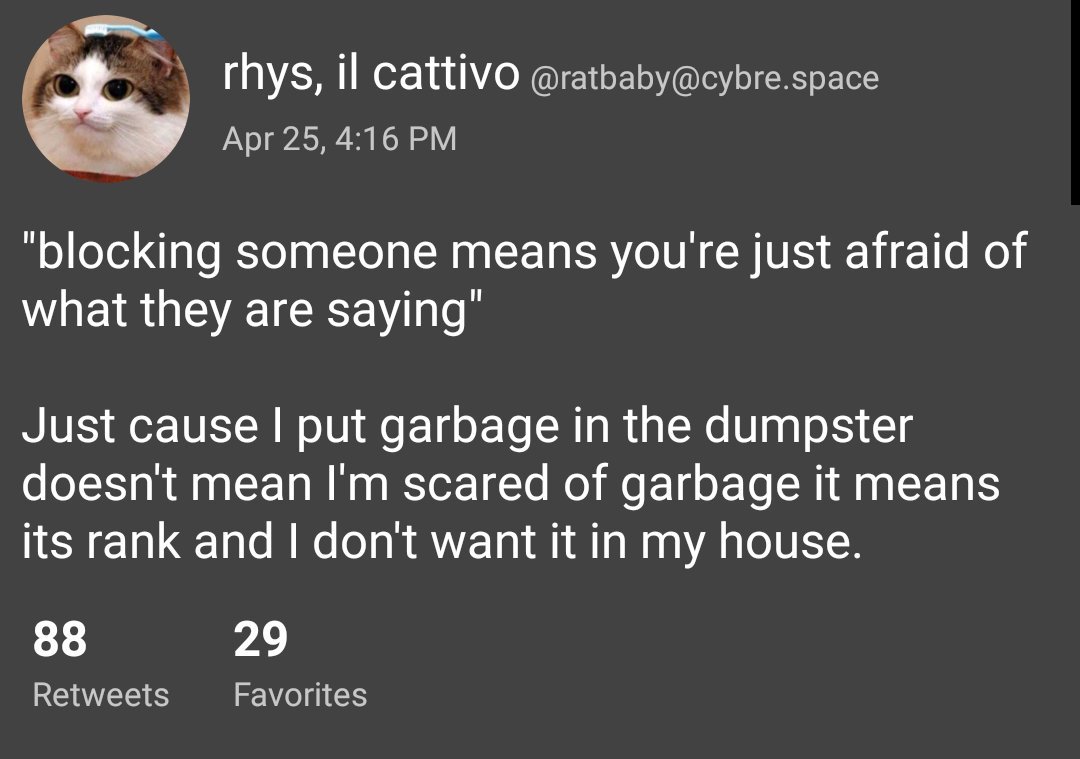
I saw a twitter post recently that compared blocking trolls to hanging up on crank callers. If someone is up your space and trying to annoy you instead of have a conversation, blocking is an appropriate response.
hey tumblr I know since this isn’t a show about two white cis gays you may not donate but if you could read below
I’m trying to raise $3,500 to get me and my family away from our abusive ex stepdad. I’m trying to do this within the next 6 weeks and being black trans and unemployed makes that really hard
At this point I’m not even asking most of you to donate, I’d really just like the exposure so this can get to someone that’s a bit better off who can afford to help out a little. I’m gonna include my PayPal and the link to my gofundme below
Mark Zuckerberg lost $119 Billion dollars on the stock market today (7/26/18). This is the largest loss of wealth in a single day in modern stock history.
This will literally not change his lifestyle or effect his livelihood at all. He is still a multi-billionaire.
If I worked every single day, for the rest of my life, at $15/hr – which is more than twice the national minimum wage – I would never make even 1/1000th the amount of just the money that Zuckerberg lost today.
If I worked every single day, for the entirety of the time that anatomically modern humans have existed (200,000 years) – at $15/hr – I would still not make one tenth of the amount of just the money he lost today.
And he is still a billionaire and will lose literally zero luxury or well-being from what happened today.
You want to know how absolutely grotesque modern wealth inequality is?
maybe go get all your facebook info downloaded as one package? there should be an option somewhere in your settings for that. then with all that stuff you need it for saved to your computer, you can delete it – maybe make a status asking all your friends to send you their phone numbers or whatever to keep in touch after. Or that you’re going inactive but leaving the page up and where to contact you
Leaving it inactive might be a good idea. I could go into it and get event dates (to save elsewhere) and leave a post on at the top of my wall saying where to contact me. That way the info the company would be collecting about me would be very minimal (event pageviews and nothing else).
I was looking through old facebook posts because I needed to find a picture and I realized as I did that, that I used to post on Facebook way more than I do now. I’d be putting stuff on my wall every day about a year and a half ago but now it’s only maybe once or twice a week.
I now only use it for two reasons.
1. To keep track of events that are *only* posted on Facebook.
2. To communicate with friends that are unreachable otherwise either because they don’t have a data plan or they only make plans on Facebook and nowhere else.
If either one of those things wasn’t true, I’d drop Facebook like a sack of potatoes. It’s essentially a glorified Google Calendar for me at this point.
Has anyone had any success with managing either of these issues outside of Facebook? I don’t want it in my life anymore.















 Rush's tumblr archive