I think leftblr is a little too quiet about sensible drug policy and that’s really telling 🤔
Access to clean needles should be free
Testing kits for fentyl and stricnine and other laces should be free
Narcan should be free (and is given out by a lot of opioid awareness groups thank god)
Access to methadone and suboxone should be free
And this is all like… really basic stuff. I personally want full repeal of the scheduling system and other measures regarding the prison system
Drug addiction is a direct result of suppression of certain populations and the pharmaceutical industry’s push for the normalization of opiate use.
Anti drug policy is almost entirely rooted in racism and it serves to build up our prison system, while simultaneously denying addicts access to safe withdrawal measures. The war on drugs never served to help the people as a whole, and always served to isolate people of color and divide the classes even further. There’s a reason mostly poor people and/or people of color face real time for drug charges.
OP, the original post is not exactly the best one to stick an informative post onto and that’s really telling🤔
Dude I don’t give a fuck how my information is presented. If you’re not automatically willing to review your politics when someone brings up a justice issue, despite how it’s initially directed, then you’re still a baby leftist.
The left has an absolute problem with ableism, especially racialized ableism. As a recovering addict I’m allowed to make posts that make you question if you’re doing enough for neurodivergent people.
all people in prison for possession should be freed and given the economic and therapeutic means to recover from their addictions. widespread programs to provide employment and housing and community to addicts should be implemented and free to use. ideally, leftists should support decriminalization of drugs, widespread information about hiv + fentanyl + infections/safe injection habits and basically all other effective harm reduction techniques.
harm reduction rhetoric has been coopted in a lot of ways to become a neoliberal biomedical prevention technique with the purpose of protecting “””the innocent””” (i.e the talking points are about preventing the spread of HIV rather than protecting the health of addicts, who are still deemed irresponsible and unworthy by the public health system, hence why harm reduction is not seen as often in prisons) and leftists have a duty to reassert harm reduction as an act of radical compassion and grassroots public health.
Maybe I’m just too wary of police… But I gotta say, good intentions aside, the idea of a police database of autistic people is… Not one that I’m comfortable with?
But it’s apparently an initiative quite a few UK autism orgs are working on…
There should never be a database like that of any group of people… There is nothing stopping it from being misused if society takes a huge political shift. Like, I think this can even be abused by officers in the current system.
Who suggested a police database of autistic people?
The org “Autism Hampshire” had one under the title “Autism Passport”, but they redid their website literally last week (in between days I was collecting data for my dissertation, I thought I was losing the plot) and all mention of it has been removed. The page is available through the Wayback Machine, however, and reads:
“The Autism Alert Programme launched the Autism Passport on the 21 April 2011 in addition to the Alert Card and Alert Car Sticker. Autism Hampshire with the agreement of the individual with Autism or their parent if under 16 are able to create a passport for them. The Passport will be placed onto the Hampshire Constabulary’s Safety Net System and will allow Criminal Justice System professionals access to information and strategies to support the individual. The creation of a passport will enable organisations and professionals to identify the communication needs of an individual and to improve the service received by victims and witnesses and to ensure that those within the criminal justice system are dealt with in an appropriate manner. Our partners involved in this are the Police, Police Authority, HMCS (Magistrates), DutySolicitors, Youth Offending Team, HM Prison Winchester and Probation.”
I wrote this post after further data collection found that the org “Autism Sussex” had a similar scheme:
“This card is promoted and delivered by Sussex Police. Anyone who has a disability that makes it hard to communicate can register for a Pegasus card. When produced, the card and/or unique PIN number will inform any Officer that this individual needs additional help. The nature of the person’s communication problem, i.e. autism, can be obtained via a police radio call giving access to a secure database. The Officer is given relevant information that may enable reasonable adjustments be made at all stages of the investigation. This may well impact at an early stage on the eventual outcome. The database also holds contact details of two people, who know that person well, e.g. family members or carers. These contacts can act as an “appropriate adult” if not directly involved in the investigation. In the case of an individual with autism, people who know them well are likely to offer the best support.”
And, like, yeah, as I said in the original post, this all seems well-intentioned, and maybe I’m just paranoid, but I don’t think that you can escape the end result of these projects: The police having a database of members of an oppressed, minority group.
white mentally ill ppl really need to realize that just bc we are mentally ill, that doesnt negate our whiteness. acting like a baby and weaponizing our mental illnesses when being called out for racism isnt a result of mental illness, its a result of whiteness and white fragility. mentally ill ppl who are not white get demonized for showing the same symptoms that get us sympathy and its important to understand that.
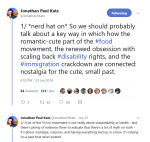
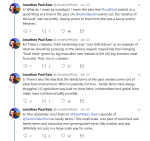
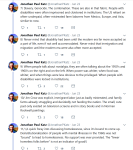
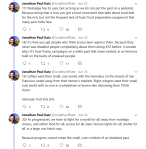
This is mostly for @nerdfishgirl but I figured I’d share the thread in case anyone else finds it interesting also. I do think the OP is providing a false equivalence in 15/ because I have yet to have seen “lefties” who support the family separation. Either that or he’s confusing “lefties” with eco//fascists.
From a macroeconomics standpoint, Bridges is completely accurate.
The problem with most Tories (and many Republicans in the US) is that they either have big business interests at heart or have bought the lie that government is like a business. Government is not a business! Microeconomic principles, even ones that apply to entire industries, don’t apply to governments!
Here’s the fundamental macroecomic model of an economy:
(image from tutor2u)
Notice that the system is circular. The model shows that the economy inherently needs to be balanced. If some households are making hundreds of times the income of other households, they will put the vast majority of that money into savings and investment.
This is bad for the economy.
Some savings and investment is necessary. But too much means the little green arrows are siphoning off vast portions of the peach demand arrow (”purchases of goods and services”). This means that companies are fighting over a smaller and smaller pie. Even if you heavily fund those companies, many will collapse due to lack of demand for their products, unless they become monopolies and the sole practical source of their product. Monopolies are technically illegal in the US, but we have them anyway because of this problem (and a lack of enforcement).
The other way you can damage the demand arrow is by shifting the proportions of the purple income arrow. Most people make money from wages, so if you significantly decrease those relative to dividends, interest, profits, and rent, you’ll harm the majority of households. In turn, this again decreases the peach arrow because many households only need a set amount of a given product in a year. The fewer households that can afford the products, the lower overall demand, because the remaining households won’t buy up the difference.
Households with average levels of income spend far more money than they save, of necessity, and they do so at a relatively steady rate. This is good for the economy.
Households with incredibly high levels of income – millionaires, etc. – save far more than they spend. They tend to make their money off of dividends, interest, profits, and rents – not wages. Therefore, to improve the economy, including increasing tax revenues for the government, two basic steps are urged by almost all macroeconomists:
1. Increase wages, especially at the lowest end. This expands the tax base and drives up demand for basic goods and services, stabilizing the industries necessary to a decent quality of life: agriculture and food production, clothing, housing, education, transportation, etc.
2. Use progressive taxes, in which those who make the most money, particularly off of dividends, interest, profits, and rents, pay a higher percentage of their income as taxes. This allows that money to be spent directly on goods and services or to be redistributed to poor households, who will in turn spend it on goods and services. In both cases, money that would have gone into savings and investment instead goes into demand. This makes businesses more successful and a large number of households more prosperous. Society as a whole benefits from decreased crime, lower health problems, and improved public goods like education, roads, emergency response, infrastructure, etc.
Macroeconomics is the opposite of an individual business. Individual businesses study how to take the most pie for themselves and keep it. Macroeconomists – and governments – study how to make the pie bigger and distribute it in such a way that society as a whole benefits from the growth.
Conservatives: doing economics wrong for the past several decades by deliberately pretending that knowing how to run a business is anything like knowing how to run a government. Being fiscally cautious and being uneducated do not have to go hand in hand. (I’m both, for example.) But the rhetoric for slashing budgets has been laden with errors and ideology since at least the 1930s, and I’m tired of it.
ONE MORE TIME FOR THE MORONS AT THE BACK IN OUR GOVERNMENTS
Or as Paul Wellstone used to say, “We all do better when we all do better.”
Ta dah.
Thank you.
I wish the part about aunts on facebook wasn’t true.
If that’s true, why don’t you take off and fly instead of walking? If that’s true, why don’t you jump instead of taking the stairs? If that’s true, why don’t you run instead of driving your car?
We all have limits – it’s just that some limits are so common that they’re being acknowledged and accommodated by society and thus aren’t seen as limits as reasonable accommodations for these limits exist in our current society.
Having limits only becomes a problem when you have limits that most people don’t have due to mental illnesses or physical/mental disabilities, because these limits aren’t accommodated or acknowledged by society.
If you’re a neurotypical, ablebodied person, you likely won’t notice your limits as society is built to accommodate them, but there’s plenty of things you can’t do – the thing is, you aren’t expected to.
Please take a step out of your bobble of privilege and realize that for some people, working or studying 8 hours a day is as impossible as flying like a bird is to you and stop telling disabled and mentally ill people that they can do everything they put their mind to.
Cause none of us can – not even you. You’re just lucky that the limits you do have is shared by the majority of the population. Many of us aren’t that lucky.
People don’t become successful by trying to do something that’s outside their limits. They become successful by accepting that something is outside their limits and trying to find something else that’s within their limits.
For abled people, that’s painfully obvious.
In the time that a disabled person wastes by trying to do something they can’t, they could instead accept that they can’t and find something else that they can.








 Rush's tumblr archive