ASSAMAKA, Niger (AP) — From this isolated frontier post deep in the sands of the Sahara, the expelled migrants can be seen coming over the horizon by the hundreds. They look like specks in the distance, trudging miserably across some of the world’s most unforgiving terrain in the blistering sun.
They are the ones who made it out alive.
Here in the desert, Algeria has abandoned more than 13,000 people in the past 14 months, including pregnant women and children, stranding them without food or water and forcing them to walk, sometimes at gunpoint, under temperatures of up to 48 degrees Celsius (118 degrees Fahrenheit).In Niger, where the majority head, the lucky ones limp across a desolate 15-kilometer (9-mile) no man’s land to Assamaka, less a town than a collection of unsteady buildings sinking into drifts of sand. Others, disoriented and dehydrated, wander for days before a U.N. rescue squad can find them. Untold numbers perish along the way; nearly all the more than two dozen survivors interviewed by The Associated Press told of people in their groups who simply could not go on and vanished into the Sahara.
“Women were lying dead, men….. Other people got missing in the desert because they didn’t know the way,” said Janet Kamara, who was pregnant at the time. “Everybody was just on their own.”
Tag: death cw
Shady Mariah headcanon/possible actual canon
So Shades saw Mariah murder Cornell, which probably means that he overheard their conversation.
So he knows why Mariah killed Cornell, but he never brought it up to her or told her that he knew. He just reassures that she was in the right in killing him.
Shades grew up in the streets of Harlem, went to prison, and even he KNOWS that it is NEVER the victim’s fault.
And he lets her know that, in his own subtle way.
Also, in their last scene together when she kisses him, he gives her that control and doesn’t make any moves other than that big smile.
This means everything to me.
Given what we now know about him I wonder if he can sympathize because he’s had people use his sexuality to victim blame him for similar situations.
I know people have strong feelings about Fallout 4 but will ANYTHING ever be as raw as when Nick Valentine confronts his past life’s wife’s murderer and the dude goes “why do you care? You’re not even alive” and Nick says “well I guess im in good company” and fucking shoots him to hell
The dark (and overlooked) history of black women lynched in the U.S.
A memorial to victims of lynching in the U.S. opens in Alabama on April 26, 2018.
The National Memorial for Peace and Justice is a six-acre site that overlooks Montgomery, the state capital. It uses sculpture, art and design to give visitors a sense of the terror of lynching as they walk through a memorial square with 800 six-foot steel columns that symbolize the victims. The names of thousands of victims are engraved on columns—one for each county in the United States where a lynching took place. In Alabama alone, a reported total of 275 lynchings took place between 1871 and 1920.
U.S. history books and documentaries that tell the story of lynching in the U.S. have focused on black male victims, to the exclusion of women. But women, too, were lynched—and many raped beforehand. In my book “Gender and Lynching,” I sought to tell the stories of these women and why they have been left out.
Between 1880 and 1930, close to 200 women were murdered by lynch mobs in the American South, according to historian Crystal Feimster.
Will this new memorial give these murdered women their due in how the U.S. remembers and feels about our troubling history?
In a recent report, Lynching in America, researchers documented 4,075 lynchings of African-Americans that were committed by southern whites in Alabama, Arkansas, Florida, Georgia, Kentucky, Louisiana, Mississippi, North Carolina, South Carolina, Tennessee, Texas and Virginia between 1877 and 1950.
Lynching differed from ordinary murder or assault. It was celebrated by members of the Ku Klux Klan as a spectacular event and drew large crowds of people who tortured victims, burned them alive and dismembered them. Lynching was a form of domestic terrorism that inflicted harm onto individuals and upon an entire race of people, with the purpose of instilling fear. It served to give dramatic warning that the ironclad system of white supremacy was not to be challenged by word, deed or even thought.
The conventional approach to teaching the history of Jim Crow and lynching has focused almost exclusively on the black male victim. However, such an approach often simplifies and distorts a much more complex history.
Not all victims were African-American men, and although allegations of African-American men raping white women were common, such allegations were not the leading motive for the lynchings. We know from the pioneering work of anti-lynching crusader Ida B. Wells-Barnett that African-American men, women and children were lynched for a range of alleged crimes and social infractions.
The book “Trouble in Mind,” by Pulitzer Prize-winning historian Leon Litwack, provides a detailed account of the many accusations of petty theft, labor disputes, arson and murder that led to these lynchings.
This fact requires a richer, more nuanced understanding of discrimination that is critical of racism and sexism at the same time. Martyrs such as Laura Nelson and Mary Turner experienced racial and sexual violence at the hands of vigilante lynch mobs because of their race and gender.
Laura Nelson and Mary Turner
In May 1911, Laura Nelson was lynched in Okemah, Oklahoma.
Nelson allegedly shot a sheriff to protect her son. The officer had been searching her cabin for stolen goods as part of a meat-pilfering investigation. A mob seized Nelson along with her son, who was only 14 years old, and lynched them both. However, Nelson was first raped by several men. The bodies of Laura and her son were hung from a bridge for hundreds of people to see.
The violent murder of African-Americans was so accepted at the time that a postcard was made of Nelson’s lynching by George Henry Farnum, a photographer. Brooklyn-based artist Kim Mayhorn created in 1998 a multimedia installation that memorialized Nelson’s death. There’s an empty dress in Mayhorn’s installation that resembles the postcard of her lynching. The disembodied dress represents the void in the historical record and Mayhorn’s effort to redress the absence of Nelson.
The title of Mayhorn’s installation, “A Woman Was Lynched the Other Day,” refers to a banner the New York NAACP would unfurl from their Fifth Avenue office when news of another lynching surfaced. With white letters inscribed on a black background, it declared “A MAN WAS LYNCHED YESTERDAY” and became a rallying cry for justice.
Seven years later, in May 1918, Mary Turner was eight months pregnant when a mob of several hundred men and women murdered her in Valdosta, Georgia. The Associated Press reported that she had made “unwise remarks” and “flew into a rage” about the lynching of her husband, insisting that she would press charges against the men responsible.
Her death has since been recognized by local residents, students and faculty at Valdosta State University, first with a public ceremony that placed a cross at the lynching site and second with a historical marker in 2010.
Nelson and Turner have often been depicted as tragic characters or “collateral victims” who supported and defended the males in their lives.
Such deaths, however, were not incidental. They were essential to maintain white supremacy, as a form of punishment for defying the social order.
Though women represent a minority of lynching victims, their stories challenge previous attempts to justify lynching as necessary to protect white women from black male rapists.
Understanding lynching and the motives behind it requires including the stories of African-American women who were robbed of dignity, respect and bodily integrity by a weapon of terror. The violence against them was used to maintain a caste system that assigned inferior roles to African-American women and men alike.
The dark (and overlooked) history of black women lynched in the U.S.
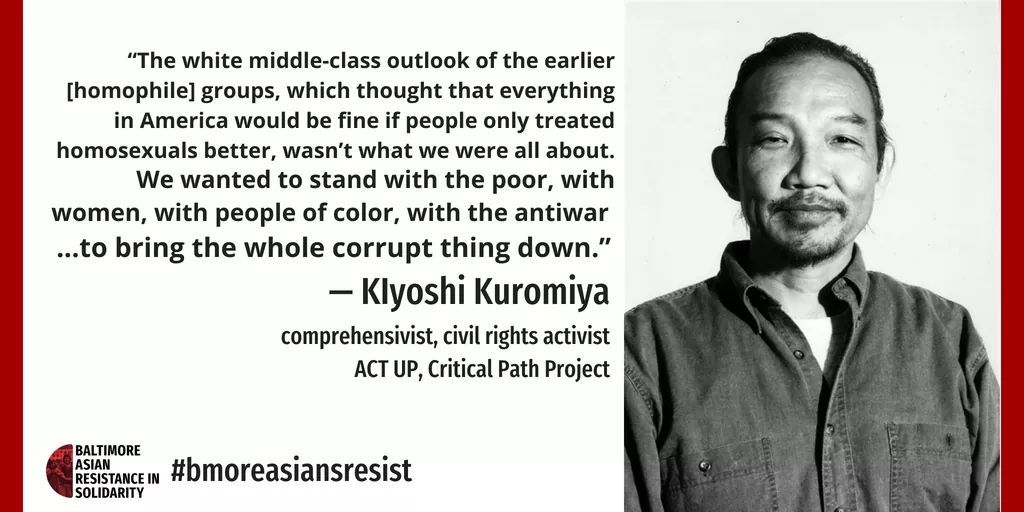
In 1968, the AmeriCong announced that a dog would be burned alive in front of University of Pennsylvania’s Van Pelt Library. 2000 people showed up in protest. They were given leaflets.
“Congratulations on your anti-napalm protest. You saved the life of a dog. Now, how about saving the lives of tens of thousands of people in Vietnam.”
From his birth in an internment camp to marching as a high schooler in Selma and being brutalized by horseback police to starting the Critical Path Project to educate people living with HIV/AIDS on health and activism to his 1999 suit, Kuromiya v United States, for the right to medical marijuana, Kiyoshi Kuromiya’s life is a celebration of direct action and education.
Today, May 19th, is National API HIV/AIDS Awareness Day. HIV is a political issue. HIV demands collective and systemic change. Here are notes from a BARS meeting session earlier this year on API folk and HIV/AIDS: https://docs.google.com/document/d/1U8Dw9MP-t9seZkTrw6Mvai3b068UWrTnoaXpHAgZkm4/edit
Interview with Kuromiya: https://thescene.com/watch/them/kiyoshi-kuromiya

Opinion | One Test Could Exonerate Him. Why Won’t California Do It?
Trigger warnings for: death, murder, child death, violence, antiblack racism, antiblack slurs, homophobic slurs, transphobic slurs, mention of attempted rape, and mention of death threats.
Pay particular attention to how the Democratic politicians mentioned in the piece refuse to allow the DNA testing that could exonerate a most likely innocent man.
Opinion | One Test Could Exonerate Him. Why Won’t California Do It?
So a friend of mine told me how yesterday his coworker died on the way to work due to speeding and crossed a red light (she was late for the third time, so I’m guessing she was trying to avoid a write up). As soon as she crossed the light she was hit on the drivers side by a semi. The messed up part is that in less than an hour her table was cleared for a new worker. In less than 4 hours they had sent out the news that they are hiring. By the end of the day the hiring manager had contacted 4 people for an interview. Moral of the story is, these jobs don’t care about your ass. They will replace you in a snap. Don’t risk or waste your life trying to go above and beyond for a job that could care less about your wellbeing.
 Rush's tumblr archive
