This weekend I was schmoozing at an event when some guy asked me what kind of history I study. I said “I’m currently researching the role of gender in Jewish emigration out of the Third Reich,” and he replied “oh you just threw gender in there for fun, huh?” and shot me what he clearly thought to be a charming smile.
The reality is that most of our understandings of history revolve around what men were doing. But by paying attention to the other half of humanity our understanding of history can be radically altered.
For example, with Jewish emigration out of the Third Reich it is just kind of assumed that it was a decision made by a man, and the rest of his family just followed him out of danger. But that is completely inaccurate. Women, constrained to the private social sphere to varying extents, were the first to notice the rise in social anti-Semitism in the beginning of Hitler’s rule. They were the ones to notice their friends pulling away and their social networks coming apart. They were the first to sense the danger.
German Jewish men tended to work in industries which were historically heavily Jewish, thus keeping them from directly experiencing this “social death.” These women would warn their husbands and urge them to begin the emigration process, and often their husbands would overlook or undervalue their concerns (“you’re just being hysterical” etc). After the Nuremberg Laws were passed, and after even more so after Kristallnacht, it fell to women to free their husbands from concentration camps, to run businesses, and to wade through the emigration process.
The fact that the Nazis initially focused their efforts on Jewish men meant that it fell to Jewish women to take charge of the family and plan their escape. In one case, a woman had her husband freed from a camp (to do so, she had to present emigration papers which were not easy to procure), and casually informed him that she had arranged their transport to Shanghai. Her husband—so traumatized from the camp—made no argument. Just by looking at what women were doing, our understanding of this era of Jewish history is changed.
I have read an article arguing that the Renaissance only existed for men, and that women did not undergo this cultural change. The writings of female loyalists in the American Revolutionary period add much needed nuance to our understanding of this period. The character of Jewish liberalism in the first half of the twentieth century is a direct result of the education and socialization of Jewish women. I can give you more examples, but I think you get the point.
So, you wanna understand history? Then you gotta remember the ladies (and not just the privileged ones).
Holy fuck. I was raised Jewish— with female Rabbis, even!— and I did not hear about any of this. Gender studies are important.
“so you just threw gender in there for fun” ffs i hope you poured his drink down his pants
I actually studied this in one of my classes last semester. It was beyond fascinating.
There was one woman who begged her husband for months to leave Germany. When he refused to listen to her, she refused to get into bed with him at night, instead kneeling down in front of him and begging him to listen to her, or if he wouldn’t listen to her, to at least tell her who he would listen to. He gave her the name of a close, trusted male friend. She went and found that friend, convinced him of the need to get the hell out of Europe, and then brought him home. Thankfully, her husband finally saw sense and moved their family to Palestine.
Another woman had a bit more control over her own situation (she was a lawyer). She had read Mein Kampf when it was first published and saw the writing on the wall. She asked her husband to leave Europe, but he didn’t want to leave his (very good) job and told her that he had faith in his countrymen not to allow an evil man to have his way. She sent their children to a boarding school in England, but stayed in Germany by her husband’s side. Once it was clear that if they stayed in Germany they were going to die, he fled to France but was quickly captured and killed. His wife, however, joined the French Resistance and was active for over a year before being captured and sent to Auschwitz.
(This is probably my favorite of these stories) The third story is about a young woman who saved her fiance and his father after Kristallnacht. She was at home when the soldiers came, but her fiance was working late in his shop. Worried for him, she snuck out (in the middle of all the chaos) to make sure he was alright. She found him cowering (quite understandably) in the back of his shop and then dragged him out, hoping to escape the violence. Unfortunately, they were stopped and he, along with hundreds of other men, was taken to a concentration camp. She was eventually told that she would have to go to the camp in person to free him, and so she did. Unfortunately, the only way she could get there was on a bus that was filled with SS men; she spent the entire trip smiling and flirting with them so that they would never suspect that she wasn’t supposed to be there. When she got to the camp, she convinced whoever was in charge to release her fiance. She then took him to another camp and managed to get her father-in-law to be released. Her father-in-law was a rabbi, so she grabbed a couple or witnesses and made him perform their marriage ceremony right then and there so that it would be easier for her to get her now-husband out of the country, which she did withing a few months. This woman was so bad ass that not only was her story passed around resistance circles, even the SS men told it to each other and honoured her courage.
The moral of these stories is that men tend to trust their governments to take care of them because they always have; women know that our governments will screw us over because they always have.
Another interesting tidbit is that there is sufficient evidence to suggest that Kristallnacht is a term that historians came up with after the fact, and was not what the event was actually called at the time. It’s likely that the event was actually called was (I’m sorry that I can’t remember the German word for it but it translates to) night of the feathers, because that, instead of broken glass, is the image that stuck in people’s minds because the soldiers also went into people’s homes and destroyed their bedding, throwing the feathers from pillows and blankets into the air. What does it say that in our history we have taken away the focus of the event from the more domestic, traditionally feminine, realms, and placed it in the business, traditionally masculine, realms?
Badass women and interesting commentary. Though I would argue that “Night of Broken Glass" includes both the personal and the private spheres. It was called Kristallnacht by the Nazis, which led to Jewish survivors referring to it as the November Pogrom until the term “Kristallnacht" was reclaimed, as such.
None of this runs directly counter to your fascinating commentary, though.
“In the spring of 1940, when the Nazis overran France from the north, much of its Jewish population tried to escape the country towards the south. In order to cross the border, they needed visas to Spain and Portugal, and together with a flood of other refugees, tens of thousands of Jews besieged the Portuguese consulate in Bordeaux in a desperate attempt to get that life-saving piece of paper. The Portuguese government forbade its consuls in France to issue visas without prior approval from the Foreign Ministry, but the consul in Bordeaux, Aristides de Sousa Mendes, decided to disregard the order, throwing to the wind a thirty-year diplomatic career. As Nazi tanks were closing in on Bordeaux, Sousa Mendes and his team worked around the clock for ten days and nights, barely stopping to sleep, just issuing visas and stamping pieces of paper. Sousa Mendes issued thousands of visas before collapsing from exhaustion.
The Portuguese government—which had little desire to accept any of these refugees—sent agents to escort the disobedient consul back home, and fired him from the foreign office. Yet officials who cared little for the plight of human beings nevertheless had a deep reverence for documents, and the visas Sousa Mendes issued against orders were respected by French, Spanish and Portuguese bureaucrats alike, spiriting up to 30,000 people out of the Nazi death trap. Sousa Mendes, armed with little more than a rubber stamp, was responsible for the largest rescue operation by a single individual during the Holocaust.”
—Homo Deus: A Brief History of Tomorrow by Yuval Noah Harari
Local Man thinks women can only be pretty or smart; gets roasted alive by smart, pretty woman.
SonderKommandos were forced laborers who would burn the bodies in concentration camps if anyone is curious. Most of them also died because the Nazis didnt want people alive who could tell the world the truth about what was happening. The Grey Zone refers to the moral conflict of being complicit in killing others but also being threatened with death yourself if you didnt comply. It comes from scientist and Holocaust survivor Primo Levi.
I know politics has been very emotional recently but it would be amazing if people could tag posts that mention the H0l0caust. Thank you.
Just to be clear, I’m not against the sentiment expressed in the posts. I think it’s very much timely and warranted. I’d just prefer that they were tagged as such.
I am going to start unfollowing people over this. If this is you, know that it’s nothing personal. The posts just create some weird feelings for me that I would guess are related to intergenerational trauma.
*Shrugs* kind of? We still haven’t had anything like the crisis WWI was. Americans can’t comprehend what it would be like to have millions of their sons die in a pointless war that they lost. And then follow that with an unfathomable economic quagmire. We would need some kind of collective national trauma to plant the seeds of a widespread fascist community that bases it’s idea of national rebirth on racial purity.
What we have now is a realization that the personalities that made up the third riech can totally exist in America. Thankfully there is no national trauma for them to exploit, we have a 241 year history of a successful democratic republic, and the media/free speech apparatus makes it easier to coordinate resistance to these pigs.
Those are good points, but I think it depends on what you take this tweet to mean. I don’t take it to mean that the circumstances are the same. I take it to mean something more like:
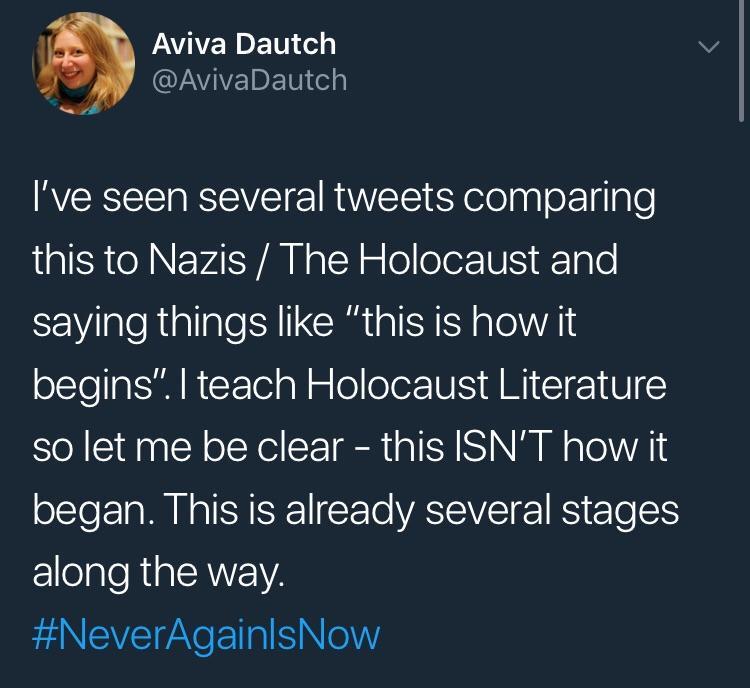
Don’t forget that the Nazis didn’t wake up one day and convince everyone Jews (and gays and Roma and and and) dying was a good thing. They dehumanized the groups they hated in stages, and rounding them up was actually not the first stage.
So I take the tweet to mean “dont think to yourself ‘we’re taking our first baby steps into fascism.’ We may indeed not be there yet, but by the time we’ve gotten to ‘rounding up innocent kids for the supposed crimes of their parents, who the government openly calls an “infestation,” and having a favored news outlet that defends this as “summer camp,”’ we’re not on the edge of a metamorphosis, were straight up in the middle of one.”
Well, yes I’d agree with that. But the grounds for a holocaust existed in Europe (and America) for decades prior to the Nazis. What happened in Germany could’ve happened anywhere under the right conditions. If just having dehumanizing sentiments means that “we’re already several steps along the way” then, sure. But we’ve been “several steps along the way” for well over a hundred years now.
I agree that this is a wake-up call that “it can happen here,” but I don’t think we’re necessarily in danger of a government sponsored genocide. It is frightening to see how easy a group of radicals at the top, coupled with apathy from the conservative elites, can do something this monstrous. However…
I think the response and backlash to this has been very encouraging. I wholeheartedly believe in cultivating a strong moral base that will draw attention to and resist these kinds of actions. We should be ready, in case we do experience a national crisis, to defend human rights. I get the idea behind the tweet, but I would still say that we’re fortunately in a far better situation to fight back against this kind of dehumanizing state policy then Germany ever was.
That’s fair. I think we’re actually saying similar things from different perspectives and agree on a good bit.
My concern is more that… the way that i usually hear the history discussed, people don’t really realize that everyone wasn’t instantly taken in by Hitlers speeches. It’s often discussed as if everyone privileged enough not to be targeted was bewitched.
And… that’s not what I gather really happened. He did bewitch crowds, but they weren’t everybody. The Nazis did not win fair elections by landslides.
Which means it’s not the sort of thing where resistance just sort of melts somehow, it’s a process over time where resistance is made to disappear.
And while I don’t think we’re seeing that now, I think it’s very important not to assume “loud resistance exists” equals “they’d never go further.”
They absolutely will, so we need to understand how serious what we’re seeing is.
One way things are different now that I think the author of that tweet is alluding to compared to how things were before is that it wasn’t just dehumanization coming from the public at large but also from people in power. Like sure in the 2000’s there were racist White kids at my high school running around saying racist things against Latino kids but it wasn’t coming from Bush and his administration. Bush won the 2004 election because he was popular among conservative Latino voters.
@ xtian atheists who come onto posts about the Holocaust all “hurr durr well why do you j00z still believe in G-d if so many of you fucking died? G-d let you die, G-d is evil and doesn’t exist, why you still worship old man with beard in the sky?”
Two things. One, you have NO understanding of how Jewish culture and Judaism works. And yes, I am calling you xtian atheists, because you are approaching the concept of religion from the model of Christianity, and are therefore poorly equipped to understand anything about Jewish text, culture, and religion. Two- you are an asshole and I hope a rat shits in your mouth while you sleep.
As my aunt says- “Ale tseyn zoln dir aroysfaln, nor eyner zol dir blaybn af tsonveytik”. May all your teeth fall out, except one to give you a toothache.
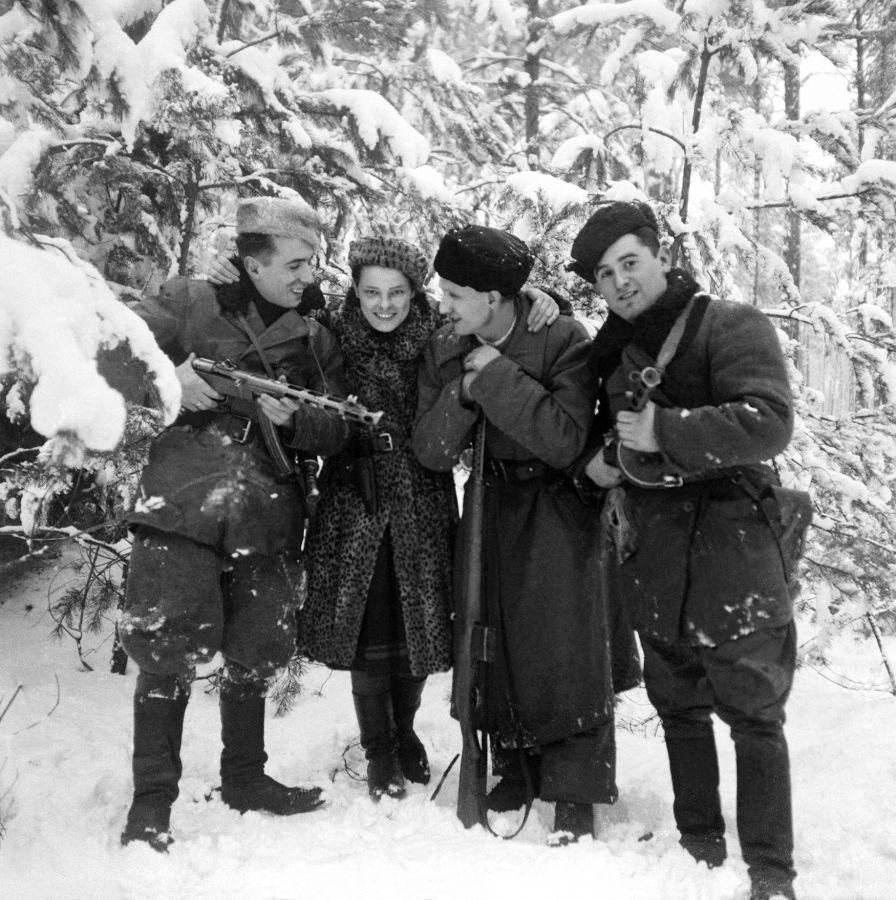
Photographer Faye Schulman reunites with three Jewish partisans from Warsaw. Schulman and the three men had thought that each other had been killed. Poland, 1943.
Born in 1925 in Lenin, Poland, Schulman grew up in a small town in what is now Belarus. In 1939, Russia and Germany divided Poland, and Lenin fell under Russian jurisdiction.
Schulman’s brother, a photographer, taught her how to take pictures, process negatives and develop prints. She worked as his assistant. She also knew a little about medicine, as her brother-in-law was a doctor.
When the Nazis invaded in 1941, they forced the town’s 1,800 Jews into a ghetto — except for six “useful Jews.” Among them: a tailor, a carpenter and a photographer.
Schulman was recruited to take pictures for the Nazis (her brother had already fled town). She would snap headshots of Nazi officials and portraits of their mistresses.
One day, she developed a photograph that was clearly a mass grave of Jews who had been killed. Peering closely at the print, she recognized her own family. She hid the negative in a box of photo paper to assure it would remain safe and unseen.
She vowed vengeance and sought justice in the forest with a group of Russians — mostly men and overwhelmingly non-Jews — she’d met up with when they raided Lenin for supplies.
She begged them to take her along. They were doubtful of her worth; what good was a woman? But she promised she could serve as a doctor’s assistant, and they accepted her into the group.
She recovered her photography equipment during a subsequent raid on Lenin.
Schulman hid her Jewish identity. During Passover, she ate only potatoes, never explaining why.
She made sure her fellow partisans remained healthy through the harshness of winter, and tended to their periodic battle wounds.
She made her own stop bath and fixer, and buried bottles of the solutions in holes in the ground, retrieving them when needed.
For two years, she lived in the forest and documented life there. She would make “sun prints” by putting the negative next to photographic paper and holding it toward the sun. She’d then give them to fellow resistance fighters.
“They treasured their pictures and respected me for it,” she said.
She married after the war. She and her husband, Morris, could take very little with them to the displaced persons camp in Germany. Though she had very few belongings after two years in the forest, Schulman possessed many, many photos and negatives. She selected only her favorite prints and negatives to take with her to the DP camp, where she spent three years. She brought those with her to Canada.
In the [“Pictures of Resistance: The Photography of Jewish Partisan Faye Schulman”] exhibit, each photo is paired with a lengthy explanation of the image. The text is in Schulman’s own words, recorded during an interview Braff conducted with her in her Toronto home in 2005.
She also wrote a book chronicling her story. “A Partisan’s Memoir: Woman of the Holocaust” was published in 1995.
“I want people to know there was resistance,” Faye said during that interview, the text of which is displayed with the photo exhibit.
“Jewish people didn’t go like sheep to the slaughter … I was a photographer. I have pictures. I have proof.” (via jweekly)
jews try and explain how intergenerational trauma works and functions in our families + communities and white gentiles r still like “so you get intergenerational trauma when anything bad has previously happened to any group of people like you??”
like i don’t know how to get y’all to stop wrapping your head around how these kinds of numbers affect a marginalized group:
a third of all Jews on the FACE OF THE EARTH died within a few years
like there’s just such a comprehensive failure to understand or empathize with what exactly that means. how many communities were destroyed, how many families were destroyed, how our languages were destroyed because most of the speakers were murdered, how many children grew up in the wake of this trauma, what it’s like to try and parent in the aftermath of a genocide that kills a third of your people (two thirds of all european Jews!), what it’s like to have the spectre of this hung over your head every single day from childhood
There’s this complete disconnect that a lot of non-Jewish gadje have about exactly what the Samudaripen (Holocaust) DID to our two populations. Like, there are entire subgroups that just don’t exist anymore… Seeing these numbers makes my heart hurt.




 Rush's tumblr archive