This is from my understanding as a layperson (not a rabbi or a mental health professional) based on knowing people. For context, it was inspired by this lovely post that all y’all should read if you are or know someone healing from trauma. Feel free to add to or critique what I say here.
1.) Memory is painful:
This is a season of remembrance and reflection, and for folks who have experienced a trauma, memory can be painful. Thinking about the past or even just being exposed to a tiny trigger of a situation (i.e. scent of an abuser’s cologne) can set an anxiety attack or flashback into motion.
2.) Feelings of guilt over the trauma:
A lot of folks who’ve experienced trauma, especially interpersonal (i.e. rape, abusive relationship) get blamed for the event(s) even though it wasn’t their fault. When we talk about taking responsibility for our actions in this season, it can be tough for this lingering doubt of responsibility not to resurface.
3.) What doesn’t kill you doesn’t make you stronger:
The effects of trauma can stop someone from being the person they’d like to be. Maybe they have become emotionally distant so they can’t be as supportive of friends and loved ones as they’d like to be. Or perhaps they’ve become more snappy, or lash out at others when they’re upset. In that case, they do need to work on these issues, but it’s more complex of a process than conversations about teshuva typically acknowledge.
Because pain from the trauma is the cause of their chet (sin/misstep), healing from the trauma and finding healthier ways to cope are what will make them a better person, not blood, sweat and tears of trying to forge through and just “be better.” Their teshuva must include patience and come from a place of self-compassion over self-blame. This perspective can be beneficial for everyone but is especially necessary in their cases.
Resources for those who have experienced trauma and for understanding your loved one who’s experienced trauma:
- Basics of trauma and PTSD (My Jewish Learning)
- Advice for people with trauma or PTSD; Advice for how to help a loved one with trauma or PTSD (My Jewish Learning)
- Reform Perspective on Mental Illness and Yom Kippur
(Coffee Shop Rabbi)
Also see her Teshuva 101- Chabad/Orthodox: A Torah Approach to Anxiety (Chabad’s The Jewish Woman)
this. i actually had a really hard time at the tisha b’av service, during the book of lamentations, even though its not about personal suffering, its hard to read through this big slog of trauma and pain and torture and not think about the times you were tortured personally ykwim. sometimes the themes can suck and be hard. yom kippur is coming up, that shit is f u k k i n hard. its ok. ur all gr8. everyones gr8. good boops. that is all.
Tag: judaism tag
When a poor man asks you for aid, do not use his faults as an excuse for not helping him. For then God will look for your offenses, and He is sure to find many.
Rabbi Shmelke of Nikolsberg
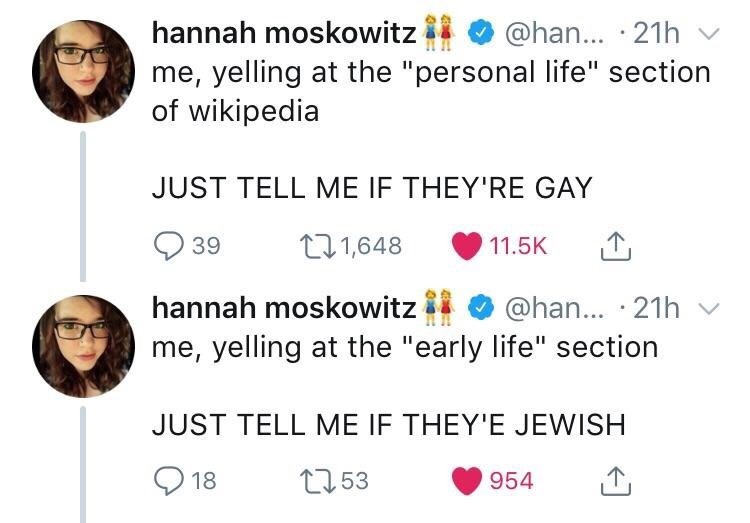
you want my hot take for the evening? people who dont like complainers just havent been exposed to good complaining, and will never know if they themselves have an inborn talent for the art of kvetching
good complaining is some combination of a) funny, b) animated and theatrical, c) insightful re: human foibles, d) inquiry into social trends and norms.it must ALWAYS involve at least a small degree of self awareness, and is often used to build camaraderie and maintain relationships.
source: im jewish
During The AIDS Crisis, This Gay Jewish Cookbook Kept A Community Together
But the cookbook was Susan Unger’s brainchild. “I was a young adult living in San Francisco in the 80’s, and the HIV epidemic was really coming at us full force and I wanted to do something….Had the AIDs crisis not been going on, I’m not sure I would have thought of the idea,” Unger said.
From start to finish, the project took about 12-18 months. The process involved queer members reaching out to the families they had been alienated from, for traditional family recipes to fill the cookbook. “The project provided a way for young people to reach out to their parents and grandparents,” Unger told me.
The Sha’ar Zahav congregation wanted to do more than just brunches. “The cookbook gave us a sense we were doing something,” said Ogus. Three dollars from every purchase of the cookbook went to the Food Bank of the San Francisco AIDs Foundation. A total of $13,000 went to the San Francisco Food Bank (about 51,607.28 in today’s dollars).
I have a copy of this cookbook.
During The AIDS Crisis, This Gay Jewish Cookbook Kept A Community Together

I hate it when white women like to act like they’re not white when they claim to be Jewish. Ummm, you’re white, and being Jewish doesn’t hide your white privilege, it actually makes you more privilege. Being Jewish doesn’t make you a Women of Colour when most Jews are BEYOND white passing.
Jews in the United States and Europe are FAR overrepresented in banking, the media, the justice system, government, ect. Jews also played a huge role in the slave trade where most of the slave ships were Jewish owned. If anything being Jewish is a privilege which has historically and still is favoring their own and benefiting off the struggles of People of Colour which has aided white supremacy. If you’re jewish and want to aid people of colour in their struggles and rape, check your privilege and call out people you know for their racism, sexism, misogyny, ect.Sit. Your. Sorry. Ass. Down.
As a blonde, blue-eyed Jew with an Anglo last name living in metropolitan America I have undeniable white passing/white privilege. But my Jewish friends with dark curly hair, “swarthy” skin, and “Semitic” noses? My friends with last names like Weber and Katz and Rosen? They don’t pass in America, let alone in Europe (and I feel 100% confident in stating that you know jack-all about how Europeans view race, but spoiler alert: Jews definitely don’t make the white people shortlist there, light skinned or not). Ever notice how white supremacist groups always include Jews on their list of “enemies of the white race?” Or how the place where Jews are really overrepresented is in hate crime victim statistics? Millennia of rape and forced assimilation in diaspora may have lightened some of our skins (fun fact: many Jews, including many Ashkenazim, are people of color), but neither we nor white Gentiles have forgotten that our ethnicity and culture stem from the Levant.
It is absolutely mindblowing that you are using antisemitic falsehoods to deny that antisemitism exists. Far from controlling the slave trade, Jews were in fact barred by law from even entering many of the countries involved in the trade and were barred from or limited in engaging in international trade venues by several others. That is a canard heavily promoted in the black community by black antisemitic groups in the 90s, and has been utterly discredited by historians. And you’re going to pull out that antisemitic “Jews control the media, banks, and government!!!!!11!” bullshit, too? Really? Put down the Protocols of the Elders of Zion and read up on the “model minority” myth–and while you’re at it, take a look at how well financial success has shielded Jews from marginalization and violence in the past.
Were Jews often used post-Civil War as racial go-betweens and tools of white oppression against the black community? Yes, and it’s fucking shameful…but when those Jewish minstrel performers, shop owners, and slumlords went home in the evenings, it was to Jewish-only communities. Not because we chose to live there, but because white Gentiles didn’t accept us in their neighborhoods. We were “white” enough to do the jobs white people didn’t want to dirty their hands with, but not white enough to live with or go to social clubs with, God forbid. The entire reason colleges began requiring interviews and essays from admission applicants was to limit the number of Jews on campus, because we’re just so fucking privileged to be Jewish. The U.S. sent Jewish asylum-seekers and refugees fleeing the Holocaust back to Europe and refused to lift the immigration quota on Jews during WWII because it didn’t want any more white people.
Whiteness/white-passingness is a privilege (and yes, we Jews who have it need to be conscious of it). But Jewishness is NOT A PRIVILEGE, least of all “historically.” We look out for “our own” because Gentiles–white or otherwise–sure as fuck won’t.
Kiss my diasporic ass.
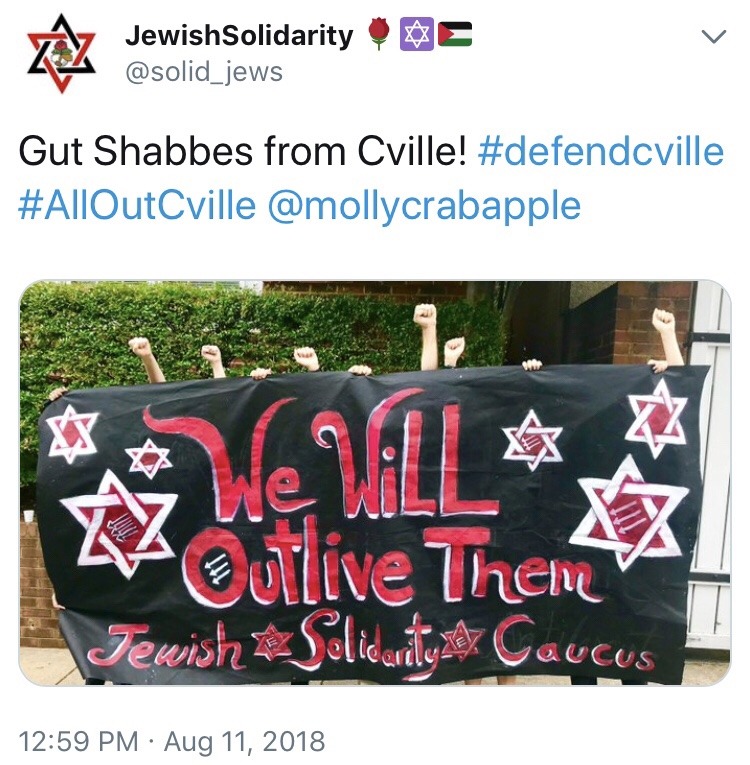
Photo of JSC members taken across from the synagogue that was intimidated by fascists carrying assault rifles last year
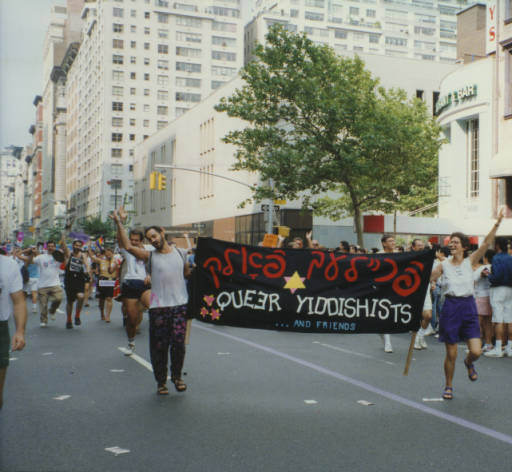
Johnny Abush, the creator and curator of the first LGBT+ Jewish archive, leads Queer Yiddishists at a pride parade circa. early 1990s.
Abush died of AIDs on November 26, 2000/Cheshvan 28, 5761, may his memory be a blessing.
Our community is strengthened when we fully support and integrate patrilineal Jews.
I’m Not Okay with Felicity Jones Playing Ruth Bader Ginsburg in Her New Biopic
…Imagine my reaction when I opened up the trailer for On the Basis of Sex last week and saw Felicity Jones grace the screen. British Felicity Jones, with her fine features and her awkward American accent, beautiful, perfectly manicured, and erasing any trace of Ginsburg’s roots.
…But I think what hurts more about watching Jones portray the first female, Jewish Supreme Court Justice is how little they physically look alike. Justice Ginsburg has strong, identifiably Ashkenazi Jewish features. She looks Jewish. Missing from Felicity Jones is any trace of RBG’s large Jewish nose. In its place is a delicate, slightly upturned nose. One that conforms more closely with White Western Christian standards of beauty. Frankly, the absence of RBG’s schnoz is bumming me out.
…This issue is more than skin deep. Judaism is a huge part of Justice Ginsburg’s identity now, but it also provides another dimension to her early career. While it’s definitely true that when RBG went to law school, it was uncommon for women to attend, and when she challenged legal precedent she was a young woman disrupting what has historically been a boys’ club, it was also unusual to be a Jew in these contexts at the time.
When Ruth Bader Ginsburg entered law school, many top universities still had “Jewish quotas.” Not many Jews were practicing law, and not many historically had done so. So it was not just that she was a woman disrupting these norms and defying conventions in the legal field, she was a Jewish woman in a professional field that did not have many Jews or women. She was a double anomaly. She is doubly impressive.
And yet, any trace of her Jewish identity — from her accent to her face — is erased in the casting of Felicity Jones in the role. This should be pissing people off. Prosthetic makeup is used all the time to transform actors into their roles in biopics. Prosthetics were used to make Nicole Kidman into Virginia Woolf in The Hours and Meryl Streep into Margaret Thatcher in The Iron Lady. So why is it missing here? Why are we allowing a key component of this icon’s identity to be erased? Why do we need a young Ruth Bader Ginsburg — who, it should be noted, was a total babe but really that’s beside the point — to be conventionally beautiful?
The way I see it, this is really problematic for two reasons. First of all, the irony of altering the appearance of a historic figure in order to make her more conventionally attractive in a movie about her combating sexual discrimination is almost too rich to put into words.
Second of all, representation is important.
…Ruth Bader Ginsburg grew up with identifiably Ashkenazi Jewish features at a time when it was not easy being Jewish in her professional field or in society in general. When RBG’s character is robbed of these features, the story loses something. We all lose something. Something important and integral to Ginsburg’s, and America’s, struggle.
And beyond the story, we lose something else. As a girl growing up with a big Jewish nose, I hated my nose because I thought that was what I was supposed to do. I thought my nose was actually incompatible with delicate femininity. How wonderful it would have been to have more examples of that in popular media, to know that it could be otherwise. And how wonderful it would be now to see the story of a young Ruth Bader Ginsburg: hard-headed, trail-blazing, beautiful, and Jewish.
Read Anna Miriam’s full piece at Alma.
I’m Not Okay with Felicity Jones Playing Ruth Bader Ginsburg in Her New Biopic
 Rush's tumblr archive