Earliest known biography of an African woman translated to English for the first time

rejectedprincesses:

angryafricangirlsunited:

The earliest known book-length biography of an African woman, a 17th-century text detailing the life of the Ethiopian saint Walatta Petros, has been translated into English for the first time.

Walatta Petros was an Ethiopian religious leader who lived from 1592 to 1642. A noblewoman, she left her husband to lead the struggle against the Jesuits’ mission to convert Ethiopian Christians to Roman Catholicism. It was for this that the Ethiopian Orthodox Täwaḥədo Church elevated her to sainthood.

Walatta Petros’s story was written by her disciples in the Gəˁəz language in 1672, after her death. Translator and editor Wendy Laura Belcher, an associate professor at Princeton University, came across the biography while she was studying Samuel Johnson’s translation, A Voyage to Abyssinia. “I saw that Johnson was fascinated by the powerful noble Ethiopian women in the text,” said Belcher. “I was speaking with an Ethiopian priest about this admiration and he told me that the women were admired in Ethiopia as well, where some of them had become saints in the Ethiopian church and had had hagiographies written about them.”

Ten years later, Belcher still remembers how “thrilling” this revelation was. “What? Biographies of powerful African women written by Africans in an African language? And to be able to pair European and African texts about the same encounter? I knew then I wouldn’t rest until I had translated this priceless work into English.”

Belcher learned Gəˁəz in order to translate Walatta Petros’s biography, working first with the Ethiopian priest, and then with the translator Michael Kleiner. “As a biography, it is full of human interest, being an extraordinary account of early modern African women’s lives — full of vivid dialogue, heartbreak, and triumph. For many, it will be the first time they can learn about a pre-colonial African woman on her own terms,” she said.

The biography has now been published in English by Princeton University Press as The Life and Struggles of Our Mother Walatta Petros. It has only been translated into two other languages before: Amharic and Italian, the latter in the 1970s.

While researching the text, Belcher discovered that the biography contained the earliest known depiction of same-sex desire among women in sub-Saharan Africa, an element she said was “censored” from the manuscript that the 1970s Italian edition was based on.

Belcher writes in the book’s preface that while she and Kleiner were translating the story from the Italian edition, they came across a “perplexing anecdote about a number of community members dying because some nuns had pushed each other around”. Kleiner suspected the manuscript had “been miscopied, perhaps deliberately, in order to censor the original, or merely by accident”, and speculated that “the nuns were not fighting but flirting with each other”.

After consulting with several Ethiopian scholars and looking at digitised copies of the original manuscripts, Kleiner and Belcher found the uncensored manuscript concurred. They translated the line as Petros seeing “some young nuns pressing against each other and being lustful with each other, each with a female companion.”

“This is the earliest anecdote we know of in which African women express desire for other women,” writes Belcher.

The academic also pointed to Walatta Petros’s relationship with her fellow nun Eheta Kristos, describing their first encounter with each other as “rapturous”. The text says that “love was infused into both their hearts, love for one another, and… they were like people who had known each other” their whole lives. Walatta Petros and Kristos “lived together in mutual love, like soul and body. From that day onward the two did not separate, neither in times of tribulation and persecution, nor in those of tranquillity, but only in death”.

“There is no doubt that the two women were involved in a lifelong partnership of deep, romantic friendship,” Belcher writes.

Identifying them as lesbians would be “anachronistic” partly because Walatta Petros was “deeply committed to celibacy”, she told the Guardian.

“Many Ethiopians are quite upset about my comments about the saint, my interpretations of her relationship with Eheta Kristos,” she said. “Part of this upset is due to not understanding my point. I think she was a sincere, celibate nun, but that she also felt desire for other women and that she was in a life-long celibate partnership with Eheta Kristos.”

I just kept smiling wider and wider the more I read.

Earliest known biography of an African woman translated to English for the first time
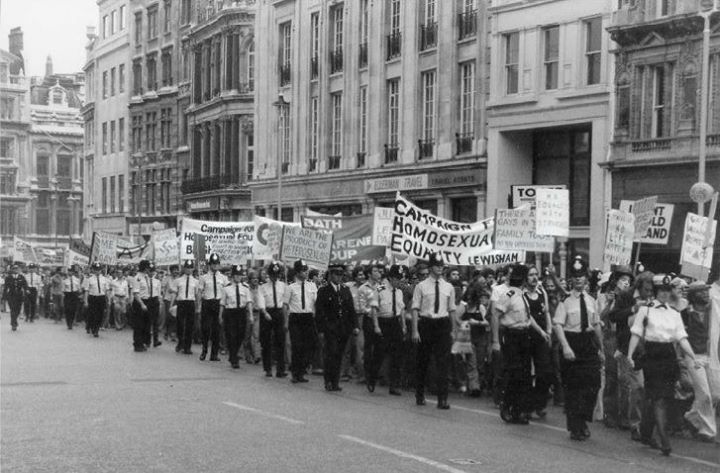
workingclasshistory:

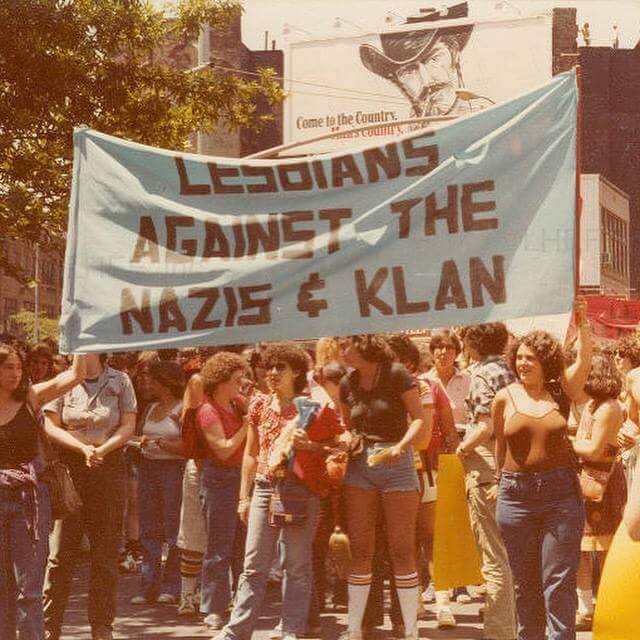
On this day, 1 July 1972, 700 people joined the first ever Gay Pride march in the UK, in London. This is a short history of gay activism in the UK at the time: https://ift.tt/1eqH4CN
Follow us on Tumblr for more of our updates: https://ift.tt/2Gj7zLP https://ift.tt/2Kp1Nif

wodneswynn:

Let’s spend today remembering Lou Sullivan, gay trans man, author, and political activist, the stone-cold sumbitch responsible for getting heterosexuality removed as a requirement for medical transition.  After testing positive for HIV, he wrote in his diary, “I took a certain pleasure in informing
the gender clinic that even though their program told me I could not
live as a gay man, it looks like I’m going to die like one.”

a friend and boy
June 16, 1951 – March 2, 1991

JUNE 18: Sally Ride goes to space (1983)

365daysoflesbians:

On June 18, 1983, the orbiter space shuttle Challenger was launched from the Kennedy Space Center in Titusville, Florida. Among its five-person crew was
Sally Ride, a physicist, astronaut, and the very first American woman in space.

Dr. Ride sits in the aft flight deck mission specialist’s seat during deorbit preparations (x). 

Sally was born in Los Angeles, California on May 26, 1951.
She was an eclectic student at her private high school, Westlake School for
Girls; she excelled in both science and English and was also a
nationally-ranked tennis player. She graduated from Stanford University with a
bachelor’s degree and then stayed on to receive her master’s and PhD in
Physics. It was while she was a student at Stanford when Sally first came
upon the newspaper ad that would change her life. In 1977, NASA published an ad in the
Stanford student newspaper seeking women interested in becoming astronauts.
Over 8,000 women applied, but only six were chosen and Sally was one of them.

In 2015, Sally’s partner Tam O’Shaughnessy published a photobiography of Sally’s life which included never-before-photos of her childhood (x). 

After being accepted by NASA, she worked for over two years
as a ground-based capsule communicator and specialized in developing the
program’s “Canadarm” robot arm. The greater public was only introduced to Sally Ride when it was announced that she would be joining the Challenger team. Sally was
subject to an unforgettable amount of misogyny by the media, with journalists
asking her now infamous questions like “"Will the flight affect your
reproductive organs?“ and “Do you weep when things go wrong on the
job?” but through it all, she stayed resilient and never let the frenzy of
attention affect her. On the 1983 space mission, Sally operated the crew’s
robotic arm and managed the communication satellites. She would partake in
another mission aboard Challenger in
1984 before retiring from NASA in 1987.

Ride (left) with partner O’Shaughnessy and their dog Gypsy, 1985 (x).

Despite the public clamoring for information and personal
details about this new feminist icon, Sally was notoriously silent about her
private life. It was only after her death on July 23, 2012 that it was revealed
that she was a lesbian and had been together with her partner, Tam
O’Shaughnessy, for over 27 years. For years after Sally left NASA, she and Tam
co-wrote children’s science books and operated the Board of Sally Ride Science
together, which focused on encouraging young girls in STEM fields. Today, Sally
is considered to be not only the first American woman astronaut, but also the
very first LGBT person to ever go into space.

-LC

asgorialanile:

canmom:

trancer21:

ratherembarrassing:

blitzfrau:

Hey since TERFs buried the original, higher quality recording, here’s the only surviving recording of trans activist Sylvia Rivera’s infamous “Y’all Better Quiet Down” speech, along with full transcription, now free and open on Archive.org. The transphobic fucks can try their best to scrub us from history, but we’re not going anywhere.

and if you can, go and see The Death and Life of Marsha P Johnson, which includes this footage as part of a fuller segment on Sylvia Rivera’s life right up until her death. what an amazing person who the world was not ready for.

(Transcription follows🙂
Sylvia Rivera: I may be—

Crowd: [booing]

Sylvia Rivera: Y’all better quiet down. I’ve been trying to get up here all day for your gay brothers and your gay sisters in jail that write me every motherfucking week and ask for your help and you all don’t do a goddamn thing for them.

Have you ever been beaten up and raped and jailed? Now think about it. They’ve been beaten up and raped after they’ve had to spend much of their money in jail to get their [inaudible], and try to get their sex changes. The women have tried to fight for their sex changes or to become women. On the women’s liberation and they write ‘STAR,’ not to the women’s groups, they do not write women, they do not write men, they write ‘STAR’ because we’re trying to do something for them.

I have been to jail. I have been raped. And beaten. Many times! By men, heterosexual men that do not belong in the homosexual shelter. But, do you do anything for me? No. You tell me to go and hide my tail between my legs. I will not put up with this shit. I have been beaten. I have had my nose broken. I have been thrown in jail. I have lost my job. I have lost my apartment for gay liberation and you all treat me this way? What the fuck’s wrong with you all? Think about that!

I do not believe in a revolution, but you all do. I believe in the gay power. I believe in us getting our rights, or else I would not be out there fighting for our rights. That’s all I wanted to say to you people. If you all want to know about the people in jail and do not forget Bambi L’amour, and Dora Mark, Kenny Metzner, and other gay people in jail, come and see the people at Star House on Twelfth Street on 640 East Twelfth Street between B and C apartment 14.

The people are trying to do something for all of us, and not men and women that belong to a white middle class white club. And that’s what you all belong to!

REVOLUTION NOW! Gimme a ‘G’! Gimme an ‘A’! Gimme a ‘Y’! Gimme a ‘P’! Gimme an ‘O’! Gimme a ‘W’! Gimme an ‘E! Gimme an ‘R’! [crying] Gay power! Louder! GAY POWER!

There’s some really important commentary on this event by several trans women on the previous upload of the video. I’m going to quote it here so it’s not lost; unfortunately the original commenters have deleted their blogs or gone private so I can’t provide full attribution.

lilacbootlaces said:

[[Trigger warning: suicide]]

Sylvia went home that night and attempted suicide.

Marsha Johnson came home and found her in time to save her life.

Sylvia left the movement after that day and didn’t come back for twenty years.

@ourcatastrophe said:

this is incredible, she is incredible, I highly recommend watching it

but I think the addendum re: the effect of this day on sylvia is really important

so often we valorise decontextualised moments of tough, articulate resistance and rage

and
the suffering of the people who embodied them is not acknowledged, it’s
uncomfortable, it’s not inspiring, we want them to stay tough and cool
and stylish forever

which is particularly terrible when I think about how sylvia felt like that because of women like me — women who are now watching this video and feeling inspired and impressed
and maybe a bit pleased with ourselves for finally having watched a
speech by the famous and really cool to name-drop sylvia rivera

girl-assassin said:

rebloggin for the true as fuck commentary (bolding mine)

n
like, on one hand this moment is decontextualized as fuck, but on the
other hand a lot of ppl try to hyper-contextualize it to make it
“history” and a very specific historical moment, so we (cis women) can
be like “oh so sad that’s how it was in the 1970s, radfems were so
awful, but it was only the whole second-wave scene that was the problem,
glad that’s over.”

Like have we forgotten the fact that Sylvia
only died in 2002? And she died young, if she were still alive she
wouldn’t even be 65 yet. I know hella older ppl in NYC who knew her
personally, and hella “leaders” of the NYC queer scene pulled horrific
shit on her constantly in the 80s, 90s, and 2000s, like literally
until the day she died (ppl from Empire State Pride agenda literally
went to St. Vincents to beef with her on her death bed) Where are the
video tapes/memorializing of that shit?

N now the Manhattan LGBT
center on 13th st has a room dedicated to her memory, despite the fact
that very center permanently banned her in 1995 for daring to suggest
they should let homeless QTPOC sleep there in sub-zero weather.

N
now there’s a whole homeless trans youth shelter on 36th st named after
her, Sylvia’s Place, that kicked my TWOC friend out on the streets for
testing positive for marijuana; failing to recognize how fucked up that
is in a shelter named after a woman who struggled with addiction all her
life, and was very vocal about the relationship between drug use and
the stress of living under constant threats of violence.

N from
the late 90s onward rich gays and lesbians openly fought against Sylvia
to try to shut down 24/7 access to the piers that she n hella other
QTPOC cruised and lived on bc they were bringing down the property
values of their multi-million west village apartments.

N like 90%
of the individual people who perpetuated fucked up violence against
Sylvia are still alive and high-profile leaders in the NYC LGBT
“community” today.

So like yes, good, remember the oppressive
weight of our history of transmisogyny…but also remember that this shit
specifically ain’t even history, it’s the current reality of the NYC
queer/trans hierarchy today—like not even figuratively, literally the same people
who pulled shit like this on Sylvia are still alive n well n all over
NYC cutting the ribbons to the newest Sylvia Rivera memorial n
eulogizing her like they never tried to fucking kill her themselves.

Sorry for constantly reblogging this but here’s some more info?

cuntybisexual:

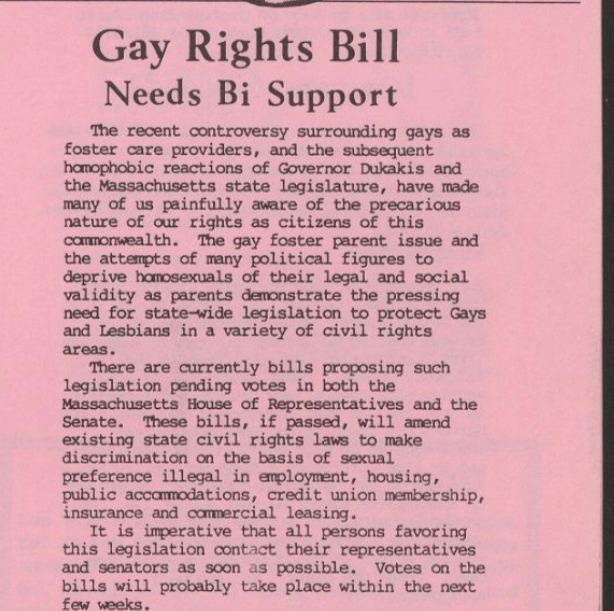
An interview with Martina Navratilova, a famous Czech-American professional tennis player who came out as bisexual in 1981, published in the 1986 issue of Bi Women: the Newsletter of the Boston Bisexual Women’s Network. 

Fun fact: Martina has a wife whose name is Julia Lemigova – they got married in 2014. 

PDA at Pride

apparentlyeverything:

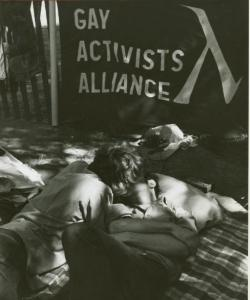
There’s a lot of discussion right now about whether “PDA” is appropriate at Pride events, so here’s a reminder that the very first Pride event in 1970 (called the Christopher Street Liberation Day Parade) featured a “Gay-In” with same-sex couples showing public affection for each other:  

image

“Gay-in” in Central Park during the 1st Christopher St Liberation Day Parade in NYC, 1970

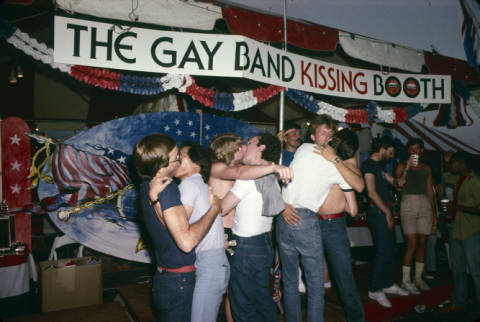
Similar events were held at other Prides in the 70s and 80s. In this period, displays of same-sex affection were especially encouraged, and some even featured gay “kissing booths”:

image

Three couples take advantage of the Gay Band Kissing Booth at the Los Angeles Christopher Street West Pride Parade, in 1982 

This was not casual, it was an intentional choice meant to send a specific political message that LGBT people would no longer stay hidden. People who say that PDA grosses them out no matter who does it are missing the point entirely. Public displays of affection among LGBT people within the context of Pride are part of its historical political message and significance. Refusing to  engage with and understand that context is inherently reactionary.