Khaled’s misogyny aside for a second but who doesn’t like eating pussy jfc
My husband said Russian men think it’s gay
Yknow what
eating pussy…is gay….
Fellas is it gay to have sex with a woman?
In the normies’ dialect, “gay” doesn’t quite mean “homosexual” – it’s more along the lines of “homosexual and/or effeminate”. Thus, for example, boy bands like One Direction are often seen as “gay” regardless of the members’ sexual orientation and despite them having a huge number of female fans: one of their major selling factors is attractiveness, and selling things with one’s appearance is a “woman’s job”, which makes a man doing it seen as effeminate or “gay”. Likewise, the only “masculine” way to have sex is to be penetrating a woman with one’s penis. Even penetrative fingering (not to mention non-pentrative clitoral stimulation) is looked down upon because it doesn’t involve a penis, but it would probably pass as an acceptable form of “foreplay” (well, other than the part where a lot of these men are also massively disgusted by vulvae, and only want to touch them with their penises) – the only “real” kind of sex is vaginal or anal penetration. Cunnilingus violates this standard of masculinity in several ways: it doesn’t involve a penis; it involves putting one’s mouth on another person’s genitals, which, fellatio being the central example of oral sex for these people, is also seen as a “woman’s job”; it involves applying effort and possibly tolerating mild physical discomfort for the sake of the partner’s pleasure, which is also a “woman’s job”. Thus, giving cunnilingus is seen as effeminate, and thus “gay”.
Y’all need to keep in mind that garden variety conservative dudebros don’t run on the same ontology as tumblr does. You may see gender identity, gender presentation, gender roles, and sexual orientation as entirely separate things, but for them these are all intertwined. Homophobia, transphobia, and sexism aren’t separate axes of prejudice that often happen to coincide (I mean, they can be; I’m talking about the specific world view that also produces things like “cunnilingus is gay”); they’re stemming from a very specific understanding what men and women are and what they should do. Redrawing categories such that gender and sexuality are separate things is a rather novel approach; even queer communities started really treating them as separate only in late 20th century, and the mainstream is far from being there – especially in less progressive countries. Quick reminder: Stonewall riots technically started over gender presentation rather than sexual orientation – it’s hard to apply sodomy laws when you don’t actually catch people having sex, but very easy to apply the laws that say that men must dress like men and women must dress like women, which what the police was checking: https://en.wikipedia.org/wiki/Stonewall_riots#Police_raid. But at the time, the boundaries between gay identity, drag queen identity, and transgender identity were very blurred.
Which is also why the compartmentalization of activism is really really bad, as is “don’t you dare to say that you’re experiencing X-phobia if you’re not X”. We can’t fight a unified force by pretending that entirely different forces are striking entirely different people. “Giving cunnilingus is gay, and therefore I won’t do it and will bully everyone who does” has the undertones of homophobia (”gays are bad, bully them”), misogyny (”giving oral sex is dishonorable, and therefore only women can do that because they’re second class citizens who have no honor to begin with”), transphobia and gender policing (”the shape of genitals you’re born with determines what you can and cannot do in life; incidentally, having been born with a penis means that you can’t give oral sex”). But even considering all these categories separately doesn’t really get us to the core of the issue that “gay” and “effeminate” are inseparable categories for these people.
Also this misogynist idea isn’t endemic to Russia, I’ve seen similar shitty attitudes in plenty of guys from the USA, and the notes on this post are full if people pointing out that this attitude is common in other countries, toi
I’ll add that it’s very noticeable that a significant swath of people ostensibly defending her feel the need to qualify it with how much they dislike Rose. Saying ‘don’t throw racist misogynistic abuse at the actress of a character you hate’ is … clearing the lowest possible bar. Apparently, it’s so difficult to simply denounce widespread racist misogyny without tacking on their seething hatred of a character her actress did not write.
terfs: drawin nasty caricatures of trans women with broad shoulders and face stubble and body hair to show how “masculine” they really are and therefore not “real women”
my cis female vagaina’d-havin never-taken-testosterone-in-my-life ass:
if your focus is on having more women in computer science, you’ll find yourself surprised in 20 years when programmers have the salary, working conditions, and prestige of secretaries. the whole prestige of comp sci is that it has few women.
we’re seeing this process also in hospitals: as there are more and more men who are becoming nurses, the salaries and powers of nurses are increasing; medicine itself is being associated with women, and so people are now questioning their high salaries. same thing happened with lawyers and computer scientists and school teachers and so on.
oh no this post has gotten around to terf tumblr, too bad op’s a trans woman, fuckers
“Plenty of gay guys in HS get bullied, play video games, & get rejected for dates. And yet we don’t hear about them going on killing sprees after getting turned down by a boy they like.
This is about misogyny & a society that tells men they are entitled to women’s bodies.”
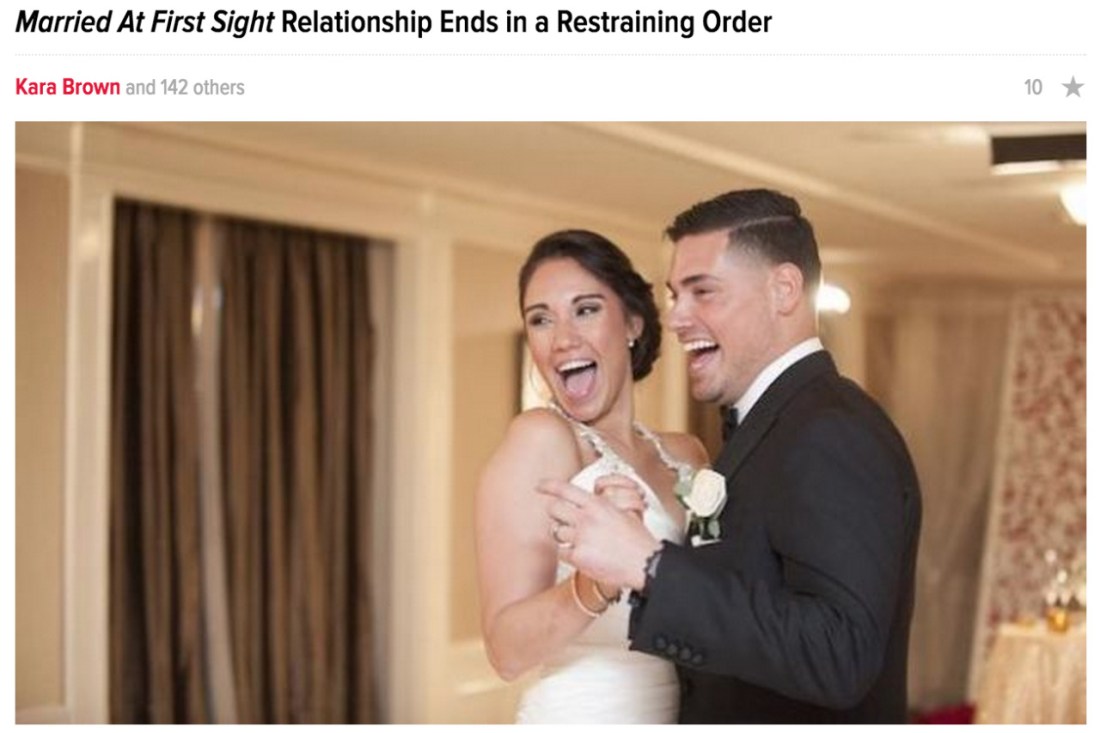
The studio didn’t background check the guy, he had a history of domestic violence, abuse, and stalking.
When editing the episodes for air they found bits of audio picked up by his mic of him telling the girl that if she said anything to the producers he’d kill her and her family
honestly who even thought this show was a good idea to begin with
how could a show where the woman is under intense pressure to Make Things Work and Not Make A Fuss because if she does she’ll be torn apart by viewers possibly attract predatory men??? really makes you think!
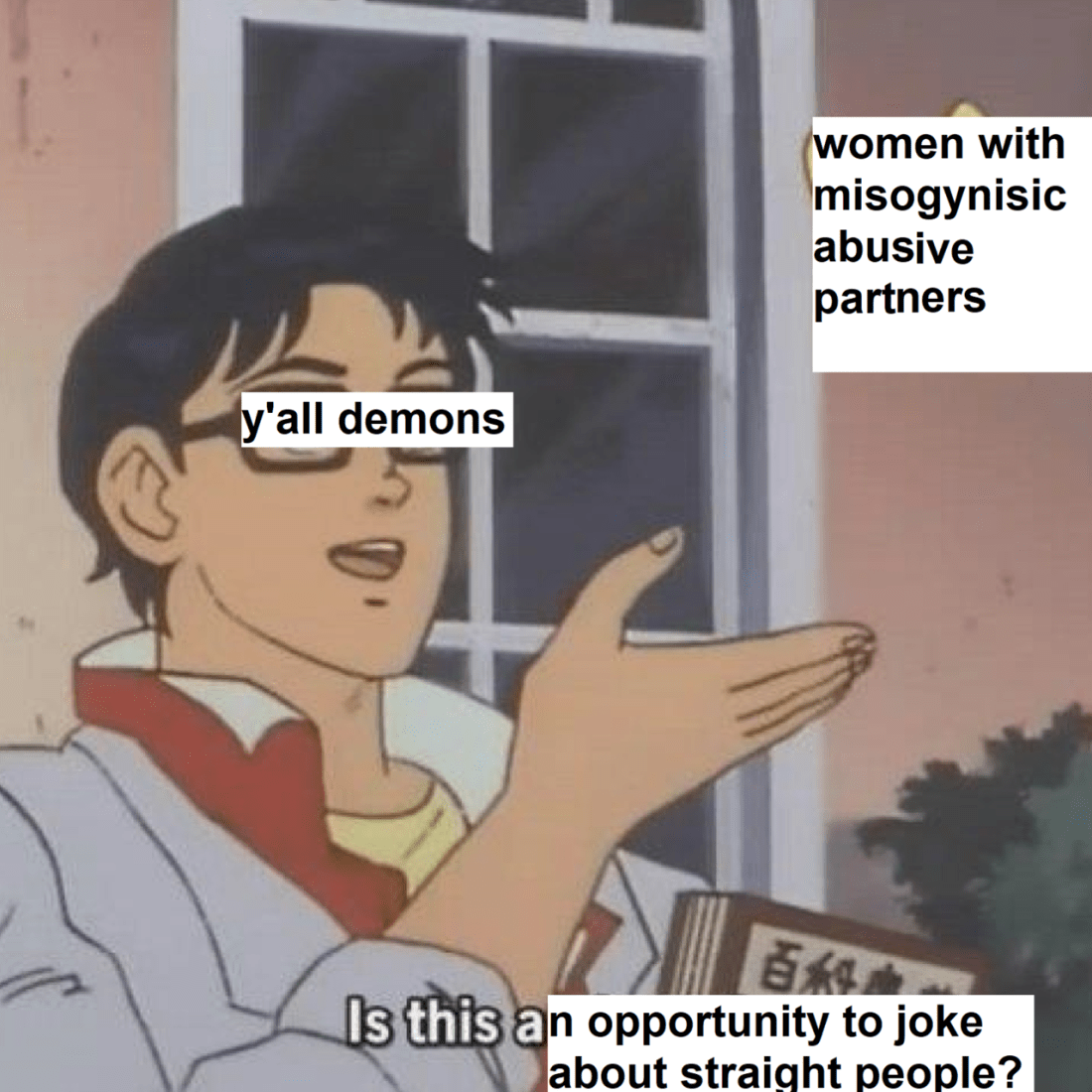
I’m all for making jokes about The Straights™ but I’m getting kind of tired of posts that go:
I like the reference to Kate Manne’s Down Girl: The Logic of Misogyny:
But “Virtuous Violence: Hurting and Killing to Create, Sustain, End, and Honor Social Relationships” (Cambridge), by the anthropologist Alan Fiske and the psychologist Tage Rai, argues that these standard accounts often have it backward. In many instances, violence is neither a cold-blooded solution to a problem nor a failure of inhibition; most of all, it doesn’t entail a blindness to moral considerations. On the contrary, morality is often a motivating force: “People are impelled to violence when they feel that to regulate certain social relationships, imposing suffering or death is necessary, natural, legitimate, desirable, condoned, admired, and ethically gratifying.” Obvious examples include suicide bombings, honor killings, and the torture of prisoners during war, but Fiske and Rai extend the list to gang fights and violence toward intimate partners. For Fiske and Rai, actions like these often reflect the desire to do the right thing, to exact just vengeance, or to teach someone a lesson. There’s a profound continuity between such acts and the punishments that—in the name of requital, deterrence, or discipline—the criminal-justice system lawfully imposes. Moral violence, whether reflected in legal sanctions, the killing of enemy soldiers in war, or punishing someone for an ethical transgression, is motivated by the recognition that its victim is a moral agent, someone fully human.
In the fiercely argued and timely study “Down Girl: The Logic of Misogyny” (Oxford), the philosopher Kate Manne makes a consonant argument about sexual violence. “The idea of rapists as monsters exonerates by caricature,” she writes, urging us to recognize “the banality of misogyny,” the disturbing possibility that “people may know full well that those they treat in brutally degrading and inhuman ways are fellow human beings, underneath a more or less thin veneer of false consciousness.”
Manne is arguing against a weighty and well-established school of thought. Catharine A. MacKinnon has posed the question: “When will women be human?” Rae Langton has explored the idea of sexual solipsism, a doubt that women’s minds exist. And countless theorists talk about “objectification,” the tendency to deny women’s autonomy and subjecthood, and to scant their experiences. Like Fiske and Rai, Manne sees a larger truth in the opposite tendency. In misogyny, she argues, “often, it’s not a sense of women’s humanity that is lacking. Her humanity is precisely the problem.”
Men, she proposes, have come to expect certain things from women—attention, admiration, sympathy, solace, and, of course, sex and love. Misogyny is the mind-set that polices and enforces these goals; it’s the “law enforcement branch” of the patriarchy. The most obvious example of this attitude is the punishing of “bad women,” where being bad means failing to give men what they want. But misogyny also involves rewarding women who do conform, and sympathizing with men (Manne calls this “himpathy”) who have done awful things to women.
As a case study of misogyny, Manne considers strangulation—almost always performed by men on female intimate partners—which she describes as “a demonstration of authority and domination,” a form of torture that often leaves no marks. Other forms of expressive violence are very much intended to leave marks, notably “vitriolage,” or acid attacks, directed against girls and women in Bangladesh and elsewhere. Catalysts for such attacks include refusal of marriage, sex, and romance. Then, there are so-called family annihilators, almost always men, who kill their families and, typically, themselves. Often, the motivation is shame, but sometimes hatred is a factor as well; and sometimes the mother of murdered children is left alive, perhaps notified by phone or a letter afterward—See what you’ve made me do. The victim is also the audience; her imagined response figures large in the perpetrator’s imagination.
Manne delves into the case of Elliot Rodger, who, in 2014, went on a killing spree, targeting people at random, after he was denied entry to a sorority house at the University of California, Santa Barbara. He slew six people and injured fourteen more before killing himself. In a videotape, Rodger, who was twenty-two, explained that women “gave their affection and sex and love to other men but never to me.” And then, talking to these women, he said, “I will punish you all for it … . I’ll take great pleasure in slaughtering all of you.”
Manne makes clear that Rodger wasn’t objectifying women; he was simply enraged that their capacity for love and romance didn’t extend to him. Manne’s analysis can be seen as an exploration of an observation made by Margaret Atwood—that men are afraid that women will laugh at them, and women are afraid that men will kill them. For Manne, such violent episodes are merely an extreme manifestation of everyday misogyny, and she extends her analysis to catcalling, attitudes toward abortion, and the predations of Donald Trump.







 Rush's tumblr archive