Man, if Elder Scrolls 6 is gonna be set in Hammerfell, we’re gonna have dumbasses screaming about forced diversity in the place that black people are known to primarily inhabit
Red guards: *exist*
That one guy who only plays a Stormcloak:
A Hammerfell game would be a perfect storm of anti-blackness, racism, and Islamophobia all in one. That wouldn’t be fun.
But then again, it could also be the Black Panther of video games. An entire nation of black people, beating back a bunch of nazi-coded elves? Yes please.
Not to mention Hammerfell has some of the BEST lore in Elder Scrolls. I’d fucking die if the protag was a new reincarnation of the Hoon-Ding.
A memorial to victims of lynching in the U.S. opens in Alabama on April 26, 2018.
The National Memorial for Peace and Justice is a six-acre site that overlooks Montgomery, the state capital. It uses sculpture, art and design to give visitors a sense of the terror of lynching as they walk through a memorial square with 800 six-foot steel columns that symbolize the victims. The names of thousands of victims are engraved on columns—one for each county in the United States where a lynching took place. In Alabama alone, a reported total of 275 lynchings took place between 1871 and 1920.
U.S. history books and documentaries that tell the story of lynching in the U.S. have focused on black male victims, to the exclusion of women. But women, too, were lynched—and many raped beforehand. In my book “Gender and Lynching,” I sought to tell the stories of these women and why they have been left out.
Between 1880 and 1930, close to 200 women were murdered by lynch mobs in the American South, according to historian Crystal Feimster.
Will this new memorial give these murdered women their due in how the U.S. remembers and feels about our troubling history?
In a recent report, Lynching in America, researchers documented 4,075 lynchings of African-Americans that were committed by southern whites in Alabama, Arkansas, Florida, Georgia, Kentucky, Louisiana, Mississippi, North Carolina, South Carolina, Tennessee, Texas and Virginia between 1877 and 1950.
Lynching differed from ordinary murder or assault. It was celebrated by members of the Ku Klux Klan as a spectacular event and drew large crowds of people who tortured victims, burned them alive and dismembered them. Lynching was a form of domestic terrorism that inflicted harm onto individuals and upon an entire race of people, with the purpose of instilling fear. It served to give dramatic warning that the ironclad system of white supremacy was not to be challenged by word, deed or even thought.
The conventional approach to teaching the history of Jim Crow and lynching has focused almost exclusively on the black male victim. However, such an approach often simplifies and distorts a much more complex history.
Not all victims were African-American men, and although allegations of African-American men raping white women were common, such allegations were not the leading motive for the lynchings. We know from the pioneering work of anti-lynching crusader Ida B. Wells-Barnett that African-American men, women and children were lynched for a range of alleged crimes and social infractions.
The book “Trouble in Mind,” by Pulitzer Prize-winning historian Leon Litwack, provides a detailed account of the many accusations of petty theft, labor disputes, arson and murder that led to these lynchings.
This fact requires a richer, more nuanced understanding of discrimination that is critical of racism and sexism at the same time. Martyrs such as Laura Nelson and Mary Turner experienced racial and sexual violence at the hands of vigilante lynch mobs because of their race and gender.
Laura Nelson and Mary Turner
In May 1911, Laura Nelson was lynched in Okemah, Oklahoma.
Nelson allegedly shot a sheriff to protect her son. The officer had been searching her cabin for stolen goods as part of a meat-pilfering investigation. A mob seized Nelson along with her son, who was only 14 years old, and lynched them both. However, Nelson was first raped by several men. The bodies of Laura and her son were hung from a bridge for hundreds of people to see.
The violent murder of African-Americans was so accepted at the time that a postcard was made of Nelson’s lynching by George Henry Farnum, a photographer. Brooklyn-based artist Kim Mayhorn created in 1998 a multimedia installation that memorialized Nelson’s death. There’s an empty dress in Mayhorn’s installation that resembles the postcard of her lynching. The disembodied dress represents the void in the historical record and Mayhorn’s effort to redress the absence of Nelson.
The title of Mayhorn’s installation, “A Woman Was Lynched the Other Day,” refers to a banner the New York NAACP would unfurl from their Fifth Avenue office when news of another lynching surfaced. With white letters inscribed on a black background, it declared “A MAN WAS LYNCHED YESTERDAY” and became a rallying cry for justice.
Seven years later, in May 1918,Mary Turner was eight months pregnant when a mob of several hundred men and women murdered her in Valdosta, Georgia. The Associated Press reported that she had made “unwise remarks” and “flew into a rage” about the lynching of her husband, insisting that she would press charges against the men responsible.
Her death has since been recognized by local residents, students and faculty at Valdosta State University, first with a public ceremony that placed a cross at the lynching site and second with a historical marker in 2010.
Nelson and Turner have often been depicted as tragic characters or “collateral victims” who supported and defended the males in their lives.
Such deaths, however, were not incidental. They were essential to maintain white supremacy, as a form of punishment for defying the social order.
Though women represent a minority of lynching victims, their stories challenge previous attempts to justify lynching as necessary to protect white women from black male rapists.
Understanding lynching and the motives behind it requires including the stories of African-American women who were robbed of dignity, respect and bodily integrity by a weapon of terror. The violence against them was used to maintain a caste system that assigned inferior roles to African-American women and men alike.
Why the white folks need self-defense classes for, they’re the oppressors. Black people are the ones that need those classes so they can defend themselves from the oppressors.
See that’s the thing I find so ironic and racist with these kind of issues. The ones doing the oppressing (white people) get all kinds of self-sustaining skills, which includes things like self-defense. The ones that need it more (Black people) don’t get any of that or if they do, it’s whatever that’s left over.
Angry Asian Guy
I did a search for those terms and I didn’t find anything about Israel offering self defense classes to white South Africans in any official capacity. I did see several sources that mentioned a former Israeli special forces guy offering free self defense classes in the headline but I didn’t read the articles because they were all white supremacist websites and I didn’t want to give them traffic.
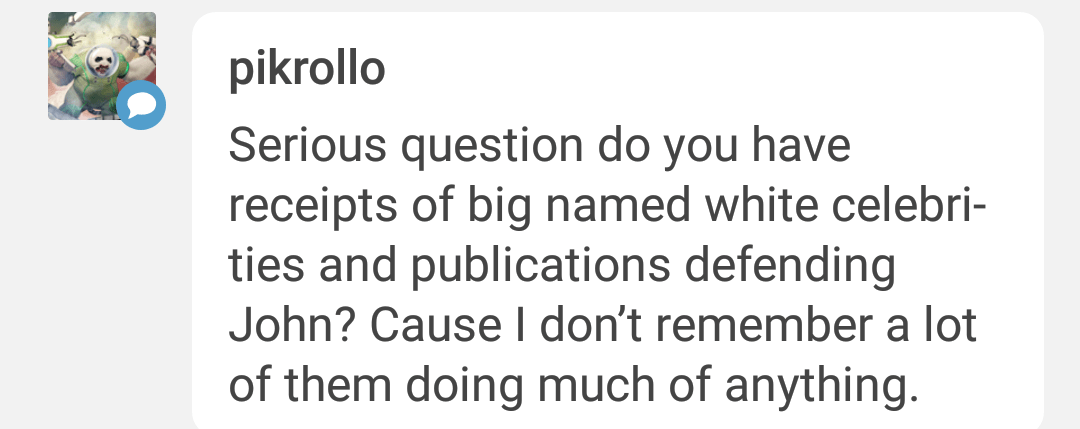
@pikrollo I don’t think this was directed at me, but I didn’t see any answers, so here are some receipts of white celebrities who defended John during #Black stormtrooper in December 2014. I should add that, although this was a year before TFA premiered, the controversy as well as the “white genocide” boycott story were in the news.
I focused on the #blackstormtrooper tag on Twitter between December 1 and December 3, 2014, a couple of days after the first trailer dropped during the height of the blackstormtrooper controversy/reaction (#blackstormtrooper trended on Dec. 2, the day John’s “Get used to it” statement came out). Yes, I scrolled through thousands of 3.5 year old tweets, with all those Spaceballs “We ain’t found shit” posts and claims that all Stormtroopers are clones.
So which white celebs supported John?
Steve Marmel, comedian and writer for shows like Fairly Odd Parents an I Am Weasel.
Joshua Caldwell, TV producer and director of the film Layover and a few episodes of South Beach.
Cole Haddon, creator of NBC’s Dracula (If you recall this show, Black British actor
Nonso Anozie played Renfield, so this was probably major deja vu).
Larry Nemecek, author of
“Star Trek: The Next Generation Companion” and a bunch of other Star Trek books.
With total respect for these guys, this is not exactly a list of the Hollywood glitterati. And I didn’t single out white men – excluding white woman journalists with a verified account (the measure I used for “celebrity”), no white woman celebrities defended John in the #blackstormtrooper tag when it was hot. Of course, that doesn’t mean that none defended him without the tag, but but that was the tag for talking about the controversy bat the time. Including journalists, there were a couple women, a few more white men, and some I’ll call gender neutral because they were under the publication name.
The media didn’t support the racism against John, but they didn’t fully condemn it, either. When John tweeted about Game of Thrones having a diversity problem, the media swarmed, because they knew it would get a reaction even without extra editorializing.
With the Black Stormtrooper controversy, the media
(excluding Black media like The Root, Ebony, etc)
had two takes, for the most part: They reported John’s reaction without commentary, or they took a more academic approach by talking about how fans were canonically wrong that Stormtroopers couldn’t be Black. Huffpo’s criticism included the “colorblind” assertion that fans shouldn’t be struck by the fact that Finn was Black, but that he was the first truly humanized Stormtrooper in the films. Which is true, but they didn’t ask why so many fans didn’t see him as more humanized.
By 2015, the issue came back ahead of the TFA premiere. Most notably, in early December, Howard Stern had JJ Abrams on his show and pressed him to address it, which he finally did, a year after the initial controversy. His response was, “
I think the people who are complaining about that probably have bigger problems than there’s a black Stormtrooper,” That was also a big story in 2015, but it was Stern who put him on the spot while others really didn’t go there.
So, there are some receipts. Compare and contrast to the current fandom racism outrage, which imo is undeniably tied to the backlash against Rian Johnson and TLJ.
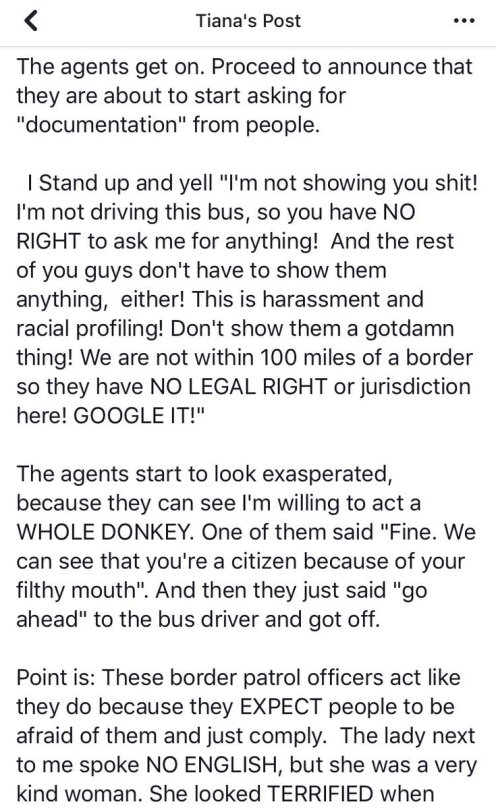
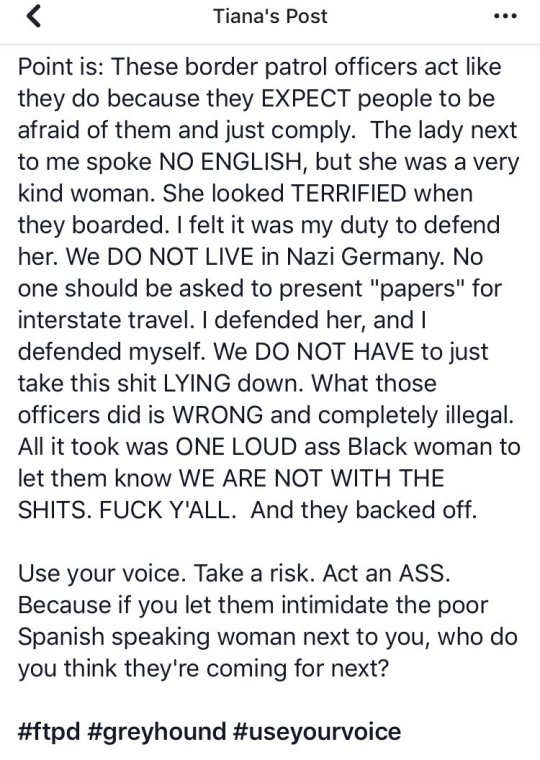
The people in this country are being treated like the people in nazi Germany did pre & during WWII. UNACCEPTABLE!!!!!!
boost this!
Fellow white people, stand up too. Don’t leave Black folks in the position of possibly getting shot for speaking up. Stand up and shield those who need it.
this is so petty but i really wish white people would stop using “the color of someone’s skin” as a stand-in term for “race.” they are not the same thing. this is not about the color of my skin, i am asian and paler than you yet you still hate me
it’s the same as when they’re like “i don’t care if you’re black, white, brown, green, purple…” as though racism is just about someone’s appearance and not deeply entrenched scientific, medical, and social categories for the express purpose of oppression and violence



 Rush's tumblr archive
