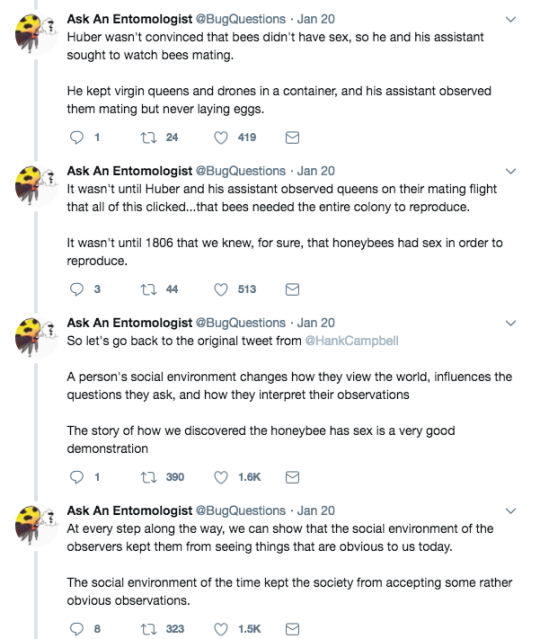
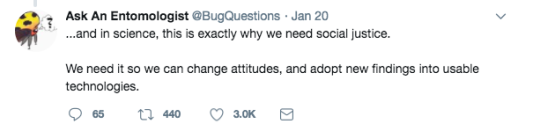
so just imagine how much these factors shape our interpretations of historical evidence. 😉
The only issue I have with this tweet thread is I think it’s a stretch to say that 17th century folks didn’t think queens could reproduce. Otherwise there wouldn’t have been such a campaign to get Elizabeth a suitor and pregnant with an heir in the first place.
it’s really fucking interesting that accusations of inaccessibility never seem to be levied against The Hard Sciences
if someone asks me what i’m doing in lab and i explain a little bit of maxwell’s vortex hypothesis, nobody expects to understand the whole thing. you have to have some foundational knowledge of calculus and electromagnetism, and you need to study faraday’s experimental data; without those, i can give you a summary of maxwell but i can’t possibly make you understand the whole thing. that’s not a failing on my part, your part, or maxwell’s. it’s just how it goes when someone produces a paper in a specialized field, and people generally accept that.
if someone asks me what i’m writing my annual essay on and i say it’s about spinoza’s conception of god as explicated through nature, suddenly i’ll get people who expect that either the entire thing needs to be stated in fifth-grade vocab terms, in which case they’ll shit on the entire field of philosophy for being easy, or i’m being inaccessible and elitist, in which case they’ll shit on the entire field of philosophy for being pretentious and esoteric. it’s striking, actually, the extent to which people have different expectations of subjects i’m in fact studying simultaneously in an interdisciplinary program.
there are plenty of academics who overuse jargon, whose writing is genuinely unintelligible and needlessly convoluted, and who i would like to punch in the face. but the solution to that problem is not to make blanket statements about how knowledge must always be accessible to people outside the field. and even when people do make those statements they never mean them. what they mean is that they think humanities are essentially lower and dumber than hard sciences and that the way students discuss them should reflect that.
I’d argue that the hard sciences should be made more accessible though. Maybe not all of them, but sciences that have policy applications absolutely.
That’s not to say that the double standard isn’t unfair to people
studying the humanities either because I agree that being told to dumb
down your work by everyone is disrespectful, just that the world loses
out on the flip side of that as well.
Most people don’t understand climate change because scientific discussion of it is confined to inaccessible academic journals. Meanwhile media companies don’t have environmental reporters anymore so, if it gets talked about in mainstream media at all, it’s going to be by people who don’t usually report on it. Scientists aren’t taught how to communicate with the public (and many see it as beneath them anyway) so they have trouble being as effective at it as PR charlatans for fossil fuel interests, and if a badly written article about climate change comes out, they’re the ones who can spin it to their advantage easier.
Rinse and repeat for pretty much any other complicated topic that attracts anti-science conspiracy theories to it like vaccines or chemtrails. The public doesn’t get the whole truth because most of the academic discussion is inaccessible and what gets disseminated out to the public is “both sides” type reporting by journalists who don’t normally cover science.
This would be made better if scientific writing was required for science majors but it usually isn’t.

 Rush's tumblr archive