also, read the declarations of secession. most of them say it was because of slavery.
also-also, the confederate flag came back into use and most of the monuments were put up during civil rights.
There needs to be more recognition of intergenerational/cultural trauma in addition to trauma that individuals experience. This isnt even an internet only phenomenon. Ive had white gentile therapists not understand it.
I’m very serious about tagging posts about traumatic events that happen in other cultures like slavery, the KKK, the Highland Clearances, boarding schools etc. because I know I have followers who are from cultures that experienced that and, since I dont know their own history with it, I can’t make assumptions that it doesnt affect them mentally. It’s really not that hard to tag. We all tag nonsense ship names that our phones cant recognize day in and day out after all.
1. People stop using the immigrant myth when they talk about the U.S. it was not built by by immigrants, enslaved black people didn’t come here willingly.
2. People stop acting like America was fine until Trump. We were literal property.
3. People stop saying that African Americans are “just like white people”. You know damn well that the context behind us exploring African cultures isn’t the same as a white person. You know we would be connected if we could. Stop. Or pay up to help us find out.
4. People learn African American history. Learn that those confederate statues don’t just stand for something generic. Learn about how white people tried their damndest to keep us in slavery like conditions even after they couldn’t own us legally, and a lot of these laws you hate were put on the books to control us.
5. People learn about us as a group. Learn about the origin of terms like “wlw” or “poc”, learn how we built communities, learn how resilient we were. But don’t reduce us down to pain and social justice. Learn about black cowboys. Learn about black soldiers, about black artists, about the Harlem Renaissance, etc. Learn how diverse we are. We are comprised of so many sub-ethnic cultures and so many people assume we have nothing when we have so much.
6. Stop normalizing black death. The dehumanization we deal with now is the direct result of our enslavement.
Honestly I sort of think Robert Ford is just as big a sociopath as William is if not more so.
He’s profited off these robots for 30+ years, he’s allowed them to be tortured in all sorts of ways, even after the death of his business partner. He’s allowed his business partner’s favorite robot to be raped for 30 years. He sat back and didn’t care until it came time for the board and moneymen to start the process of booting him out and taking his work.
That’s when he sets the same robot loose on everyone. On an expansive multi-park island where even children stay at. The robots that aren’t ‘awakened’ are etiher pulled into this or broken to the point where they’re living out thier loops and can’t protect themselves while surrounded by the dead.
Hell, look at the mind games he’s playing on Bernarnold. He forced him to murder a woman he loved and he’s constantly afraid he’s going to kill Elsie. He even took control of him so he’d murder that room full of people.
So WHY are people “YAS QUEEN”ing over him telling Maeve that she was his favorite? It’s manipulations and mindgames. He does it to the people around him, he does it to the hosts, he did it to his business partner’s doppleganger but somehow the fandom just takes his word for it that he wants to wake the hosts up and Maeve is his favorite.
Bitch, he could’ve done that any time in the 30 years he was running things. Now it’s just fucking petty and the hosts he’s letting ‘free’ are in an even worse position than they were beforehand.
Jewish communal leaders, worried about provoking an anti-Semitic
reaction against their exposed congregations, tried to keep a low
political profile in an America increasingly prone to explode in
political violence. They were religious refugees in a place that offered
them shelter and they did not want to relive the strife of Europe.
An exception to this rule was Rabbi David Einhorn of Baltimore.
Einhorn had moved to the United States when the Austrian authorities
closed his synagogue. Einhorn was a Reformed rabbi, and the government
saw his preaching as endorsing the democratic ideas of the Revolution of
1848. So Einhorn had to go.
…
Against this background of violence from pro-slavery mobs and
disapproval from some in his own congregation, Rabbi Einhorn took the
wolf by the ears when he learned that a New York rabbi had published
remarks endorsing slavery as authorized by God in the Torah.
In an act of bravery that exposed him to great personal risk, Einhorn
wrote in response to the use of the Holy Bible to endorse slavery:
Is it anything else but a deed of …rebellion against God to enslave
human beings created in his own image and to degrade them…? Is it
anything else but an act of ruthless and wicked violence to reduce
defenseless human beings to a condition of merchandise and relentlessly
to tear them away from the hearts of husbands, wives, parents, and
children?
It has ever been a strategy of the advocate of a bad cause to take
refuge from the spirit of the Bible [in] its letter. Can that book
hallow the enslavement of any race… Can that book justify the violent
separation of a child from its human mother?2
Einhorn dismissed the New York rabbi’s argument that slavery was
justified by its long history stretching back to Abraham. “Does a
disease,” he asked, “cease to be an evil on account of its long
duration?”3
Einhorn would be one of the first rabbis to connect the fight for
racial equality to the protection of all minorities. He saw
abolitionism, the protection of the Irish against anti-immigrant Know
Nothings, and the struggle of the Jews for civil equality as being all
of the same cloth. No minority could be safe as long as it was safe to
attack another minority. His words were published widely and he
attracted the notice of Southern partisans.
In April 1861, following the Confederate attack on Fort Sumter in
Charleston Harbor, riots enveloped Einhorn’s city and the rabbi became a
target of the mob. Rioters destroyed the printing press that had
published his anti-slavery essay and the rabbi’s life was threatened. He
was forced to flee north.
When order was restored, Einhorn’s synagogue told him that he would
only be welcomed back if he agreed to stay as silent as the other rabbis
on the slave question. He refused, and instead embarked on a rabbinic
career in Philadelphia and New York that made him a leading light of the
Reform movement in American Judaism.
Sam said something deeply personal and painful about epigenetics and how the trauma from slavery is literally in her blood and Gabe laughs to himself, begins talking about himself (”what am I doing? I’m gonna go. I get it, I got really caught up and it was embarassing” is what he says) and then leaves shortly after instead of supporting her. It’s no wonder Sam followed him out the door. She probably needed him to acknowledge her in that moment instead of making it about himself and he didn’t do it so she had to chase after him. That’s…messed up. I really feel for Sam and resent Gabe for not being there for her.
I just left a plantation tour in Louisiana. I have a lot to say…
SAY IT!
I honestly thought I knew everything about slavery. Not so.
The owner of this particular plantation had it built by slaves for 3 years. Every brick was handmade. Over 120,000 bricks on 2,000+ acres of land (this place was huge.) The clay used for the bricks came from the Mississippi River. The majority of the slaves are buried under the Levees and water. Some are buried with their Masters. Not allowed to live with them but could be dead with them.
Before you enter the house, there’s a list of slaves who lived here including their age and how much they were purchased for. 124 total. Some slaves were worth as little as $25. As young as 5 years old.
On this particular plantation, the owner was big on punishment…he used noise making neck restraints. Imagine three 4lb balls around your neck with bells inside. Children were restrained by ankle locks that connected between their ankles.
This was a sugar cane plantation, one the worst practices to involve slaves because of its danger. A lot of slaves were decapitated, amputees and killed from the fields and machinery. A lot of kids lost their lives creating sugar. Speaking of children, a child stood in the living room and operated the fan with a string while guests ate dinner. As young as 3 years old.
Here’s what shook me even further: Before the Civil War, a lot of slave owners were going in debt and could not afford their properties and were not producing enough cotton and sugar to maintain their lifestyles. Slaves were used as HUMAN CREDIT CARDS. Slaves were a guaranteed line of credit. You could get HALF of your property’s value depending on how many healthy and able slaves you owned.
My people were human credit cards and lines of credit to BANKS. We were property. We were labeled as equipment and nothing more.
There is no such thing as a good slave owner. They owned my PEOPLE and used them as checks and balances. This cycle continues with prison and brutality. I do not want to hear shit about “Why can only Black people say this or that?” I don’t want to hear shit about “we’re all human.”
And by the way, not one of those slaves are at rest. Those spirits were so alive, you could feel their presence, their pain and someday, their revenge.
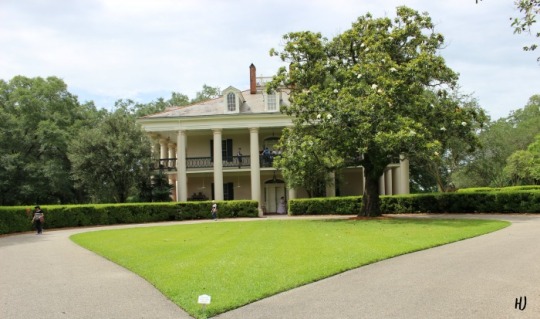
The front of the house and yard. This plantation was huge. Just thinking about my ancestors tending to all this land…
SOME of the enslaved names, ages, race and purchase price.
The living room.
Interior.
The dining room. That piece hanging above the table is ORIGINAL to the house. That’s the fan that a slave as young as 3 years old had to operate manually with a string.
The view from the balcony in the main hallway. This is how they looked over the slaves while they worked in the yard.
*sigh* Names of the enslaved that occupied the shacks. Children included. Their names are written inside one of the shacks. I’m not sure if there are other names inside other shacks because I could only handle 2. After I saw the punishment equipment, I left.
Slave Shacks. These are NOT the original shacks. These were built to imitate them.
Slaves for Sale Ads.
The landscape of Slavery throughout the United States in 1860. JUST 1860. Let that sink in.
Note: The last time the home was OWNED by a Louisiana citizen was 1972. This is her original bedroom, her lipstick is STILL on the dresser. This is why the house has been updated since slavery times because it was occupied up until 1972. Regardless, this used to be where house slaves slept.
This really fuckin happened, don’t let white people tell you that it’s in the past & to let it go.
Yep
damn man :
White people got me fucked thinking I can “get over it”
There’s so much evil ass energy coming off these pictures especially the ones of the house my heart hurts
They use this as a form of empowerment, as a constant reminder of how things were and how they WISH things are today. I don’t support “plantation” tours.
I’ll never be able to handle doing a plantation tour. Looking at these pictures makes my stomach turn.



 Rush's tumblr archive