This you can even make with a cereal box, pop bottles, a craft or box cutter knife, and some duct tape. For those who are trying to beat the heat and don’t have an AC unit, or are trying to save money on their electricity bill.
To make your own, please follow the following steps for a window strip:
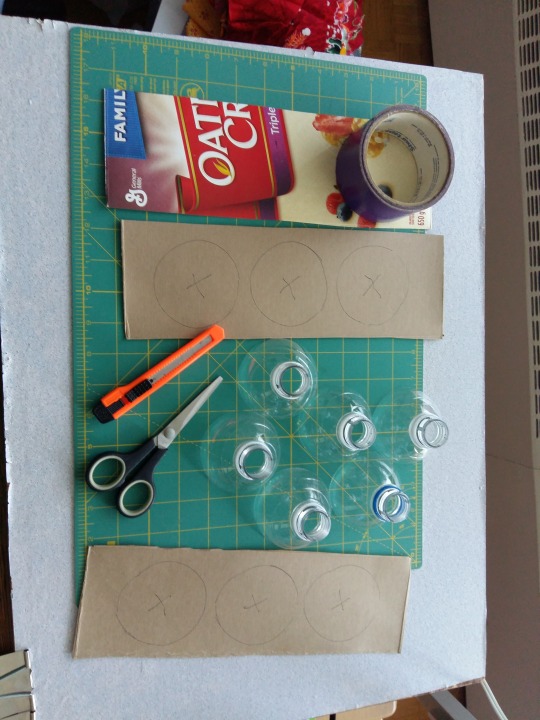
Materials: Cardboard (i used a cereal box), Duct tape (in the colour of your choice), pop bottles or water bottles (just the tops as you can see how they were cut), some cutting device to cut cardboard and/or tape, and a marker, or marking device of your choice that will mark onto cardboard
Step 1) Cut off your pop or water off at the widest point so it makes kind of a funnel shape
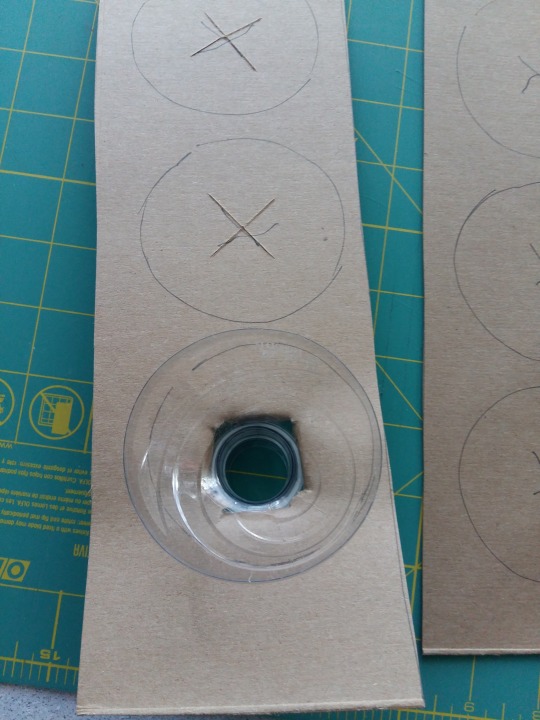
Step 2) you can make these bigger, but I made mine into a strip. Cut the cardboard into how big you want your panel or strip. Trace the base of your cap and mark the centre of where the lid goes with an X (thats where the opening will go. In the picture, I made mine just a bit wider than the pop bottle tops
Step 3) Cut the X where you marked it, and make it so it’s cut big enough to push the smallest part of your bottle through the X
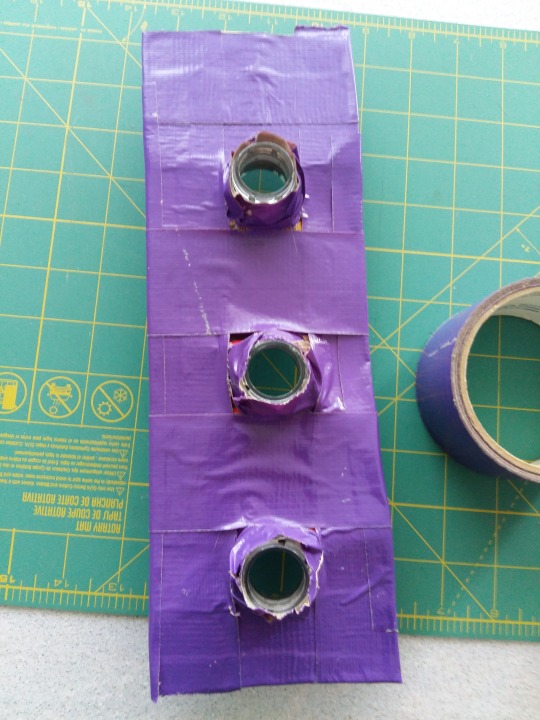
Step 4) Secure all the spout parts with Duct tape (in the colour of your choice. Mine’s purple.) You do not have to do step 4, but it is advised so the pop bottle tops dont pop out of the openings you made.
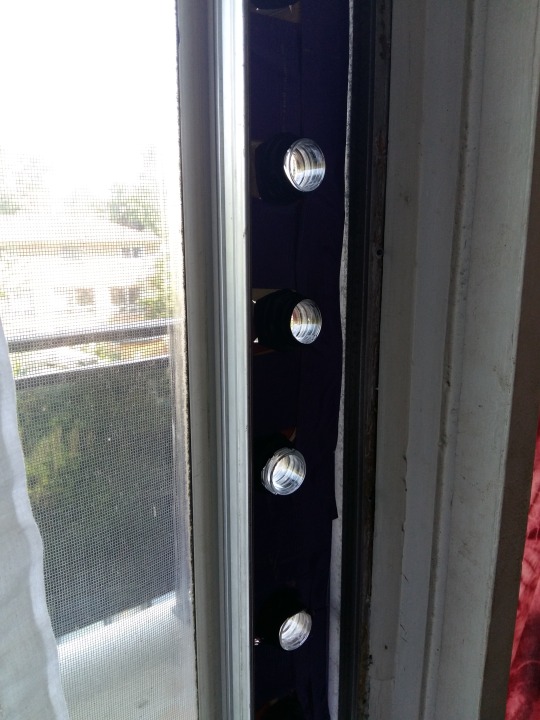
Step 5) Place your strip or panel with the biggest part facing the screen or opening of your window, and have the smallest part facing the inside of the building.
The science: as the air blows into the wider part of the pop bottle cone, it compresses the air and cools it down as it goes through the smaller part, hence cooling the air around you without having to use any electricity to make this work.
sustainability as a concept done on an individual basis shouldn’t be framed as planet saving because it’s. not. you can’t save the earth by planting your own tomatoes, because the destruction of the earth is due to corporations
what you CAN do is use individual sustainability to gain a level of independence from capitalism for yourself and for your community through things like sharing grown food
hot take: urbanization is good, cities are good, industrialization is good, population growth is good. living self-sufficiently in the wilderness is an option availible only to those who are able-bodied and reasonably wealthy and places the desires of the individual for a more primitive lifestyle over the needs of our collective society. densely populated green cities are the best way to fairly and efficiently allocate resources. additionally, by concentrating the population in a few specific areas (which is already occurring organically) we can allow urban sprawl and rural areas that would otherwise be populated to be overtaken by wilderness. urbanization has lead to greater technological and cultural advancements and a better quality of life and will continue to improve our society if we can make it sustainable
anyway stop building tiny houses and start building green cities 2k18
I’d like to remind those who feel that caring about clothes and aesthetics is ‘too frivolous’ and ‘not solarpunk enough’ that they’re rehashing a conversation feminists have already had. “Don’t you have more important things to worry about than fashion?”
(1) Clothing is wrapped up with culture and identity. It’s shaped by local climate and social mores. If you’re writing speculative fiction, how people dress is going to be part of your world-building process.
(2) The same goes for art and architecture.
(3) We can care about more than one thing at a time. Being interested in fashion and design does not make a person less interested in creating a world that’s more just, renewably powered, and moving past net-zero to drawdown.
(4) Clothing is read differently on different bodies, with heteropatriarchal sexism, ageism, racism and colonialism all playing roles in how what a person is wearing changes how they are perceived. Want an anti-racist, decolonized future? Want to challenge gender norms? You’ll have to think about clothes.
We can critique the solarpunk fashion posts that are out there for a variety of legitimate reasons: too many flower crowns, too much green, too much colour, too many impractical outfits with lots of excess fabric, too much cultural appropriation, not enough size diversity or representation of people with disabilities, and so on. (Personally, I predict re-localization of fashion design and manufacture, combined with bioregional dyeing of natural fibres, cradle-to-cradle design for synthetic fibres, and zero-waste pattern cutting.)
There are legit critiques of solarpunk architecture posts too, depending on whether your solarpunk is urban or rural, flooded or desertified, techno-optimistic or permaculture-low-tech, post-scarcity or scavenged from the ruins.
But, please, quit it with the gatekeeping and faux-intellectual snobbery. People who got interested in solarpunk for aesthetic reasons instead of political reasons have just as much to offer in imagining the future as you do; they just have a different area of expertise than yours.
– What’s the weather doing? Is it monsoon season, or is polar vortex instability causing extreme cold?
– What is culturally appropriate to the region? Is the society closed, or is there lots of travel between regions? Are many cultural traditions being fused?
– What textile materials are readily available locally (linen/cotton/hemp or other bast fibres, wool/silk or other protein fibres, plastics)? Are fibres scarce or abundant? Do non-synthetic fibres rot, or does high UV break down plastics?
– Is the society still using mined petrochemicals for non-fuel uses, such as synthetic dyes, or is everything naturally dyed using plant extracts?
– Has society switched to zero-waste pattern cutting or returned to textile traditions using uncut rectangular pieces straight from the loom?
Before we can live in a world of vertical gardens covering stained glass skyscrapers, we need to build a world of backyard garden boxes made of reclaimed wood. Before we can cover every rooftop with solar panels, we need to equip every home with solar smokeless cooking made of scrap metal
The appeal of those green cityscapes in the pretty pictures isn’t just that they’re hi-tech and clean, it’s that they sprout from a society that values compassion, the environment, and human lives more than it values profit. We need to build that society first, and we need to build it from the ground up with what we have available
The solarpunk future is for our grandchildren. Our job is to pave the way for it
 Rush's tumblr archive