
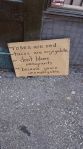





Signs at Families Belong Together March.
The government called it a “segregation center,” but Satsuki Ina calls it a prison camp.
Japan attacked Pearl Harbor in December 1941. The following February, President Franklin D. Roosevelt signed an executive order authorizing the incarceration of anyone on the West coast who was deemed a threat, including everyone with Japanese ancestry. Government officials arrested Ina’s parents and took them to a horse track outside San Francisco that doubled as a temporary holding area. Ina’s family ultimately was sent to the Tule Lake Segregation Center near the California-Oregon border. Ina’s mother was pregnant at the time.
Tule Lake was a maximum-security prison camp that, at its peak, locked up over 18,000 people. Some 1,200 guards watched over the inmates from 28 watch towers. Some of the guards had machine guns. they were backed up by eight tanks.
“And that’s where I was born,” Ina told me.
Her father delivered a speech at Tule Lake at one point, declaring that it was his constitutional right to be free like other Americans. Ina says the U.S. charged him with sedition and punished him by separating the family and sending him to a prison camp in Bismarck, North Dakota.
By the time World War II ended, her family had been reunited at a prison camp in Crystal City, Texas. Ina was two and a half years old when she and her family were released. She says that time in detention has stayed with her, manifesting in longterm stress and negative physical consequences.
Today she’s a psychotherapist who has spent time visiting family detention centers, including the South Texas Family Residential Center, which sits just 44 miles away from her childhood prison in Crystal Lake.
Ina’s experience is eerily similar to what many young immigrants are experiencing today. I spoke to Ina about her life, work, and the longterm effects of detaining children in prison camps.
This interview has been condensed and edited for clarity.
You were born inside a prison camp here in the U.S. The U.S. government apologized for locking up Japanese-American families. What goes through your mind now when you hear the is U.S. detaining about 11,000 children in “shelters” across the country?
It’s alarming. It’s so resonant with what my family and my whole community had to experience. America made a horrible mistake back then.
When Pearl Harbor was attacked, there was so much collective anxiety in our country that finding a scapegoat was a natural outcome. The U.S. government just completely bypassed constitutional rights and human rights. And that’s that’s what I feel like is happening today with the inhumanity of separating children from their parents as a form of punishment.
I interviewed mothers in a family detention facility and I asked them why they would take such a huge risk and cross the continent to to get to the U.S. border. And it’s because they did not want to be separated from their children.
They worried that their daughter could be kidnapped and become part of sex trafficking or that their boy would be captured and become part of a gang. The women told me that they felt like they had to gather their children and escape so that they could keep their children from being separated from them.
What are some of the longterm effects that these children in detention may have to live with?
I am a psychotherapist, so I work with children who have been traumatized and what they are experiencing is definitely trauma. One of the worst traumas for children is to be separated from their caregivers and then placed in what they calling “temporary detention facilities.” But it’s indefinite detention—they have no idea how long they’re going to be held. They have no idea if they’ll ever see their parents again.
That level of anxiety causes tremendous emotional stress, and we know from the research in neuroscience that constant release of these stress hormones can affect a child’s ability to learn, a child’s ability to self-manage, to regulate themselves.
The longterm impact that I’ve seen in my own Japanese American community is this hyper-vigilance, this need to constantly prove themselves, and always being on edge. Japanese Americans are viewed often as the model minority but I see the behavior of needing to strive and not offend and belong and maybe give up their own personal aspirations to fit in has come at a great sacrifice and is a reaction to having been incarcerated unjustly.
You left the prison camp when you were two and half years old. How did those years affect you?
This kind of treatment has consequences for a lifetime for a child. The trauma effect is pretty severe when there’s been captivity trauma. We were unjustly incarcerated when we weren’t guilty of anything.
Today I live with anxiety about the possibility of random accusations or being blamed for something. That’s constantly present. So we are always working hard to please people and not cause trouble. There’s a constant need to be perfect. We don’t show up in the criminal justice system but we end up with a lot of psychosomatic disorders and symptoms resulting from over-achievement. We question our integrity and worthiness. I’m over-educated, for example. I have a Bachelors, Masters, PhD, I’m a licensed therapist, a certified gerontologist, the list goes on.
That high level of anxiety has given me high blood pressure. A lot of us who were incarcerated as children have high blood pressure. A study by Dr. Gwendolyn Jensen found that Japanese men who were detained had a 2.1 greater risk of cardiovascular disease, cardiovascular mortality, and premature death than Japanese men in Hawaii who were not imprisoned. [The study found the youngest detainees reported more post-traumatic stress symptoms and unexpected and disturbing flashback experiences.]
A Former Japanese Internment Camp Prisoner on the Dire Effects of Putting Kids in Detention

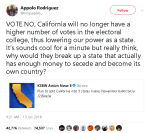
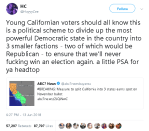
Tbh we should get rid of the electoral college
That’s a good point! California is one of the states signed on to the agreement to assign electoral votes in line with the national popular vote (once a majority of electoral votes are so bound by all states in total), so dismantling the largest chunk of the electoral college currently (which is so bound) without other serious reforms actually makes the electoral college harder to reform or quickly abolish without, like, a full scale revolution.
Anyway, the real drivers behind this proposition are actually more
a) to destroy the progressive tax model the current state of California has created which shows that low/regressive tax models like Kansas’ for instance aren’t flukes, that taxing wealthy people under the right circumstances isn’t the end of the world – we can be here all day talking about the better solution of communist revolution and the like, but the point isn’t arguing for that, it’s arguing against libertarian hellscape capitalism
b) to create high tax / low wage confluences in especially Silicon Valley and Orange County (both of which are border regions on the proposed map) – the ostensible system is to easily allow businesses and lower employees to be located on one side of the boundary and managers’/owners’ incomes on the other, so that profits can be safely sequestered into “income” for the “right” people and as much of that as possible distributed by local and even state taxes “within the community” (of wealthy people). To be clear, this sort of shit is *already* a problem in California, this exacerbates it by drawing even more stark lines through two of the major metropolitan areas in the state.
c) to provide White people in what would become New South California more political leeway to deport undocumented people, which just the threat of has been continually used since Trump was elected to shut down strikes and labor organizing, because White people are fucking demons.
To sum up, it’s a cash grab meets “end sanctuary cities” status post by your racist aunt. Throw it in the fucking trash and get on board with a real revolution.











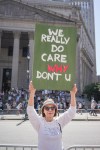

#EndFamilySeparation NYC: On June 30, New Yorkers joined together with dozens of other cities in a National Day of Action to Fight for Families and to demand that Donald Trump and his administration stop separating kids from their parents. #familiesbelongtogether #keepfamiliestogether
I’m avoiding the thing about Trump’s family separation policy as much as possible because it literally makes me want to melt down in a rage the moment I think about it almost at all, and as a Canadian there’s an incredibly limited amount I can do when I have to keep my own precarious mental health functioning
but I just want you to know that a lot of the field of Attachment Theory in psychology began after WWII, when psychologists examined the physical and psychological health of children sent away from their parents for their own “safety”
and what we found about the psychological results of broken child-caregiver attachment has led us to conclude that it is literally MORE HUMANE to leave families intact in refugee camps in warzones, than to separate the children from their parents, even if those children are sent to the best of all possible environments.
Speaking as a fucking psychologist I just want you to know that if you want to fuck someone up FOR FUCKING LIFE, the BEST possible way to do it, is to abruptly separate them from the adults who love and care for them. For maximum fuckery do it before the age of 3, 5 is pretty damn good at fucking them up for life too, but honestly any time before adulthood is pretty effective. You will fuck them up in a way we just DON’T know how to heal yet. You don’t just leave them catastrophically more at risk for mental illness, learning disorders, addictions, abuse, and future trauma, you also put them at much higher risk of things like diabetes, heart attack, and suicide.
and then I thought about what kind of environments those kids ARE being sent into and I need to throw up nowOp do you have any links to papers or anything? Preferably not paywalled?
Honestly the field is so huge and so broad that I have too many sources rather than too few. The harder thing is pointing to a concise, targeted, tailored-to-be-relevant summary. (But if child trauma experts in the US aren’t working on producing one at this very instant, I’ll eat my hat.)
The two places I recommend starting are the Child Trauma Academy Library and the National Child Traumatic Stress Network.
American Psychological Association statement on border separation
American Public Health Association statement on border separation
At this point all you need to do is Google search ‘border’ and ‘child abuse’ and you’ll get buried in articles. Google Scholar is about the same
Thanks! @emotional-karuma, there you go.
Separation is terrible, institutional care is deadly, and these kids are getting both.
Institutional care kills babies. It damages them developmentally, even if the care is “perfect” functionally (clean children, well fed, medical care given) we’re hearing reports that the adults at the facilities are not allowed to offer comfort and that the children are not allowed to hug each other. If people want more, look at the Romanian Orphanage history. I’m not posting links because it makes me cry to think about it.
One of the more layperson-accessible books on attachment and the results of childhood trauma is The Boy Who Was Raised As A Dog. It isn’t perfect, but it’s as easy to read as a novel, and the case studies will stick in your head.
As a Canadian, we can contact Minister Ahmed Hussen and demand that the Safe Third Country agreement be dropped. It’s a bullshit piece of post 9/11 legislation and must go. The numbers are 1 613 995-0777 and 1 416 656-2526.
At the very least we can make sure the immigrants fleeing America have somewhere to go.
“Of course, the white men and women who consider her approach taking the “low road” care little about the death threats directed at her because they are not the subjects of Trump’s hateful rhetoric, his xenophobic immigration policies, or his penchant for viewing black people with opinions as property rather than as free human beings. The majority of white journalists condemning Waters refuse to confess that their whiteness inoculates them from his bigotry and that it compels them to prioritize the humanity of the abuser over the discomfort of the victims who face Trump’s abuse. There is no “both sides” debate between a black woman who is using her mouth to resist hate and a white supremacist who can write racist policy. But the dissent against Waters has little to do with so-called civil discourse. Waters is an easy target because she is a black woman. She is loud outspoken, angry passionate and divisive candid. She is also the most disrespected and unprotected woman in America, as Malcolm X proclaimed about black women. That fact explains why much of white America—journalists and all—sympathizes with Sarah Huckabee Sanders, a white woman who functions as a modern-day Joseph Goebbels, over Waters, a black woman who is challenging the fascism that Trump is normalizing on a daily basis. It tells us that no matter how high black women ascend in the power structure of America, their standing will always take second place to white women, their racism be damned.”
—
Trump and Friends Come for Maxine Waters, a Black Woman Who Doesn’t Give a Damn About Your Calls for Civility by Terrell Jermaine Starr



 Rush's tumblr archive