
polararts:

the-bi-writer:

killerchickadee:

truth-has-a-liberal-bias:

zeshuetoral:

pewresearch:

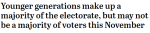
As
of April, 59% of U.S. adults who are eligible to vote are Gen Xers, Millennials
or “post-Millennials.” Yet if past midterm election turnout patterns hold true,
these younger Americans are unlikely
to cast the majority of votes
this November.

Time to break the mold! This year, everyone votes!

The only (peaceful) way to keep Trump and the Republicans in check, is to vote.

Register to Vote and Confirm or Change Registration

If you’re not voting against these people then you’re voting for them. You can’t bitch about what Trump is doing to this country if you’re not even attempting to do something about it.

listen i say this every time i see a voting post, but if there’s a barrier that keeps you from physically voting (like, you go to college in a different place than your permanent address, you have work/school, you’re home with kids, you’re disabled, etc) YOU CAN GET A MAIL IN BALLOT. 

It’s called “absentee voting”, and over half of states don’t even require any sort of documentation for you to get one. You can literally just. Request one. And then you can vote by mail ahead of time, saving yourself So. Much. Stress.

[info on how to get an absentee ballot in each state

Oregon has mail in ballots for everyone, and we consistently have high voter turn out, which is why I spread this info, every chance I can. 

Note: Also, technically your employer has to give you a couple hours off on election day if you’re working more than a certain number of hours, but losing paid hours isn’t an option for a lot of people. So get on that absentee request!

I’m going to get political for half a second and say absentee voting is really easy!

If you’re a little lost on who to vote forThis app assesses your political views and shows your % matches.

+A list of everyone who voted against net neutrality (Avoid voting for, so the internet stays free)
+Environmentally Supportive senators 

The Villages is America’s largest retirement community, a carefully
planned, meticulously groomed dreamscape of gated subdivisions,
wall-to-wall golf courses, adult-only pools and old-fashioned town
squares. It’s advertised as “Florida’s friendliest hometown,” and it’s
supposed to evoke a bygone era of traditional values when Americans knew
their neighbors, respected their elders and followed the rules. It has
the highest concentration of military veterans of any metropolitan area
without a military base. It has strict regulations enforcing the
uniformity of homes (no second stories, no bright colors, no modern
flourishes) as well as the people living in them (no families with
children, except to visit). And it is Trump country, a reliably
Republican, vocally patriotic, almost entirely white enclave that gave
the president nearly 70 percent of the vote.

Older voters are America’s most reliable voters, which is why
baby-boomer boomtowns like The Villages represent the most significant
threat to a potential Democratic wave in Florida in 2018—and the most
significant source of Republican optimism for many years to come.
Because while the Villages may look like the past, with its retro
architecture and gray-haired demographics, it sells like the future.
This master-planned paradise an hour northwest of Disney World has been
the fastest-growing metro area in the United States in four of the past
five years. And as the baby boom generation continues to retire, The
Villages is continuing to expand into nearby cattle pastures, luring
more pensioners to this fantasyland in the sunshine, gradually swinging
America’s largest swing state to the right.

Trump supporters who get the most media attention tend to be
economically anxious laborers in economically depressed factory towns.
But in Florida, economically secure retirement meccas like The Villages
are the real reason Trump won in 2016—and why the state’s Republicans,
who have controlled Tallahassee for two decades, think they can avoid a
blue wave in 2018 and help reelect Trump in 2020. For all the hype about
Puerto Ricans moving to the Sunshine State after Hurricane Maria, or
high school students like the Parkland gun control activists turning 18
and registering to vote, any Democratic surge could be offset by the
migration of Republican-leaning seniors who like Florida’s balmy weather
and lack of income tax. If midterm elections typically play out as
judgments on the presidency, then Florida’s upcoming contests will be a
race between the usual laws of political gravity and the state’s
demographic destiny: Trump remains unpopular with younger voters, and
Democrats have already flipped four Florida legislative seats in
low-profile special elections this year, but the older voters who are
most likely to vote in the midterms are increasingly likely to move to
Florida and support the president.

It makes sense that they’re coming to The Villages, because this
leisure-class Sun Belt oasis is a lot more pleasant than the dying
working-class Rust Belt towns that journalists usually visit on
Trump-voter safaris. It feels like a 40-square-mile cruise ship, or a
college campus without required classes. It has enough golf courses to
play a different one every week of the year, and more than 100 miles of
golf cart trails that keep traffic congestion to a minimum. It’s the
pickleball capital of America, appropriate considering that the
badminton-meets-tennis-ish paddle game has become America’s
fastest-growing sport. It has 3,000 clubs that keep 125,000 Villagers
busy doing everything from belly dancing to astrology, water aerobics to
water skiing, karaoke to quilting. It isn’t exactly luxurious, but it’s
comfortable with a median home price above $250,000; though a new POLITICO/AARP poll
finds plenty of concern elsewhere in Florida , the only real economic
anxiety for most Villagers is the state of their investment portfolios,
which are thriving in the Trump era. At a meeting of the Financial
Markets and Investment Club in early June, a speaker announced: “NASDAQ
just closed at a record high!”

That meant more wealth on paper for club members like 80-year-old
Larry Harman, a former Chicago-area stockbroker who watches the markets
so closely he founded a separate club devoted to options trading. But
while Harman voted for Trump, and says he gladly would again, his
investment gains are not the reason: “I keep telling people: Come on,
Trump has nothing to do with your portfolio.” Harman, a former Marine,
is much more excited about Trump’s crusade against the National Football
League. “Players taking a knee, that’s bullshit!” Harman told me. “I’m
with the president 100 percent: Throw your hand over your heart and
respect our flag.”

All of the Boomer assholes in that article will be voting. Doesn’t matter how ignorant or racist they are.

Why should they get to decide the future of this country?

If reading this makes you want to fly over there and deck them…
https://vote.gov/

fierceawakening:

cornbreadcrumbs:

fierceawakening:

cornbreadcrumbs:

whitepeopletwitter:

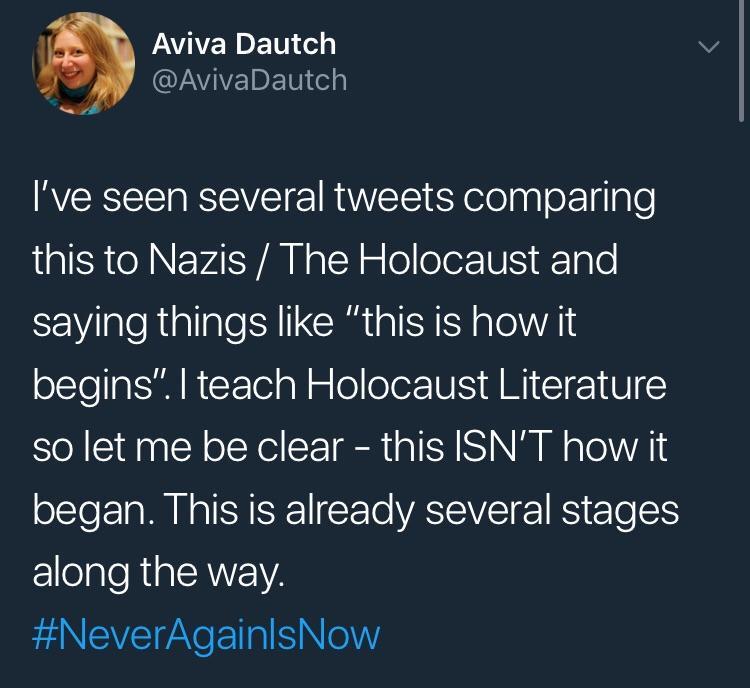
It’s begun

*Shrugs* kind of? We still haven’t had anything like the crisis WWI was. Americans can’t comprehend what it would be like to have millions of their sons die in a pointless war that they lost. And then follow that with an unfathomable economic quagmire. We would need some kind of collective national trauma to plant the seeds of a widespread fascist community that bases it’s idea of national rebirth on racial purity.

What we have now is a realization that the personalities that made up the third riech can totally exist in America. Thankfully there is no national trauma for them to exploit, we have a 241 year history of a successful democratic republic, and the media/free speech apparatus makes it easier to coordinate resistance to these pigs.

Those are good points, but I think it depends on what you take this tweet to mean. I don’t take it to mean that the circumstances are the same. I take it to mean something more like:

Don’t forget that the Nazis didn’t wake up one day and convince everyone Jews (and gays and Roma and and and) dying was a good thing. They dehumanized the groups they hated in stages, and rounding them up was actually not the first stage.

So I take the tweet to mean “dont think to yourself ‘we’re taking our first baby steps into fascism.’ We may indeed not be there yet, but by the time we’ve gotten to ‘rounding up innocent kids for the supposed crimes of their parents, who the government openly calls an “infestation,” and having a favored news outlet that defends this as “summer camp,”’ we’re not on the edge of a metamorphosis, were straight up in the middle of one.”

Well, yes I’d agree with that. But the grounds for a holocaust existed in Europe (and America) for decades prior to the Nazis. What happened in Germany could’ve happened anywhere under the right conditions. If just having dehumanizing sentiments means that “we’re already several steps along the way” then, sure. But we’ve been “several steps along the way” for well over a hundred years now.

I agree that this is a wake-up call that “it can happen here,” but I don’t think we’re necessarily in danger of a government sponsored genocide. It is frightening to see how easy a group of radicals at the top, coupled with apathy from the conservative elites, can do something this monstrous. However…

I think the response and backlash to this has been very encouraging. I wholeheartedly believe in cultivating a strong moral base that will draw attention to and resist these kinds of actions. We should be ready, in case we do experience a national crisis, to defend human rights. I get the idea behind the tweet, but I would still say that we’re fortunately in a far better situation to fight back against this kind of dehumanizing state policy then Germany ever was.

That’s fair. I think we’re actually saying similar things from different perspectives and agree on a good bit.

My concern is more that… the way that i usually hear the history discussed, people don’t really realize that everyone wasn’t instantly taken in by Hitlers speeches. It’s often discussed as if everyone privileged enough not to be targeted was bewitched.

And… that’s not what I gather really happened. He did bewitch crowds, but they weren’t everybody. The Nazis did not win fair elections by landslides.

Which means it’s not the sort of thing where resistance just sort of melts somehow, it’s a process over time where resistance is made to disappear.

And while I don’t think we’re seeing that now, I think it’s very important not to assume “loud resistance exists” equals “they’d never go further.”

They absolutely will, so we need to understand how serious what we’re seeing is.

One way things are different now that I think the author of that tweet is alluding to compared to how things were before is that it wasn’t just dehumanization coming from the public at large but also from people in power. Like sure in the 2000’s there were racist White kids at my high school running around saying racist things against Latino kids but it wasn’t coming from Bush and his administration. Bush won the 2004 election because he was popular among conservative Latino voters.

BREAKING: In a win for digital privacy, #SCOTUS reverses and remands the 6th Circuit’s ruling in Carpenter v. United States in that police need a warrant to get cellphone data

justinspoliticalcorner:

https://platform.twitter.com/widgets.js

https://platform.twitter.com/widgets.js

https://platform.twitter.com/widgets.js

https://platform.twitter.com/widgets.js

https://platform.twitter.com/widgets.js

theglowpt2:

if you’ve seen the breaking news that trump just signed an executive order today to end the family separation policy here’s some quick info to keep things in perspective

  • this doesn’t end the “zero tolerance” policy of prosecuting anyone who crosses the border “illegally” 
  • the only thing this changes is that going forward, entire families will be detained together while awaiting prosecution 
  • this offers no solution for freeing the thousands of children currently held in ICE child prisons or any path to reuniting them with their families 
  • children will still be detained and treated as criminals
  • this will likely lead to thousands of families being held in ICE facilities and tent cities that will face the exact same issues of overcrowding, abuse, and inhumane conditions that exist in the child prisons

this is not a victory or a solution. This is the administration trying to cover their asses and avoid any more public outrage. They want people to see this as the end of the news story and go back to their lives. They want people to forget the thousands of children they are still keeping in cages in ICE facilities across the nation. This issue is not over and we cannot stop being outraged until we are given proof that the thousands of kidnapped children are returned to their families, and that the policy of arresting and prosecuting people who cross the border is ended. 

What’s Really Happening When Asylum-Seeking Families Are Separated?

gallifreyburning:

meret118:

Excerpts:


AC:

The short of it is, we will take sample sizes of numbers and individuals
we’re seeing that are being prosecuted for criminal entry. The majority
of those are free to return to the home country. Vast majority. We
can’t quite know exactly because our sample size is between one hundred
and two hundred individuals. But 90 percent of those who are being
convicted are having their children separated from them.
The 10 percent
that aren’t are some mothers who are going with their children to the
detention centers in Karnes and Dilley.

But, for the most part, the ones that I’ve been working with are the
ones that are actually being prosecuted for criminal entry, which is a
pretty new thing for our country—to take first-time asylum seekers who
are here seeking safe refuge, to turn around and charge them with a
criminal offense.

Those parents are finding themselves in adult
detention centers and in a process known as expedited removal, where
many are being deported. And their children, on the other hand, are put
in a completely different legal structure.

They are categorized as
unaccompanied children and thus are being put in place in a federal
agency not with the Department of Homeland Security but with Health and
Human Services. And Health and Human Services has this complicated
structure in place where they’re not viewed as a long-term foster care
system—that’s for very limited numbers—but their general mandate is to
safeguard these children in temporary shelters and then find family
members with whom they can be placed.

So they start with parents, and
then they go to grandparents, and then they go to other immediate family
members, and then they go to acquaintances, people who’ve known the
children, and they’re in that system, but they can’t be released to
their parents because their parents are behind bars.

And we may see more
parents that get out of jail because they pass a “credible fear”
interview, which is the screening done by the asylum office to see who
should be deported quickly, within days or weeks of arrival, and who
should stay here and have an opportunity to present their asylum case
before an immigration judge of the Department of Justice.

So we have a
lot of individuals who are in that credible fear process right now, but
in Houston, once you have a credible fear interview (which will
sometimes take two to three weeks to even set up), those results aren’t
coming out for four to six weeks.

Meanwhile, these parents are just kind
of languishing in these detention centers because of the zero-tolerance
policy. There’s no individual adjudication of whether the parents
should be put on some form of alternative detention program so that they
can be in a position to be reunited with their kid.

TM: So, just so I make sure I understand: the
parents come in and say, “We’re persecuted” or give some reason for
asylum. They come in. And then their child or children are taken away
and they’re in lockup for at least six weeks away from the kids and
often don’t know where the kids are. Is that what’s happening under zero
tolerance?

AC: So the idea of zero tolerance under the stated
policy is that we don’t care why you’re afraid. We don’t care if it’s
religion, political, gangs, anything. For all asylum seekers, you are
going to be put in jail, in a detention center, and you’re going to have
your children taken away from you. That’s the policy
. They’re not 100
percent able to implement that because of a lot of reasons, including
just having enough judges on the border. And bed space. There’s a big
logistical problem because this is a new policy.

So the way they get to
that policy of taking the kids away and keeping the adults in detention
centers and the kids in a different federal facility is based on the
legal rationale that we’re going to convict you, and since we’re going
to convict you, you’re going to be in the custody of the U.S. Marshals,
and when that happens, we’re taking your kid away.

So they’re not able
to convict everybody of illegal entry right now just because there
aren’t enough judges on the border right now to hear the number of cases
that come over, and then they say if you have religious persecution or
political persecution or persecution on something that our asylum
definition recognizes, you can fight that case behind bars at an
immigration detention center. And those cases take two, three, four,
five, six months. And what happens to your child isn’t really our
concern. That is, you have made the choice to bring your child over
illegally. And this is what’s going to happen.

TM: Even if they crossed at a legal entry point?

AC: Very few people come to the bridge. Border
Patrol is saying the bridge is closed. When I was last out in McAllen,
people were stacked on the bridge, sleeping there for three, four, ten
nights. They’ve now cleared those individuals from sleeping on the
bridge, but there are hundreds of accounts of asylum seekers, when they
go to the bridge, who are told, “I’m sorry, we’re full today. We can’t
process your case.” So the families go illegally on a raft—I don’t want
to say illegally; they cross without a visa on a raft. Many of them then
look for Border Patrol to turn themselves in, because they know they’re
going to ask for asylum. And under this government theory—you know, in
the past, we’ve had international treaties, right? Statutes which
codified the right of asylum seekers to ask for asylum. Right? Article
31 of the Refugee Convention clearly says that it is improper for any
state to use criminal laws that could deter asylum seekers as long as
that asylum seeker is asking for asylum within a reasonable amount of
time. But our administration is kind of ignoring this longstanding
international and national jurisprudence of basic beliefs to make this
distinction that, if you come to a bridge, we’re not going to prosecute
you, but if you come over the river and then find immigration or are
caught by immigration, we’re prosecuting you.

TM: So if you cross any other way besides the bridge, we’re prosecuting you. But … you can’t cross the bridge.

AC: Sometimes they will tell the parent, “We’re taking your child away.”
And when the parent asks, “When will we get them back?” they say, “We
can’t tell you that.” Sometimes the officers will say, “because you’re
going to be prosecuted” or “because you’re not welcome in this country”
or “because we’re separating them,” without giving them a clear
justification.

In other cases, we see no communication that the parent
knows that their child is to be taken away. Instead, the officers say,
“I’m going to take your child to get bathed.” That’s one we see again
and again. “Your child needs to come with me for a bath.” The child goes
off, and in a half an hour, twenty minutes, the parent inquires, “Where
is my five-year-old?” “Where’s my seven-year-old?” “This is a long
bath.” And they say, “You won’t be seeing your child again.”

Sometimes
mothers—I was talking to one mother, and she said, “Don’t take my child
away,” and the child started screaming and vomiting and crying
hysterically, and she asked the officers, “Can I at least have five
minutes to console her?” They said no. In another case, the father said,
“Can I comfort my child? Can I hold him for a few minutes?” The officer
said, “You must let them go, and if you don’t let them go, I will write
you up for an altercation, which will mean that you are the one that
had the additional charges charged against you.” So, threats. So the
father just let the child go.

So it’s a lot of variations. But sometimes
deceit and sometimes direct, just “I’m taking your child away.” Parents
are not getting any information on what their rights are to communicate
to get their child before they are deported, what reunification may
look like.

We spoke to nine parents on this Monday, which was the 11th,
and these were adults in detention centers outside of Houston. They had
been separated from their child between May 23 and May 25, and as of
June 11, not one of them had been able to talk to their child or knew a
phone number that functioned from the detention center director. None of
them had direct information from immigration on where their child was
located. The one number they were given by some government official from
the Department of Homeland Security was a 1-800 number. But from the
phones inside the detention center, they can’t make those calls. We know
there are more parents who are being deported without their child,
without any process or information on how to get their child back.

TM: And so it’s entirely possible that children will be left in the country without any relatives?

AC: Could be, yeah.

TM: And if the child is, say, five years old …?

AC: The child is going through deportation proceedings, so the likelihood that that child is going to be deported is pretty high.

TM: How do they know where to deport the child to, or who the parents are?

AC: How does that child navigate their deportation case without their parent around?

TM: Because a five-year-old doesn’t necessarily know his parents’ information.

AC: In the shelters, they can’t even find the
parents because the kids are just crying inconsolably. They often don’t
know the full legal name of their parents or their date of birth.
They’re not in a position to share a trauma story like what caused the
migration. These kids and parents had no idea. None of the parents I
talked to were expecting to be separated as they faced the process of
asking for asylum.

TM: I would think that there would be something in
place where, when the child is taken, they’d be given a wristband or
something with their information on it?

AC: I think the Department of Homeland Security
gives the kids an alien number. They also give the parents an alien
number and probably have that information. The issue is that the
Department of Homeland Security is not the one caring for the children.
Jurisdiction of that child has moved over to Health and Human Services,
and the Health and Human Services staff has to figure out, where is this
parent? And that’s not easy.

Sometimes the parents are deported. Kids
are in New York and Miami, and we’ve got parents being sent to Tacoma,
Washington, and California. Talk about a mess.
And nobody has a right to
an attorney here. These kids don’t get a paid advocate or an ad litem
or a friend of the court. They don’t get a paid attorney to represent
them. Some find that, because there are programs. But it’s not a right.
It’s not universal.

More at the link.

Contact your senators TODAY and ask them to pass the Keep Families Together Act – you can call (5calls.org) or write (resist.bot)! Donate your time and/or money to organizations that are working to help the families who have been affected by this White House policy!

MAKE NOISE! DON’T STOP MAKING NOISE!

What’s Really Happening When Asylum-Seeking Families Are Separated?

snommelp:

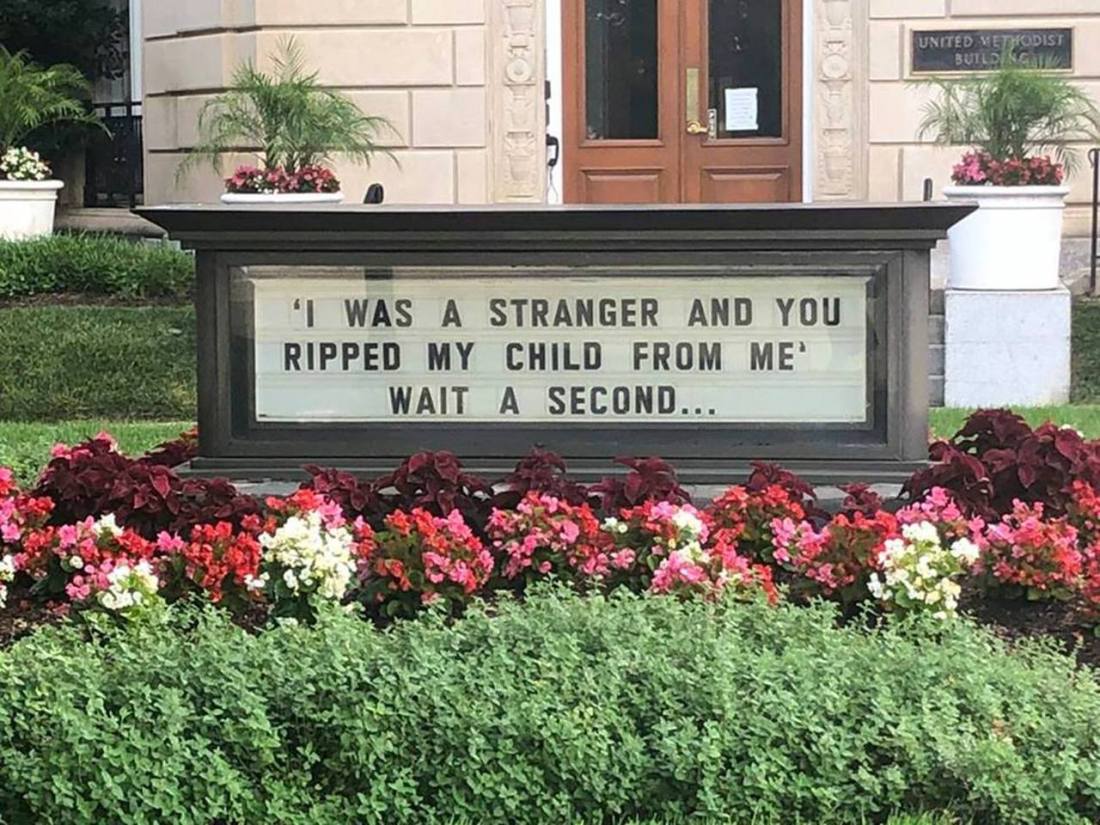
The United Methodist Building is the only non-governmental building on Capitol Hill in Washington, D.C. Adjacent to the U.S. Capitol and the Supreme Court, it had the perfect message on its reader board this week.

Let those with ears hear, and eyes see.

And may none of us remain silent.

scrapbot13:

wheremyscalesslither:

gatorfisch:

murphysmom67:

niggazinmoscow:

It’s fucking prison camps holding 1,400 children. that’s fascism

This is incredibly difficult to look at. I fear this will continue and he will commit even worse crimes against humanity. I believe the UN is sitting on June 27 to discuss the humanitarian aspects of Trumps decisions here.

Glad to see major network coverage of this

So sorry that this isnt snakes but… wow.

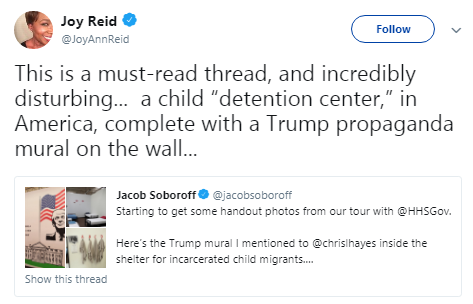
The quotes with his face are in Spanish as well as English. This is a reeducation center.

Remove children from parental influence, hold them long enough for them to captor-bond for survival, surround them with a new ideology 24/7. The youngest ones become blank slates, and the older ones wear down and adapt just to belong.

The next step would be to with hold all contact from their parents indefinitely. You could then punish them for speaking or learning their native tongue, and teach them domestic and hard labor skills and “employ” them outside of the camps to [insert synonym for “it builds character” here]. Since they aren’t actually citizens, minimum wage and labor laws don’t apply to them.

Ask the Native Americans and Austriallian Aboriginals how well this system works.

puppetmaker40:

marvelsmostwanted:

Here’s a call script for your Senators and/or representatives – scroll down to “Tell your members of Congress: Condemn the Trump administration’s separation of families.” This is especially important if you live in a red state. Trump is trying to claim that the separation of families is due to a “law” enacted by Democrats – there is no such law. This is a Trump administration policy. It’s important for Republicans to know we don’t believe his lies, and that we know exactly who is responsible for this. Calling Democratic members of Congress helps, too – even if they already support keeping families together at the border, it will help to continue to encourage them to take action.

The bill is S.3036, the Keep Families Together Act. You can read it here.

Find an event near you: familiesbelong.org 

#FamiliesBelongTogether

One thing to add. Find out if your representative has children or grandchildren and ask,them how they would feel if it happened to them. Play to empathy