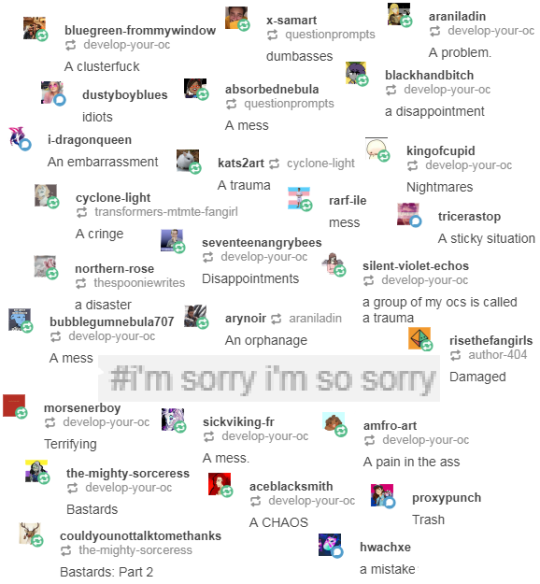
why. do people get off on writing traumatizing events happening to their ocs
why cant you just say “yeah i enjoy developing my ocs’ backstories” or “its fun coming up with their lore” instead of being freaks who talk about how fuuun it is to abuse your ocs n how you just loooove making em into bloody messes
like its not cute
i dont know how to make this clearer but that comics like this:
are fucking everywhere on tumblr and always have like 50k notes is terrifying. yall get a hobby and stop n*tting over trauma n abuse its weird n youre Not off the hook for being the character creator if youre gonna act like THIS about it
almost 100% the time it’s the creator projecting their own trauma on their ocs and it’s actually painfully obvious that that’s the case…
Actually it’s also just people writing what the hell they want a lot of the time and there’s nothing wrong with that.
Also the comic example here is clearly a style of exaggeration to make something funny out of a relatable experience that’s developed over years of talking about it in a certain way; in most people’s cases, the relatable experience is creating drama and development through anything from tragic back stories to traumatic events.
If you go back a couple years on tumblr, you’d actually find posts discussing why so many people wanted to create sad, dark, or painful stories for their characters, and why they were always put through such horrible things (and why everyone seemed to ready to do it.)
Some people said they did it to explore their own experiences. Some people did it because it was a way to explore those themes they were unfamiliar with in a completely fictional world. I think overwhelmingly, people agreed it gave characters a lot more depth, ability to be empathized with, and attachment. It fosters protective feelings in people to see characters go through bad experiences.
In any case, there was a shift in how OC treatment (and character treatment in fandom as well,) was viewed and talked about. People went from “I’m about to make my fav go through something bad bc I love him and it’ll make him into the character I love” (or something similar, you get my drift,) to funny posts like the ones above, because among creators there was and is an understanding of how we all tend to do that to them, and its making a joke from it because you don’t get noticed by being the nth person to make the same ~relatable post~ again, you do it by taking something relatable and making it new and funny (welcome to tumblr.)
But I guess it’s more edgy to completely ignore the language development that’s pretty consistent with the dramatic escalation EVERYTHING gets spoken about on here (basically the “cultural subtext,”) to call people freaks in order to participate in callout culture and feel superior in some way, so good for you I guess?????
Writer/roleplayer jokes and character development is are problematic now I guess.
Stories have conflict in them Karen
Do the initial posters live under a rock, or????
How exciting, now people are telling us how to write and talk about our own ocs! Not only must you fic in certain approved ways. Woth approved characters and ships, but now your original stuff must also pass muster.
I’d say tumblr makes me long for death but I expect soon there will be posts about how stating one wants to die/be killed needs to stop too.
I’m sorry, let’s go back to Storytelling 101 where we learn that conflict is necessary. Whether that means the characters are being chased around and/or eaten by dinosaurs, snapped out of existence by some purple alien asshole, suffering a long and miserable journey to the heart of a volcano where they have their finger bitten off, losing their parents and an entire school of friends and mentors to a pissed-off wizard without a nose, or coping with drug addiction and/or an abusive relationship (obvs the most relatable out of these options) CONFLICT IS NECESSARY!
We (meaning fandom creators but also mainstream creators, see above) use conflict as a medium to tell a story. No successful book has ever been like, “These cool people existed, everything was fine and they lived happily ever after the end.”
And anyway, they’re fictional, so why does OP even care?
A group of geese is a gaggle, a group of herons is a siege — what would a group of your OCs be called? (Either all your OCs as a group, or a single OC multiplied to create a group.)
…are y’all okay? 👀
@yarking, thought you might get a laugh out of this.
“this character did a problematic thing-” its a story helen, commonly including things like conflict and drama
The thing an astonishing amount of people keep ignoring is framing. It’s not enough that a character Did A Bad, how does the piece of media present that action?
There’s a world of difference between: a) this character Did A Bad and That’s Bad b) this character Did A Bad and the creators don’t seem to be aware of this so it’s Just A Thing That Happens c)
this character Did A Bad and That’s Great, people who think Doing A Bad is Bad are Wrong.
Like, both Atlas Shrugged and Bioshock are about a guy who’s sick of people and their “rules” and “caring about people other than yourself”, and decides to build his own paradise hidden away from the world where he doesn’t have to kowtow to any of that tedious ~morality~ other people seem to have for some reason. In this kind of reductive mindset, both must be equally hashtag problematic.
In Atlas Shrugged, the book is so keen to trip over itself in glorifying the mindset behind the story that it literally stops dead for sixty solid pages of the author giving up what little pretence of actual narrative the story has to just pasting The Objectivist Manifesto into the mouth of one of the book’s many, many empty mouthpieces. The guy is so right, he’s a genius and could revolutionise the world if only those pesky normies with their ~ethics~ would just get the fuck out of his way and let him do whatever he wants.
In Bioshock, the guy’s glorious monument to self-interest falls apart into a hellish dystopia only a few years after being constructed because, shocker (heh), gathering an entire city’s worth of amoral “rational free thinkers" would result in everybody turning on each other and their unchecked scientific experiments turning everyone into barely-human monsters. Because safety laws and the bounds of ethics are for squares!
One of these is an unabashed advertising tool for the ideology behind it, one of these is a satire of that same ideology by presenting a realistic prediction of how the original set-up of an objectivist “paradise” hidden from the world would actually play out anywhere on Earth that isn’t inside Ayn Rand’s head.
Framing, my lovelies. It’s very important, far more important, in fact, than the immensely shallow surface-level reading of “in media A character B did thing C and thing C is bad therefore everyone who so much as thinks about liking media A is literally worse than Satan”.
Then again, actually engaging with media on any level beyond the immediate surface isn’t conducive to holier-than-thou Hot Takes so ¯_(ツ)_/¯
Don’t forget type d) this Character Did A Bad and the creators might leave some clues but overall expect you to figure out for yourselves that it’s A Bad because they figure their audiences are adults who can think critically. Unfortunately, a lot of Online people are not, literally or just psychologically, adults, and mistake this for type b) or c).
My original story has gone through so many drafts throughout the years and I’m still adding and subtracting things from it. But there’s a basic direction the story is going and there’s enough flexibility for me to take or add concepts.
It’s…..a very common way to write….lmao.
I’m completely redoing a fic I wrote almost three years ago so I feel this
I’ve had this story since elementary school and the evolution of it is hilarious.
I had one from Middle School that was about a supersoldier named Fen who ended up leaving the despotic organization he was a part of and joined a rebellion. It’s similar enough to Finn’s story that, if I did want to publish it, I’d be worried now people would think I ripped it off. I still plan on writing something in the same verse though.
My original story has gone through so many drafts throughout the years and I’m still adding and subtracting things from it. But there’s a basic direction the story is going and there’s enough flexibility for me to take or add concepts.
It’s…..a very common way to write….lmao.
I’m completely redoing a fic I wrote almost three years ago so I feel this
When a character doesn’t realize they’ve been, like, shot or whatever and they hand brushes against their side and comes away wet with blood, and they’re just staring at it like wtf is this and then their knees just totally give out on them and they sink down, maybe gasping a little as the reality finally hits them. That’s good stuff.
I see that, and raise you a character who knows they’ve been shot, but waits until the rest of their crew is out of sight to put their hand against the slowly spreading stain of blood on their shirt, then trying to steady their breathing so they can follow without letting on how injured they are.
Okay but like the character who doesn’t realize they’ve been hurt trying to see if everyone else is okay only to slowly realize that everyone is looking at them with mounting horror. Then they touch their side to find it’s wet and oh no
What about the characters who are greviously wounded, but keep going anyways untill they accomplish their task and save the day, but then as soon as everything calms down and everything seems good, they collapse on the ground, exhausted and hurt?
What about characters who are wounded but you’re not sure how wounded, and they keep going until they accomplish their goal and save the day and protect the other characters. Then the characters look at each other to realize the wounded character is actually going to be okay, only to have a fatal wound inflicted upon him by someone they all thought was dead?
We’ve all been warned about the dangers of using too much description. Readers don’t want to read three paragraphs about a sunset, we’re told. Description slows down a story; it’s boring and self-indulgent. You should keep your description as short and simple as possible. For those who take a more scientific approach to writing fiction, arbitrary rules abound: One sentence per paragraph. One paragraph per page. And, for god’s sake, “Never open a book with weather” (Elmore Leonard).
But what this conventional wedding wisdom fails to take into account is the difference between static and dynamic description. Static description is usually boring. It exists almost like a painted backdrop to a play. As the name suggests, it doesn’t move, doesn’t interact or get interacted with.
There were clouds in the sky. Her hair was red with hints of orange. The house had brown carpeting and yellow countertops.
In moderation, there’s nothing wrong with static description. Sometimes, facts are facts, and you need to communicate them to the reader in a straightforward manner.
But too much static description, and readers will start to skim forward. They don’t want to read about what the house looks like or the stormy weather or the hair color of each of your protagonist’s seventeen cousins.
Why? Because they can tell it’s not important. They can afford to skip all of your description because their understanding of the story will not be impacted.
That’s where dynamic description comes in. Dynamic description is a living entity. It’s interactive, it’s relevant. It takes on the voices of your narrators and characters. In short, it gives us important information about the story, and it can’t be skimmed over.
So how do you make your description more dynamic so that it engages your readers and adds color and excitement to your story? Here are a few tips.
(I have a TON more tips about setting and description. These are just a few. But I’m trying to keep this short, so if you have any questions or want more advice about this, please feel free to ask me.)
Another thing that helps is comparisons. Obviously, you can go overboard, but even a mental picture can be worth a thousand words.
For example, I could say there are two very tall trees, very bowed in a way that the tops met and they formed an arch. That gives you a decent idea of what it looks like objectively, but if I added that it all had the poise and stateliness of an old church, it makes you think about it in that light.
You can do this with characters too, but tread lightly. Some comparisons have a nasty history and can make your readers not want to read more because it feels distasteful. But if you use some basic decency and respect, and do your research, it can be very effective.
For example, one of my characters was very quiet, meek, didn’t really take care of herself a lot, so I described her as having hair with the look of dead straw and hands as pink and bony as mouse paws.



 Rush's tumblr archive