I got pretty fed up with looking for words to replace said because they weren’t sorted in a way I could easily use/find them for the right time. So I did some myself.
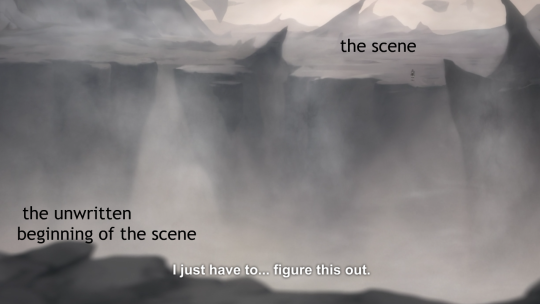
Just go straight to the scene. The best advice I ever read, from one of my favorite authors, was to get in to a scene as fast as you can, and get out as fast as you can.
If you’re filling the story with stuff you don’t find interesting, just to bridge gaps, the audience will figure that out. Audiences are pretty smart.
Don’t waste your time, and the audiences, by writing the boring filler. Just get to the good stuff. Audiences will understand that we’re no longer in scene A, and that now we’re in scene B.
It’ll help with the pace, and push the story forward.
Useful if this is how you think, though often I don’t see the outline until after the draft is written, because after awhile one just internalize this kind of stuff from all the media one ingests. Point is, use if helpful, ignore if not.
Another suggestion for anyone interested: because one of my weaknesses as a writer is sustaining narrative momentum, I’ve recently started using this mystery novel breakdown as a template, even though mystery/detective isn’t the genre I write in. It’s really useful as a way to keep track of what the story needs at a given moment in terms of balance and character.
Some of my longtime readers will know that a couple years ago I was fortunate enough to turn my fiction-writing into a legitimate second-career. Now, I don’t believe in credentials or authority and all that but, as someone who writes books, I want to say that YOU have it within you to write them too.
And not only CAN you write books, you NEED TO write them. Let me explain why…
There is only one kind of book worth writing and that is the book that you have always wanted to read.
@neuropunk-travesty made a small post last week about issues with some literary genres (namely fantasy) and suggested “occupying” the genre – I agree that this is a great idea.
When we talk about something like “The Western Canon” the viewpoints, contexts, and backgrounds of the works are extremely narrow. Each work has been added to the Canon because it adds to a meta-theme of “canonicity.” This is an intentional act of curation of “acceptable” ideas and directly privileges certain ideologies over others.
For a long time the publishing industry served the same function. As it existed under capitalism, publishing embraced ideas of “market” and “demographic cross-over.” The silencing of certain perspectives was always chalked up to “market forces” – sorry, kid, nobody would PAY to read that…
But these industries don’t just cater to the tastes of a paying audience, they shape these tastes. They reproduce over and over certain formulas and tropes until the presence of the trope/formula becomes mandatory – Nice YA Dystopia you got there, kid, but where’s the love-triangle?
The homogeneity of ideas is not a failure of capitalism, it is in intentional product of it.
You will rarely find works of resistance published, and when you do it is always about “inverting tropes” – thus reifying the “reality” of these tropes even by criticizing them.
If you want to find radical politics in a paperback, good luck. Even something like feminism only appears in its most status-quo-friendly and commodified form. I spent the last week looking for lists of “Feminist Fantasy Lit” and multiple lists big-upped Game of Thrones. That’s a problem.
We will never see the books we want to read unless WE write them.
Now, you might write your book and then it won’t make it through the many ingenious gates of the traditional publishing – and that’s okay. Nothing truly radical ever did.
But today we have the technology and the digital infrastructure where you can self-publish and get your message out. And honestly, fuck it – you can always write it long-hand in a notebook or pass around your hand drawn illuminated manuscript and other people will READ it.
Because that’s the thing: a book does not exist until you actually WRITE it. Talking about it and planning it are all great but it isn’t a book until it’s read by someone.
Every single person reading this has something in them that only they can say. Every person reading this has within them a book that only they could write.
Our goal is to create a better world. But we can’t create a better world until we have imagined a better world. We must produce our own radical fictions and revolutionary futures. We need to seize the means of producing literature.
You don’t think your ideas are revolutionary? We have been taught to fear and revere the thoughts held in books. That’s because access to books is easy to control and censorship is facilitated by the publishing process. My friend, just the act of writing your own thoughts and placing them next to the “sacred texts” is a revolutionary act.
You have something to say. You have a book to write. You know that there exists a book that you have always wanted to read.
You will never be able to read it until you write it. WE will never be able to read it until you write it.
After putting my writing on hold for several weeks, I decided to jump back in. I expected to find all sorts of problems with my story–inconsistencies in the plot, lack of transitions, poor characterization–the works. But what began to stick out to me was something to which I’d given little thought in writing.
Filter words.
What are Filter Words?
Actually, I didn’t even know these insidious creatures had a name until I started combing the internet for info.
Filter words are those that unnecessarily filter the reader’s experience through a character’s point of view. Dark Angel’s Blog says:
“Filtering” is when you place a character between the detail you want to present and the reader. The term was started by Janet Burroway in her book On Writing.
In terms of example, you should watch out for:
To see
To hear
To think
To touch
To wonder
To realize
To watch
To look
To seem
To feel (or feel like)
Can
To decide
To sound (or sound like)
To know
I’m being honest when I say my manuscript is filled with these words, and the majority of them need to be edited out.
What do Filter Words Look Like?
Let’s imagine a character in your novel is walking down a street during peak hour.
You might, for example, write:
Sarah felt a sinking feeling as she realized she’d forgotten her purse back at the cafe across the street. She saw cars filing past, their bumpers end-to-end. She heard the impatient honk of horns and wondered how she could quickly cross the busy road before someone took off with her bag. But the traffic seemed impenetrable, and she decided to run to the intersection at the end of the block.
Eliminating the bolded words removes the filters that distances us, the readers, from this character’s experience:
Sarah’s stomach sank. Her purse—she’d forgotten it back at the cafe across the street. Cars filed past, their bumpers end-to-end. Horns honked impatiently. Could she make it across the road before someone took off with her bag? She ran past the impenetrable stream of traffic, toward the intersection at the end of the block.
Are Filter Words Ever Acceptable?
Of course, there are usually exceptions to every rule.
Just because filter words tend to be weak doesn’t mean they never have a place in our writing. Sometimes they are helpful and even necessary.
Susan Dennard of Let The Words Flow writes that we should use filter words when they are critical to the meaning of the sentence.
If there’s no better way to phrase something than to use a filter word, then it’s probably okay to do so.
Want to know more?
Read these other helpful articles on filter words and more great writing tips:
art block is your brain telling you to do studies.
draw a still life. practice some poses. sketch some naked people. do a color study. try out a different technique on a basic shape.
art block doesnt stop you from drawing, it stops you from making your drawings look the way you want them to. and thats because you need to push your skills to the next level so you can preform at that standard
think of it as level grinding for your next work.
As a scientific illustrator- this is 100% true and going to review your basics will fix it every goddamn time. Not only does it keep your skills sharp, when you’re not emotionally invested in the final product of a piece, you relax and your brain makes more/better art juice for you. So, when you get back to that big/important piece? You’ll know what to do and how to do it.
Nothing in nature blooms all year round. Rest, and take care of yourself.
so remember that worldbuilding website, notebook.ai, that was goin around and everyone was so excited, but it turned out you had to pay a (frankly outrageous) subscription to access any of the best tools?
On the first draft, don’t sweat it so much. Individual voices will start to come through the more you write and the more you get to know your story.
But once you’ve got the measure of each character, start to think about:
a) What they want in each scene (i.e.: What are they trying to accomplish? To persuade another character of their point of view? To manipulate another character? To admit they’re wrong? To avoid blame?)
b) How their personality might affect their style of speech (i.e.: Are they uncertain and anxious? Are they confident? Are they trying to keep a secret? Are they low or high status in the scene? Do they splurge out all their thoughts or never say what they mean?)
Beyond that, think about SUBTEXT in dialogue. Few of us really say what we mean, and never is that more true in fiction. Sure, the reader might know what’s going on in a character’s head but dialogue often serves to provide red herrings or complicate the situation or layer up the conflict. What’s going on beneath the surface that might inform the way your characters speak to one another?
Also look at this amazing scene from American Beauty (yes yes, Kevin Spacey your faves are problematic but suspend that for a moment because we’re talking about the WRITING here): https://youtu.be/ED7_y4jETo0
Each character has a distinctive way of speaking and getting their point across:
Lester is dry and obviously trying to hold onto his frustration, making his dialogue stilted and short – until he blows his top. His dialogue is mainly focused on the asparagus but we know that’s not what he’s really talking about.
Carol is sarcastic, borderline hysterical and talks A LOT – braindumping all her anger onto her husband. She’s almost talking to herself in this scene, in a way that makes us suspect she feels like no one ever listens to her.
And Jane is quiet, insecure, and mumbles most of her dialogue. She does not want to be in the middle of this argument, and no one pays much attention to her at all. We get a palpable sense of her discomfort and feel sympathetic for her even though she barely says more than a few lines.
Each voice is unique and each character is demonstrating their underlying desires and feelings sithout necessarily saying them out loud.
On a sidenote: relying too much on dialect and accent and voice ‘quirks’ can be a lazy way of trying to differentiate characters. That said, some characters may well have certain speech patterns that help to both distinguish them from the other characters and reinforce the way they think/express themselves. For example, compare Granny Weatherwax and Nanny Ogg from Terry Pratchett’s witches series. Granny is all passive aggression and carefully chosen words while Nanny is a motormouth who says what she thinks and naturally puts people at their ease (often as a way of getting information out of them that they’d be too scared to tell Granny). The quirks of each are subtle but super effective.


 Rush's tumblr archive